WorldPop Research Group, School of Geography and Environmental Science, University Road, University of Southampton, Southampton, SO17 1BJ, UK.
Department of Geography, Kent State University, 413 McGilvrey Hall, 325 S. Lincoln Street, Kent, OH, 44240, USA.
J Racial Ethn Health Disparities. 2024 Aug;11(4):2009-2021. doi: 10.1007/s40615-023-01669-4. Epub 2023 Jun 27.
The food environment influences the availability and affordability of food options for consumers in a given neighborhood. However, disparities in access to healthy food options exist, affecting Black and low-income communities disproportionately. This study investigated whether racial segregation predicted the spatial distribution of supermarkets and grocery stores better than socioeconomic factors or vice versa in Cleveland, Ohio.
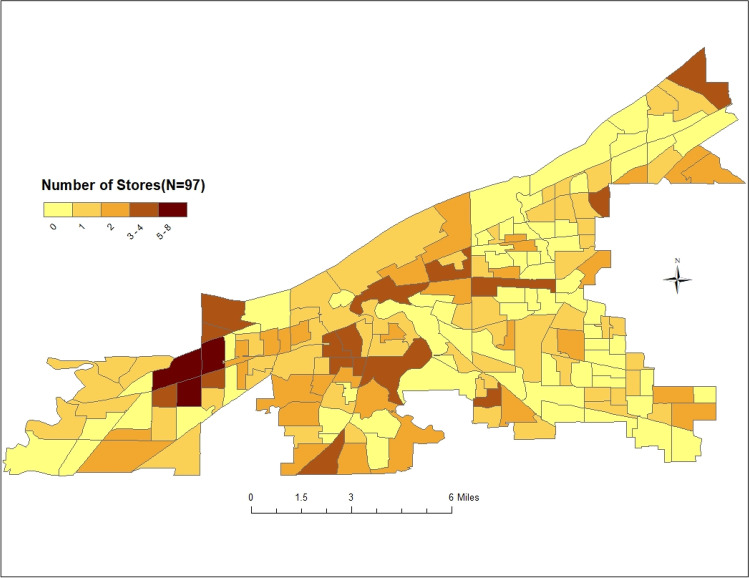
The outcome measure was the count of supermarket and grocery stores in each census tract in Cleveland. They were combined with US census bureau data as covariates. We fitted four Bayesian spatial models. The first model was a baseline model with no covariates. The second model accounted for racial segregation alone. The third model looked at only socioeconomic factors, and the final model combined both racial and socioeconomic factors.
Overall model performance was better in the model that considered only racial segregation as a predictor of supermarkets and grocery stores (DIC = 476.29). There was 13% decrease in the number of stores for a census tract with a higher majority of Black people compared to areas with a lower number of Black people. Model 3 that considered only socioeconomic factors was less predictive of the retail outlets (DIC = 484.80).
These findings lead to the conclusion that structural racism evidenced in policies like residential segregation has a significant influence on the spatial distribution of food retail in the city of Cleveland.
食品环境影响消费者在特定社区获得和负担得起食品的情况。然而,健康食品选择的获取存在差异,这对黑人和低收入社区的影响不成比例。本研究调查了在俄亥俄州克利夫兰,种族隔离是否比社会经济因素更好地预测了超市和杂货店的空间分布,或者反之亦然。
本研究的结果衡量标准是克利夫兰每个普查区内超市和杂货店的数量。它们与美国人口普查局的数据相结合作为协变量。我们拟合了四个贝叶斯空间模型。第一个模型是没有协变量的基线模型。第二个模型只考虑种族隔离。第三个模型只考虑社会经济因素,最后一个模型则结合了种族和社会经济因素。
总体而言,仅考虑种族隔离作为超市和杂货店预测因素的模型表现更好(DIC=476.29)。与黑人人数较少的地区相比,黑人占多数的普查区的商店数量减少了 13%。仅考虑社会经济因素的模型 3对零售网点的预测性较差(DIC=484.80)。
这些发现表明,政策中的结构性种族主义,如居住隔离,对克利夫兰市的食品零售空间分布有重大影响。