Astana Medical University, Astana, Kazakhstan.
University Medical Center, Astana, Kazakhstan.
Asian Pac J Cancer Prev. 2023 Jun 1;24(6):1885-1896. doi: 10.31557/APJCP.2023.24.6.1885.
The aim is to study the trends of lymphosarcoma incidence in the regional context in Kazakhstan.
The retrospective study was done using descriptive method of oncoepidemiology. The extensive, crude and age-specific incidence rates are determined according to the generally accepted methodology used in statistics. The data were used to calculate the average percentage change (APС) using the Joinpoint regression analysis to determine the trend over the study period.
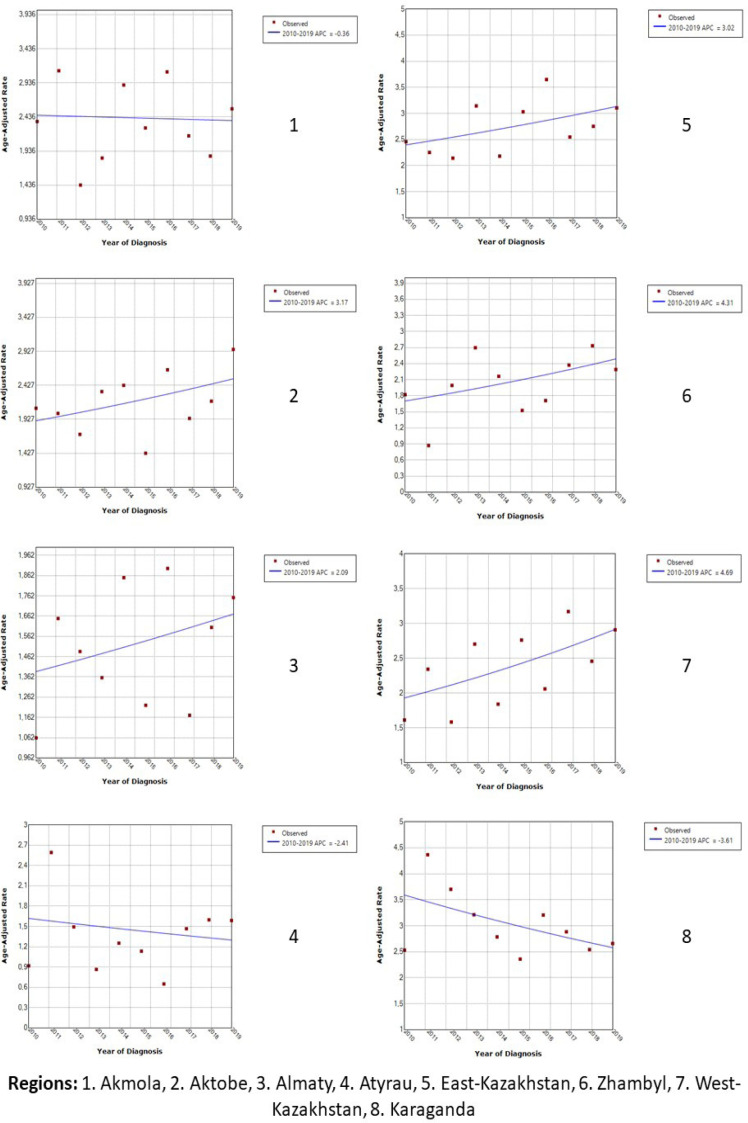
3,987 new cases of lymphosarcoma were registered in the country (50.7% in men, 49.3% in women). During the studied years the average age of patients was 54.2±0.8 years. The highest incidence rates per 100,000 in the entire population were found in the age groups 65-69 years (10.4±0.6), 70-74 years (10.7±0.8), and 75-79 years (10.3±0.8). The highest tendency to increase in age-related incidence rates was at the age over 85 (APC=+8.26) and to decrease at the age under 30 (APC=-6.17). The average annual standardized incidence rate was 2.3 per 100,000, and in dynamics tended to increase (APC=+1.43). It was found that the downward trend was observed in five regions (Akmola, Atyrau, Karaganda, North and South Kazakhstan), and the most pronounced decline was in the Karaganda (APC=-3.61) and South Kazakhstan (APC=-2.93) regions. When compiling thematic maps, incidence rates were determined based on standardized indicators: low - up to 1.97, average - from 1.97 to 2.60, high - above 2.60 per 100,000 for both sexes.
Trends in the incidence of lymphosarcoma in Kazakhstan are growing and have geographical variability, and a high incidence is observed in the eastern and northern regions of the country. Sex differences have been established the incidence in men is higher than in female population, but the rate of increase in the incidence in women is more pronounced.
研究哈萨克斯坦地区淋巴肉瘤发病率的趋势。
采用描述性肿瘤流行病学方法进行回顾性研究。根据统计学中普遍采用的方法,确定广泛、粗率和年龄特异性发病率。使用这些数据,使用 Joinpoint 回归分析计算平均百分比变化 (APC),以确定研究期间的趋势。
该国登记了 3987 例新淋巴肉瘤病例(男性占 50.7%,女性占 49.3%)。在研究期间,患者的平均年龄为 54.2±0.8 岁。整个人群中每 10 万人发病率最高的年龄组分别为 65-69 岁(10.4±0.6)、70-74 岁(10.7±0.8)和 75-79 岁(10.3±0.8)。年龄相关发病率呈上升趋势的最高趋势出现在 85 岁以上人群(APC=+8.26),而在 30 岁以下人群中呈下降趋势(APC=-6.17)。平均年标准化发病率为 2.3/10 万,呈上升趋势(APC=+1.43)。结果发现,有五个地区(阿克莫拉、阿特劳、卡拉干达、北哈萨克斯坦和南哈萨克斯坦)呈下降趋势,其中卡拉干达(APC=-3.61)和南哈萨克斯坦(APC=-2.93)地区下降最为明显。在编制专题地图时,根据标准化指标确定发病率:低-低至 1.97、平均-1.97 至 2.60、高-男女均高于 2.60/10 万。
哈萨克斯坦淋巴肉瘤发病率的趋势呈上升趋势,且具有地域变异性,该国东部和北部地区发病率较高。已确定男女发病率存在性别差异,男性发病率高于女性,但女性发病率的增长率更为明显。