Astana Medical University, Astana, Kazakhstan.
Central Asian Institute for Medical Research, Astana, Kazakhstan.
Asian Pac J Cancer Prev. 2023 May 1;24(5):1521-1532. doi: 10.31557/APJCP.2023.24.5.1521.
The aim is to study the trends of lung cancer (LC) incidence in the regional context in Kazakhstan.
The retrospective study was done using descriptive and analytical methods of oncoepidemiology. The extensive, crude and age-specific incidence rates are determined according to the generally accepted methodology used in sanitary statistics. The data were used to calculate the average percentage change (APС) using the Joinpoint regression analysis to determine the trend over the study period.
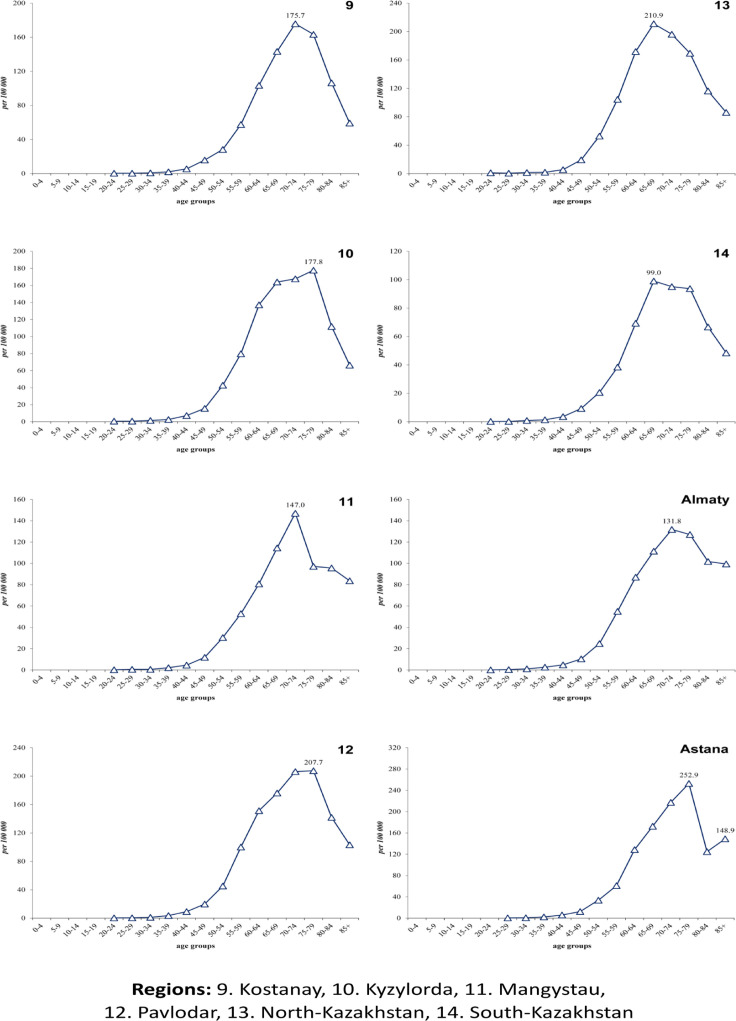
Over the 10 years under study, 36,916 new cases of LC were registered in the country (80.5% - in men and 19.5% - in women). During the studied years the average age of patients was 64.2±0.1 years (95%CI=63.9-64.4). The highest incidence rates per 100,000 in the entire population were found in the age groups 65-69 years (147.6±2.7), 70-74 years (159.3±2.5), and 75-79 years (147.1±3.2). The incidence of LC tended to increase only at the age of 80-84 years (APC=+1.26) and the most pronounced average annual decline rates were observed in the age groups of 45-49 years (APC=-4.09), 50-54 years (APC=-4.20) and 85+ years (APC=-4.07). The average annual standardized incidence rate was 22.2 per 100,000, and in dynamics tended to decrease (APC=-2.04). There is a decrease in incidence in almost all regions, with the exception of the Mangystau region (APC=+1.65). During the compilation of cartograms, incidence rates were determined on the basis of standardized indicators: low - up to 20.6, average - from 20.6 to 25.6, high - above 25.6 per 100,000 for the entire population.
The incidence of lung cancer in Kazakhstan is decreasing. The incidence among the male population is six times higher than among the female, while the rate of decline is more pronounced. The incidence tends to decrease in almost all regions. High rates were found in the northern and eastern regions.
研究哈萨克斯坦地区肺癌(LC)发病率的趋势。
采用描述性和分析性肿瘤流行病学方法进行回顾性研究。根据卫生统计中普遍采用的方法,确定广泛、粗率和年龄特异性发病率。使用 Joinpoint 回归分析计算平均百分比变化(APC),以确定研究期间的趋势。
在所研究的 10 年内,该国登记了 36916 例新的 LC 病例(80.5%为男性,19.5%为女性)。研究期间患者的平均年龄为 64.2±0.1 岁(95%CI=63.9-64.4)。整个人群中每 10 万人发病率最高的年龄组为 65-69 岁(147.6±2.7)、70-74 岁(159.3±2.5)和 75-79 岁(147.1±3.2)。LC 的发病率仅在 80-84 岁时呈上升趋势(APC=+1.26),而在 45-49 岁(APC=-4.09)、50-54 岁(APC=-4.20)和 85 岁以上(APC=-4.07)年龄组观察到最明显的平均年下降率。标准化发病率的平均年增长率为 22.2/10 万,且呈下降趋势(APC=-2.04)。除曼格斯套州外,几乎所有地区的发病率都有所下降(APC=+1.65)。在编制专题地图时,根据标准化指标确定发病率:低为 20.6 以下,中为 20.6-25.6,高为 25.6 以上/10 万,适用于整个人口。
哈萨克斯坦的肺癌发病率正在下降。男性发病率是女性的六倍,而下降速度更为明显。发病率几乎在所有地区都呈下降趋势。高发病率出现在北部和东部地区。