Gruber Sarah, Nickel Angela
Department of Product Safety, Johner Institut GmbH, Konstanz, Germany.
Department of Regulatory Science, Johner Institut GmbH, Konstanz, Germany.
Front Med Technol. 2023 Jun 14;5:1195529. doi: 10.3389/fmedt.2023.1195529. eCollection 2023.
Medical device manufacturers are obliged to prove the biocompatibility of their products when they come into contact with the human body. The requirements for the biological evaluation of medical devices are specified by the international standard series ISO 10993. Part five of this series describes the performance of cytotoxicity tests. This test evaluates the effects of medical device use on cell health. The existence of the specific standard suggests that the tests will produce reliable and comparable results. However, the ISO 10993-5 offers wide latitude in the test specifications. In the past, we noticed inconsistencies of the results from different laboratories.
To determine if the specifications of the standard ISO 10993-5 are explicit to ensure the comparability of test results and, if not, identify potential influencing factors.
An interlaboratory comparison was conducted for the cytotoxicity test according to ISO 10993-5. Fifty-two international laboratories evaluated the cytotoxicity for two unknown samples. One was polyethylene (PE) tubing, which is expected to be non-cytotoxic and the other was polyvinyl chloride (PVC) tubing, for which a cytotoxic potential was presumed. All laboratories were asked to perform an elution test with predefined extraction specifications. The other test parameters were freely chosen by the laboratories according to the guidelines set by the standard.
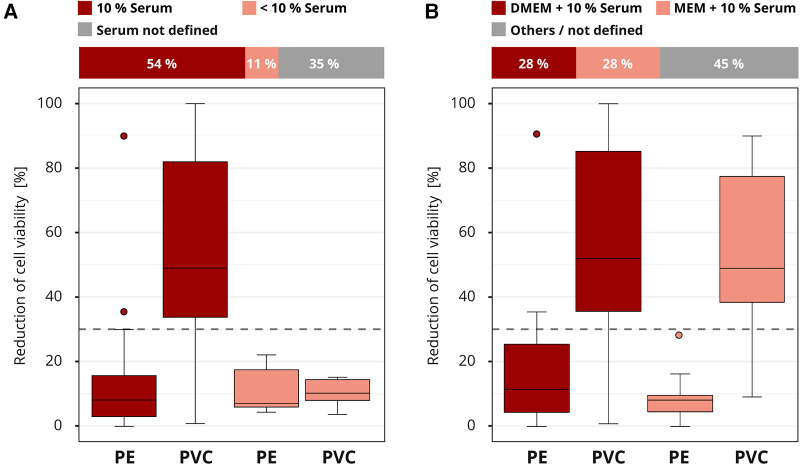
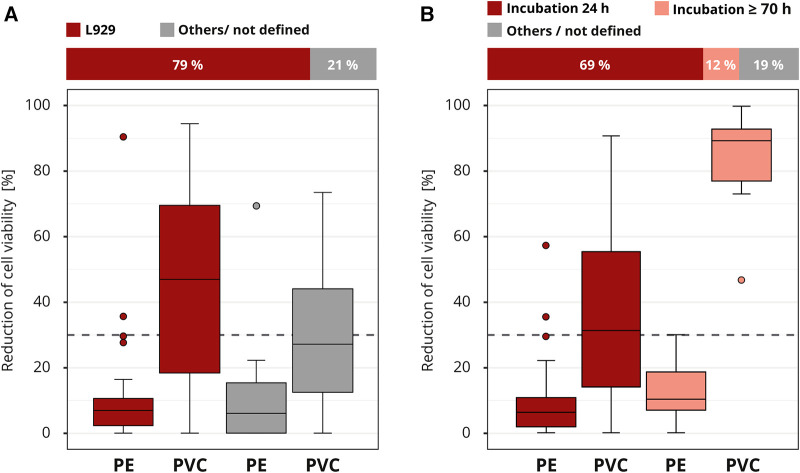
To our surprise only 58 percent of the participating laboratories identified the cytotoxic potential of both materials as expected. Particularly for PVC a considerable variation of the results between the laboratories was observed [mean = 43 ± 30 (SD), min = 0, max = 100]. We showed that ten percent serum supplementation to the extraction medium, as well as longer incubation of the cells with the extract, greatly increased the test sensitivity for PVC.
The results clearly show that the specifications set by the ISO 10993-5 are not explicit enough to obtain comparable results for an identical medical device. To set requirements that ensure reliable cytotoxicity assessments, further research will be necessary to identify the best test conditions for specific materials and/or devices and the standard needs to be revised accordingly.
医疗设备制造商有义务在其产品与人体接触时证明其生物相容性。医疗设备生物学评价的要求由国际标准系列ISO 10993规定。该系列的第五部分描述了细胞毒性试验的执行情况。此试验评估医疗设备使用对细胞健康的影响。特定标准的存在表明这些试验将产生可靠且可比的结果。然而,ISO 10993 - 5在试验规范方面提供了广泛的自由度。过去,我们注意到不同实验室的结果存在不一致性。
确定ISO 10993 - 5标准的规范是否明确以确保试验结果的可比性,若不明确,则识别潜在的影响因素。
根据ISO 10993 - 5进行了细胞毒性试验的实验室间比对。52个国际实验室对两个未知样品的细胞毒性进行了评估。一个是聚乙烯(PE)管材,预期无细胞毒性,另一个是聚氯乙烯(PVC)管材,推测具有细胞毒性潜力。要求所有实验室按照预定义的提取规范进行洗脱试验。其他试验参数由实验室根据标准设定的指南自由选择。
令我们惊讶的是,只有58%的参与实验室按预期识别出了两种材料的细胞毒性潜力。特别是对于PVC,各实验室之间的结果存在相当大的差异[平均值 = 43 ± 30(标准差),最小值 = 0,最大值 = 100]。我们表明,在提取培养基中添加10%的血清,以及让细胞与提取物孵育更长时间,可大大提高对PVC的试验灵敏度。
结果清楚地表明,ISO 10993 - 5设定的规范不够明确,无法为相同的医疗设备获得可比的结果。为了设定确保可靠细胞毒性评估的要求,有必要进一步研究以确定特定材料和/或设备的最佳试验条件,并且标准需要相应修订。