Dickinson Richard B, Lele Tanmay P
Department of Chemical Engineering, University of Florida, Gainesville, FL, United States.
Department of Biomedical Engineering, College of Engineering, Texas A&M University College Station, College Station, TX, United States.
Front Cell Dev Biol. 2023 Jun 15;11:1058727. doi: 10.3389/fcell.2023.1058727. eCollection 2023.
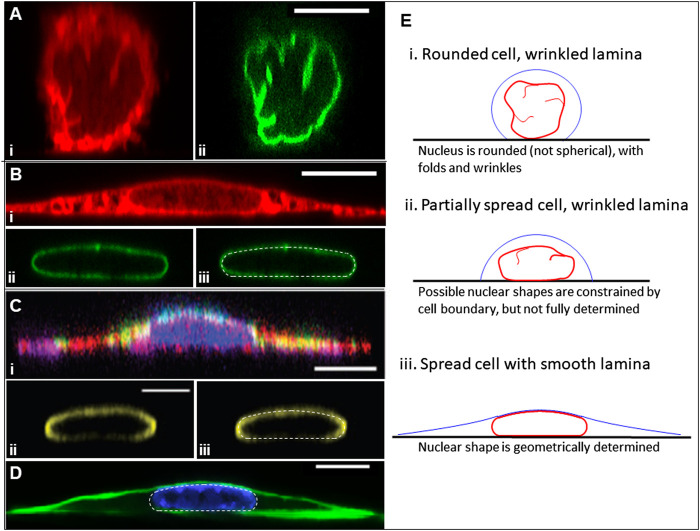
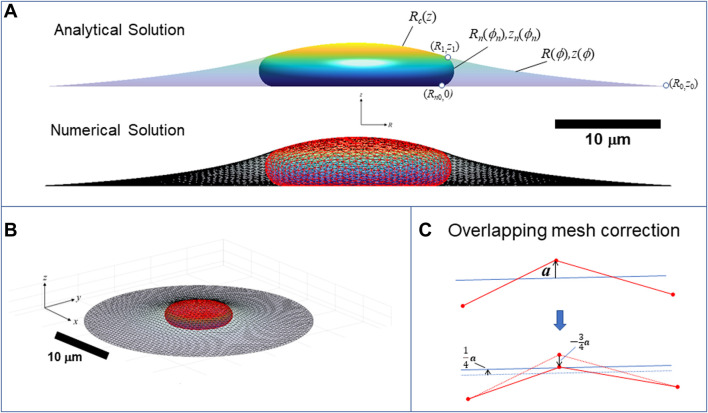
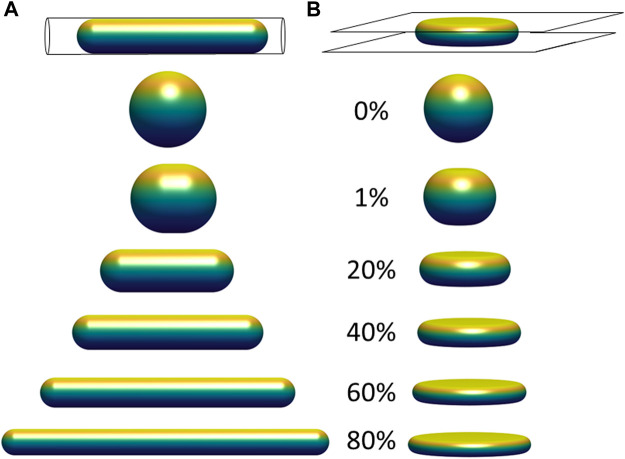
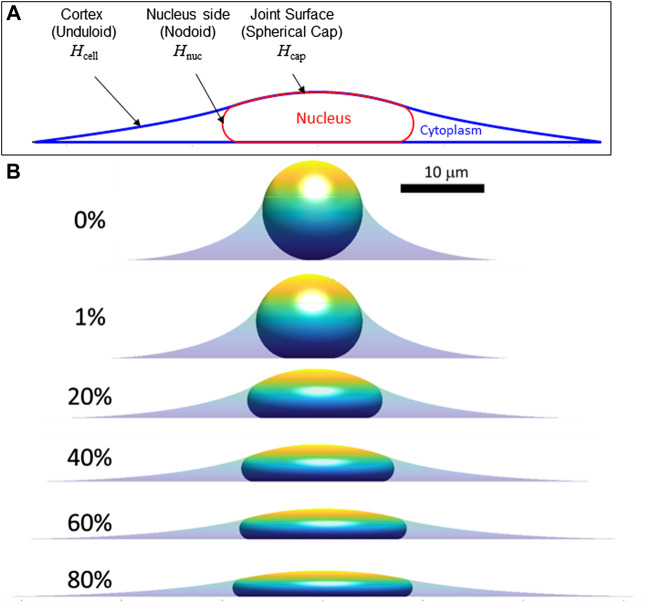
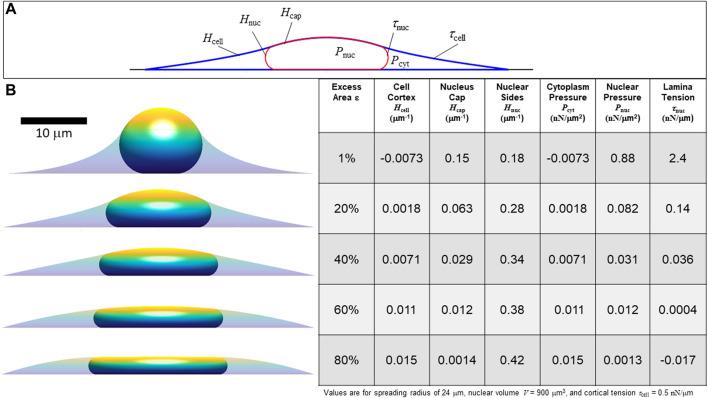
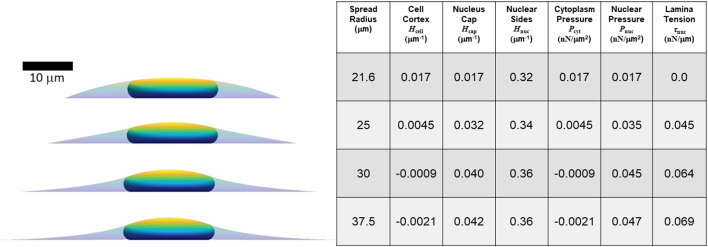
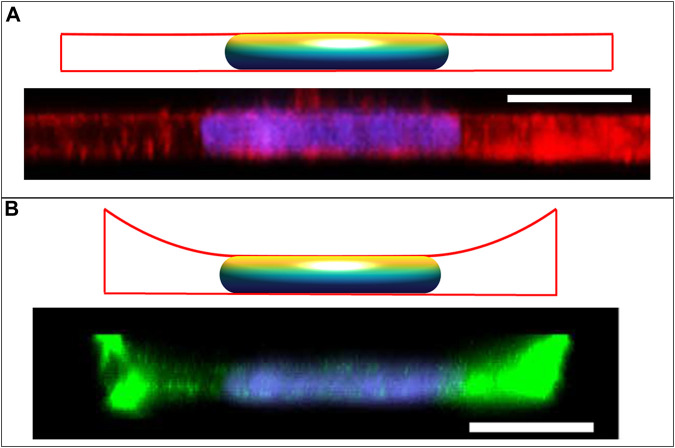
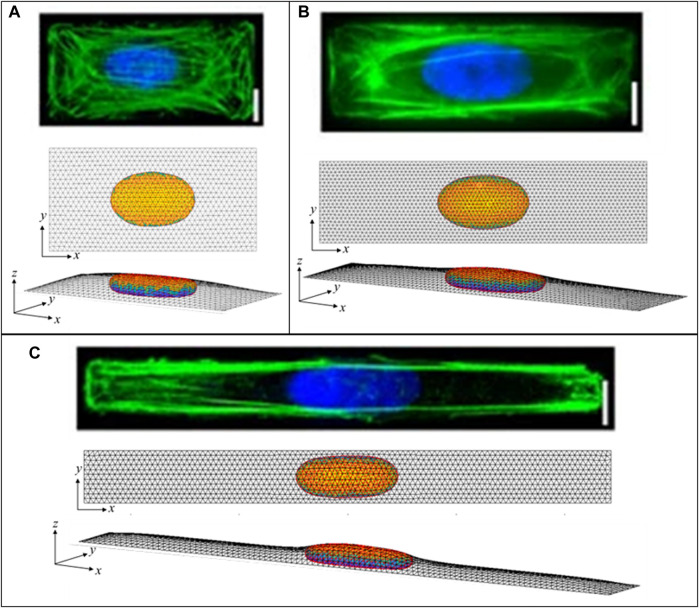
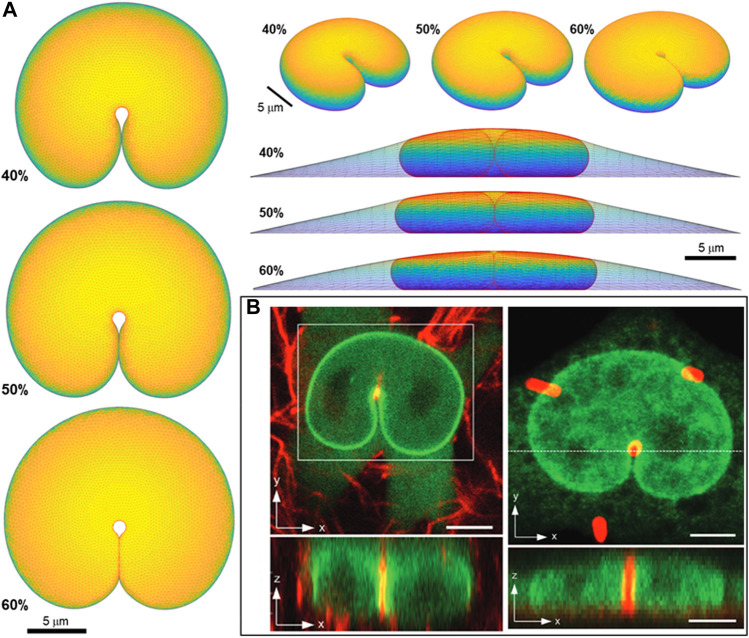
Nuclei have characteristic shapes dependent on cell type, which are critical for proper cell function, and nuclei lose their distinct shapes in multiple diseases including cancer, laminopathies, and progeria. Nuclear shapes result from deformations of the sub-nuclear components-nuclear lamina and chromatin. How these structures respond to cytoskeletal forces to form the nuclear shape remains unresolved. Although the mechanisms regulating nuclear shape in human tissues are not fully understood, it is known that different nuclear shapes arise from cumulative nuclear deformations post-mitosis, ranging from the rounded morphologies that develop immediately after mitosis to the various nuclear shapes that roughly correspond to cell shape ( elongated nuclei in elongated cells, flat nuclei in flat cells). We formulated a mathematical model to predict nuclear shapes of cells in various contexts under the geometric constraints of fixed cell volume, nuclear volume and lamina surface area. Nuclear shapes were predicted and compared to experiments for cells in various geometries, including isolated on a flat surface, on patterned rectangles and lines, within a monolayer, isolated in a well, or when the nucleus is impinging against a slender obstacle. The close agreement between predicted and experimental shapes demonstrates a simple geometric principle of nuclear shaping: the excess surface area of the nuclear lamina (relative to that of a sphere of the same volume) permits a wide range of highly deformed nuclear shapes under the constraints of constant surface area and constant volume. When the lamina is smooth (tensed), the nuclear shape can be predicted entirely from these geometric constraints alone for a given cell shape. This principle explains why flattened nuclear shapes in fully spread cells are insensitive to the magnitude of the cytoskeletal forces. Also, the surface tension in the nuclear lamina and nuclear pressure can be estimated from the predicted cell and nuclear shapes when the cell cortical tension is known, and the predictions are consistent with measured forces. These results show that excess surface area of the nuclear lamina is the key determinant of nuclear shapes. When the lamina is smooth (tensed), the nuclear shape can be determined purely by the geometric constraints of constant (but excess) nuclear surface area, nuclear volume, and cell volume, for a given cell adhesion footprint, independent of the magnitude of the cytoskeletal forces involved.
细胞核具有依赖于细胞类型的特征形状,这对细胞的正常功能至关重要,并且在包括癌症、核纤层蛋白病和早衰症在内的多种疾病中,细胞核会失去其独特的形状。细胞核形状是由核内成分——核纤层和染色质的变形导致的。这些结构如何响应细胞骨架力以形成细胞核形状仍未得到解决。尽管调节人体组织中细胞核形状的机制尚未完全了解,但已知不同的细胞核形状源于有丝分裂后累积的核变形,范围从有丝分裂后立即形成的圆形形态到大致与细胞形状相对应的各种细胞核形状(细长细胞中的细长细胞核、扁平细胞中的扁平细胞核)。我们建立了一个数学模型,以在固定细胞体积、核体积和核纤层表面积的几何约束下预测各种情况下细胞的细胞核形状。对处于各种几何形状中的细胞的细胞核形状进行了预测,并与实验进行了比较,这些细胞包括孤立在平面上、在图案化的矩形和线条上、在单层内、孤立在孔中,或者当细胞核撞击细长障碍物时的情况。预测形状与实验形状之间的紧密一致性证明了细胞核塑形的一个简单几何原理:核纤层的多余表面积(相对于相同体积球体的表面积)在恒定表面积和恒定体积的约束下允许形成多种高度变形的细胞核形状。当核纤层光滑(张紧)时,对于给定的细胞形状,仅从这些几何约束就可以完全预测细胞核形状。这一原理解释了为什么完全铺展的细胞中扁平的细胞核形状对细胞骨架力的大小不敏感。此外,当已知细胞皮层张力时,可以从预测的细胞和细胞核形状估计核纤层中的表面张力和核压力,并且预测结果与测量的力一致。这些结果表明,核纤层的多余表面积是细胞核形状的关键决定因素。当核纤层光滑(张紧)时,对于给定的细胞粘附足迹,细胞核形状可以纯粹由恒定(但多余)的核表面积、核体积和细胞体积的几何约束来确定,而与所涉及的细胞骨架力的大小无关。