Zhao Wenqian, Tu Hui, Chen Jianxiao, Wang Jing, Liu Haoting, Zhang Fengshou, Li Jing
College of Medical Technology and Engineering, Henan University of Science and Technology, Luoyang, China.
Department of Nephrology, The Fourth Affiliated Hospital, Zhejiang University School of Medicine, Yiwu, Zhejiang, China.
Front Neurosci. 2023 Jun 19;17:1199299. doi: 10.3389/fnins.2023.1199299. eCollection 2023.
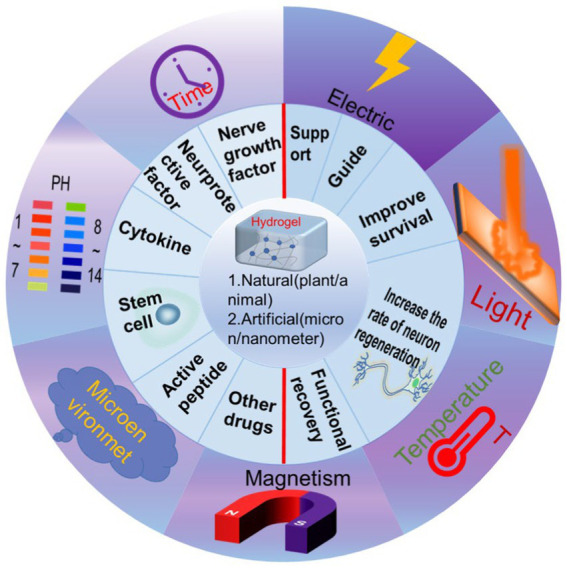
Repairing injuries to the nervous system has always been a prominent topic in clinical research. Direct suturing and nerve displacement surgery are the primary treatment options, but they may not be suitable for long nerve injuries and may require sacrificing the functionality of other autologous nerves. With the emergence of tissue engineering, hydrogel materials have been identified as a promising technology with clinical translation potential for repairing nervous system injuries due to their excellent biocompatibility and ability to release or deliver functional ions. By controlling their composition and structure, hydrogels can be Functionalized and almost fully matched with nerve tissue and even simulate nerve conduction function and mechanical properties. Thus, they are suitable for repairing injuries to both the central and peripheral nervous systems. This article provides a review of recent research progress in functionalized hydrogels for nerve injury repair, highlighting the design differences among various materials and future research directions. We strongly believe that the development of functionalized hydrogels has great potential for improving the clinical treatment of nerve injuries.
修复神经系统损伤一直是临床研究中的一个重要课题。直接缝合和神经移位手术是主要的治疗选择,但它们可能不适用于长神经损伤,并且可能需要牺牲其他自体神经的功能。随着组织工程的出现,水凝胶材料因其优异的生物相容性以及释放或递送功能性离子的能力,已被视为一种具有临床转化潜力的、用于修复神经系统损伤的有前景的技术。通过控制其组成和结构,水凝胶可以被功能化,几乎与神经组织完全匹配,甚至模拟神经传导功能和力学性能。因此,它们适用于修复中枢神经系统和周围神经系统的损伤。本文综述了用于神经损伤修复的功能化水凝胶的最新研究进展,突出了各种材料之间的设计差异以及未来的研究方向。我们坚信,功能化水凝胶的发展在改善神经损伤的临床治疗方面具有巨大潜力。