Key Laboratory of Animal Science of National Ethnic Affairs Commission of China, Chengdu 610041, PR China; College of Animal and Veterinary Sciences, Southwest Minzu University, Chengdu 610041, PR China.
Key Laboratory of Animal Science of National Ethnic Affairs Commission of China, Chengdu 610041, PR China; College of Animal and Veterinary Sciences, Southwest Minzu University, Chengdu 610041, PR China.
Poult Sci. 2023 Sep;102(9):102874. doi: 10.1016/j.psj.2023.102874. Epub 2023 Jun 16.
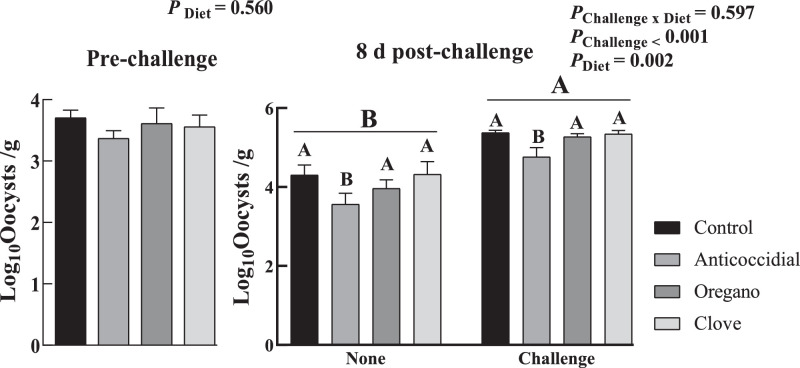
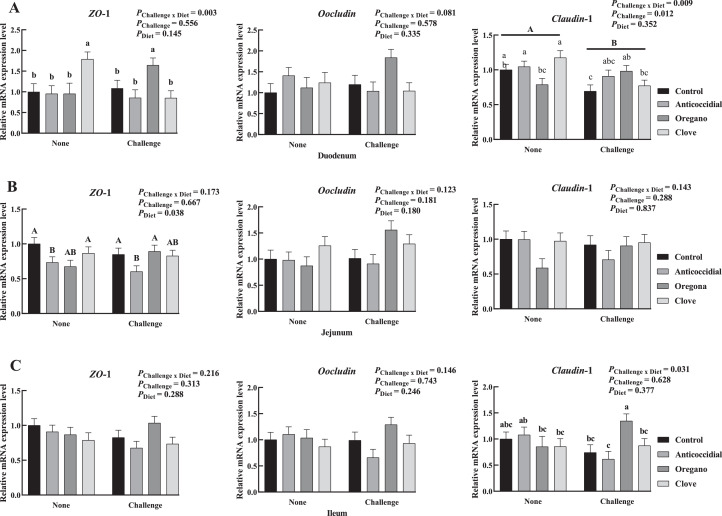
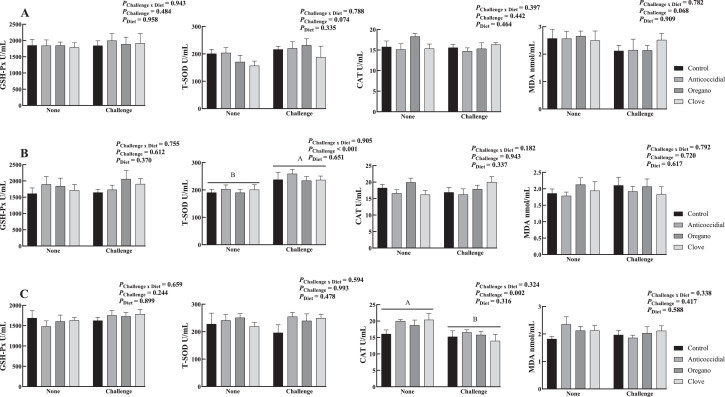
The effects of dietary supplementation of essential oil on growth performance, carcass yield, meat quality, serum antioxidant capacity, and intestinal tight junctions of broilers with or without Eimeria challenge were investigated. A total of 576 one-day-old male broilers were randomly separated into 8 treatments (6 replication floor-pens per treatment, 12 broilers per pen) in a 4 × 2 factorial design. The 4 diets consisted of 1) a corn and soybean meal basal diet, 2) an anticoccidial diet (60 g nicarbazin and 60 g narasin per ton of feed), 3) an oregano oil diet (500 ppm oregano oil), and 4) a clove oil diet (500 ppm clove oil). On d 10, half chicks were challenged with 1 × 10 sporulated oocysts of E. tenella, E. acervulina, and E. maxima per chick, whereas the others were inoculated with an equal amount of dilution (0.5 mL). The Eimeria challenge induced a higher fecal oocyst output on d 18, a lower duodenum Occludin expression level on d 28, a lower serum catalase level, and a higher cook loss and protein loss in thigh muscle on d 42. The anticoccidial diet lowered fecal Eimeria output and increased d 1 to 42 BW gain as compared to the control diet. The clove oil treatment enhanced duodenum ZO-1 expression level in nonchallenged birds, increased BW gain from d 1 to 14 and breast yield on d 42. The oregano oil treatment enhanced ZO-1 expression of challenged birds, reduced feed intake from 15 to 28 d, and helped broilers gain more tender meat. For those Eimeria-challenged broilers, both clove and oregano oil treatments recovered drip loss in breast muscle. Our results suggested that Eimeria challenge in broiler early age could interrupt later serum antioxidant capacity and damage meat quality. The dietary supplementation of clove or oregano essential oils could improve broiler growth performance and partially relieve the coccidial damage in gut integrity and meat quality.
本研究旨在探讨日粮中添加精油对感染和未感染柔嫩艾美耳球虫(Eimeria)雏鸡生长性能、屠体产量、肉品质、血清抗氧化能力和肠道紧密连接的影响。选用 576 只 1 日龄雄性肉鸡,采用 4×2 析因设计,随机分为 8 个处理(每个处理 6 个重复,每个重复 12 只鸡)。日粮 1)为玉米-豆粕基础日粮,2)为抗球虫日粮(每吨饲料添加 60g 尼卡巴嗪和 60g 那拉菌素),3)为牛至油日粮(500ppm 牛至油),4)为丁香油日粮(500ppm 丁香油)。第 10 天,一半雏鸡每只感染 1×10 个柔嫩艾美耳球虫卵囊(E.tenella、E.acervulina 和 E.maxima),另一半雏鸡接种等量稀释液(0.5mL)。感染柔嫩艾美耳球虫后,第 18 天粪便卵囊排出量增加,第 28 天十二指肠 Occludin 表达水平降低,第 42 天血清过氧化氢酶水平降低,大腿肌肉蒸煮损失和蛋白质损失增加。与基础日粮相比,抗球虫日粮降低了粪便柔嫩艾美耳球虫排出量,提高了 1 至 42 日龄的体重增重。与对照组相比,丁香油处理提高了未感染鸡的十二指肠 ZO-1 表达水平,增加了 1 至 14 日龄的体重增重和 42 日龄的胸肌产量。牛至油处理提高了感染鸡的 ZO-1 表达水平,降低了 15 至 28 日龄的采食量,并有助于获得更嫩的鸡肉。对于感染柔嫩艾美耳球虫的肉鸡,丁香油和牛至油处理均降低了胸肌的滴水损失。本研究表明,早期感染柔嫩艾美耳球虫会干扰后期的血清抗氧化能力,并损害肉品质。日粮中添加丁香油或牛至油可以提高肉鸡的生长性能,并在一定程度上缓解球虫对肠道完整性和肉品质的损害。