Departament of Ergometry-Instituto do Coracao (Incor), Hospital das Clinicas HCFMUSP, Faculdade de Medicina, Universidade de Sao Paulo, Sao Paulo, Brazil - 05403-900.
Arrhythmia Unit-Instituto do Coracao (InCor), Hospital das Clinicas HCFMUSP, Faculdade de Medicina, Universidade de Sao Paulo, Av. Dr. Eneas de Carvalho Aguiar, 44 AB, CEP 05403-900 Sao Paulo, Brazil.
Europace. 2023 Jul 4;25(7). doi: 10.1093/europace/euad157.
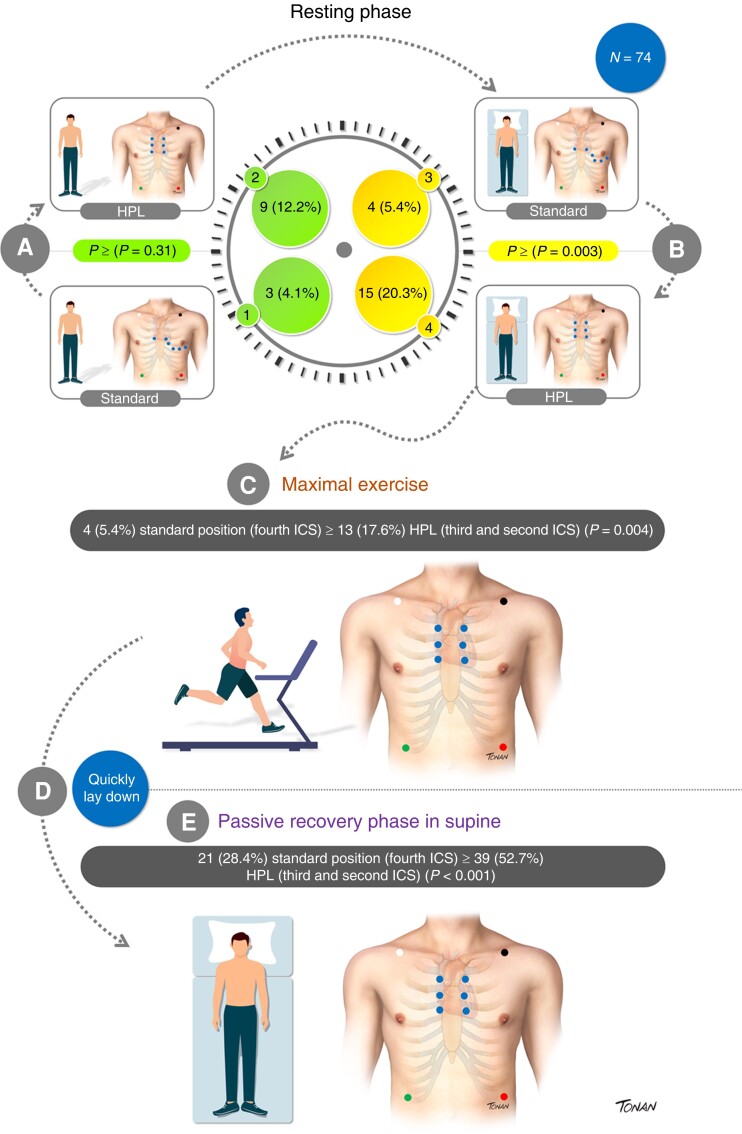
High precordial leads (HPL) on the resting electrocardiogram (ECG) are widely used to improve diagnostic detection of type 1 Brugada ECG pattern (Br1ECGp). A parasympathetic activation marks the initial recovery phase of treadmill stress testing (TET), and this can be useful for detecting the typical ECG pattern. Our study aimed to evaluate the role of a new HPL-treadmill exercise testing (TET) protocol in detecting Br1ECGp fluctuation compared to resting HPL-ECG.
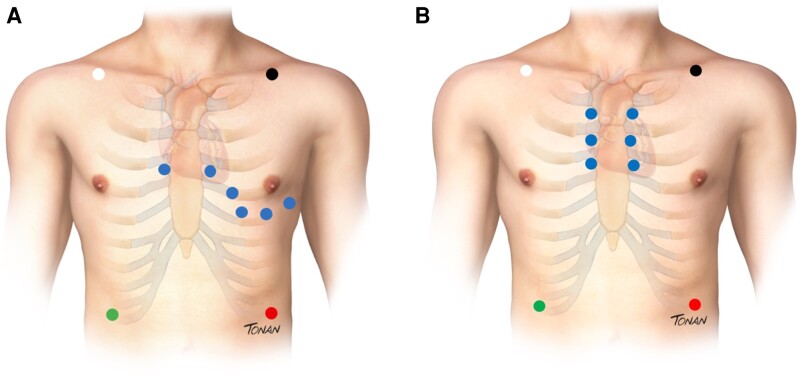
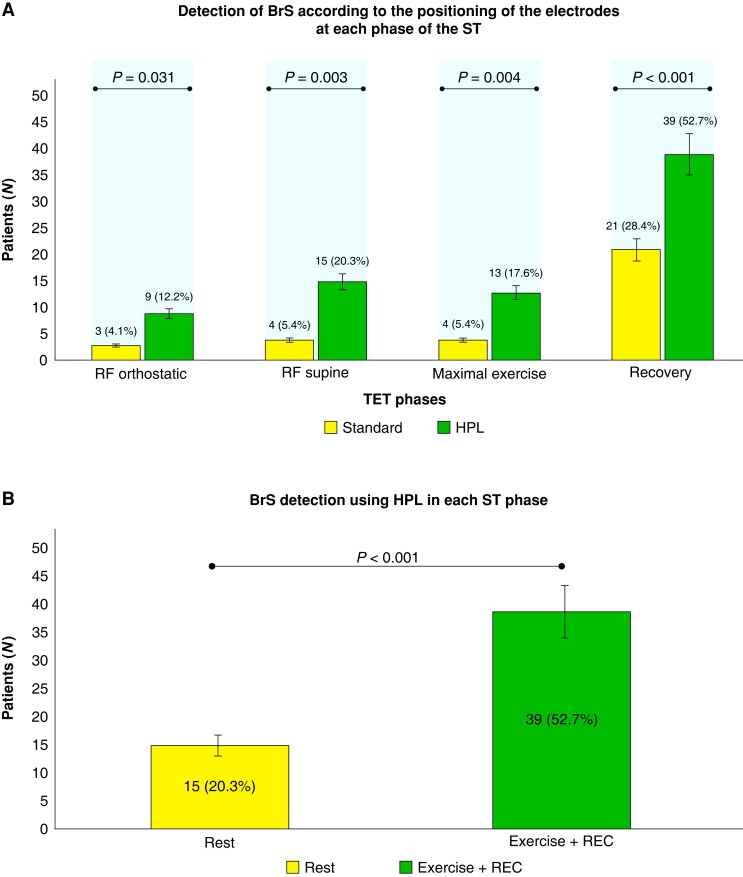
74 out of 163 patients of a Brugada syndrome (BrS) Brazilian cohort (GenBra Registry) underwent exercise testing with HPL-TET protocol. Precordial leads were displayed in strategic positions in the right and left parasternal spaces. The step-by-step analysis included ECG classification (as presence or absence of Br1ECGp) in standard vs. HPL leads placement in the following sequences: resting phase, maximal exercise, and the passive recovery phase (including 'quick lay down'). For heart rate recovery (HRR) measurements and comparisons, a Student's t-test was applied. McNemar tests compared the detection of Br1ECGp. The significance level was defined as P < 0.05. Fifty-seven patients (57/74; 77%) were male, the mean age was 49.0 ± 14, 78.4% had spontaneous BrS, and the mean Shanghai score was 4.5. The HPL-TET protocol increased Br1ECGp detection by 32.4% against resting HPL-ECG (52.7% vs. 20.3%, P = 0.001) alone.
Stress testing using HPL with the passive recovery phase in the supine position offers an opportunity to unmask the type 1 Br1ECGp, which could increase the diagnostic yield in this population.
在静息心电图(ECG)中使用高胸导联(HPL)广泛用于提高 1 型 Brugada 心电图模式(Br1ECGp)的诊断检出率。迷走神经激活标志着跑步机运动试验(TET)的初始恢复期,这对于检测典型心电图模式很有用。我们的研究旨在评估新的 HPL-跑步机运动试验(TET)方案与静息 HPL-ECG 相比,在检测 Br1ECGp 波动中的作用。
巴西 Brugada 综合征(BrS)队列(GenBra 注册研究)中的 163 例患者中的 74 例接受了 HPL-TET 方案的运动试验。在右和左胸骨旁间隙的战略位置显示胸前导联。逐步分析包括在标准导联与 HPL 导联位置(有无 Br1ECGp)的心电图分类,顺序如下:静息期、最大运动期和被动恢复期(包括“快速躺下”)。对于心率恢复(HRR)测量和比较,应用 Student's t 检验。McNemar 检验比较 Br1ECGp 的检出率。定义显著性水平为 P < 0.05。57 例患者(57/74;77%)为男性,平均年龄为 49.0 ± 14 岁,78.4%有自发性 BrS,上海评分平均为 4.5。HPL-TET 方案较静息 HPL-ECG 单独增加 Br1ECGp 检出率 32.4%(52.7% vs. 20.3%,P = 0.001)。
在仰卧位使用 HPL 进行应激试验并在被动恢复期,可以揭示 1 型 Br1ECGp,这可能会增加该人群的诊断检出率。