Guangdong Provincial Key Laboratory of Computer Vision and Virtual Reality Technology, Shenzhen Institute of Advanced Technology, Chinese Academy of Science, Shenzhen, China.
The Chinese University of Hong Kong, Hong Kong SAR, China.
BMC Med Imaging. 2023 Jul 8;23(1):91. doi: 10.1186/s12880-023-01045-y.
Segmentation of liver vessels from CT images is indispensable prior to surgical planning and aroused a broad range of interest in the medical image analysis community. Due to the complex structure and low-contrast background, automatic liver vessel segmentation remains particularly challenging. Most of the related researches adopt FCN, U-net, and V-net variants as a backbone. However, these methods mainly focus on capturing multi-scale local features which may produce misclassified voxels due to the convolutional operator's limited locality reception field.
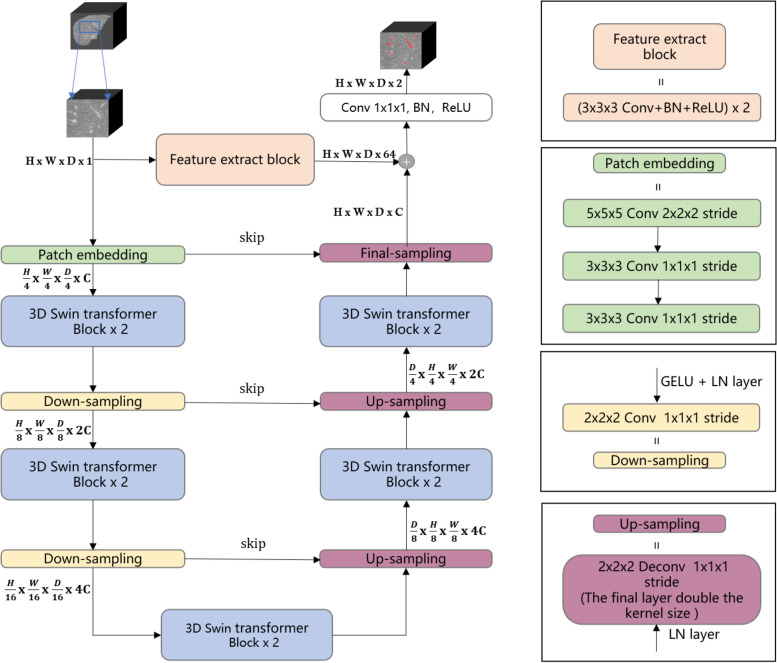
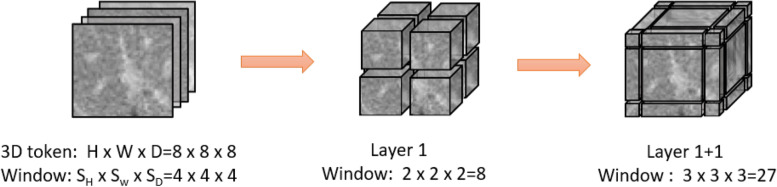
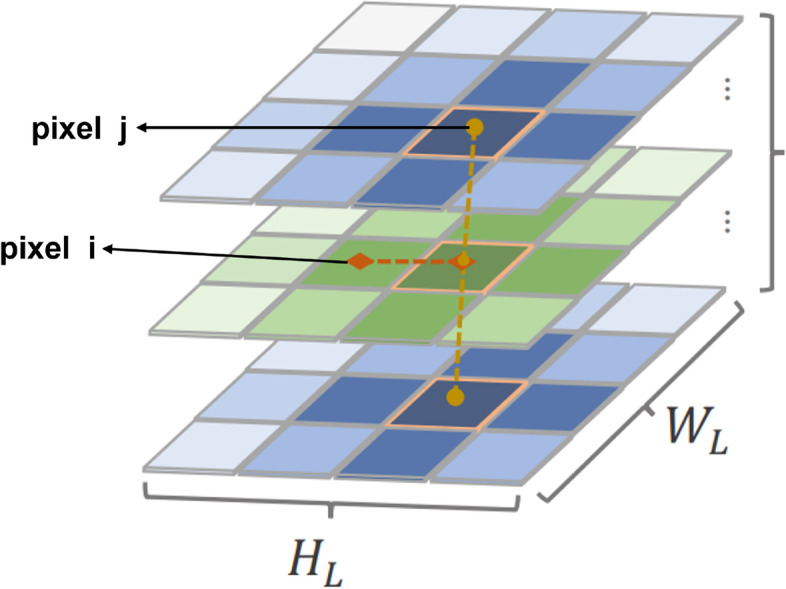
We propose a robust end-to-end vessel segmentation network called Inductive BIased Multi-Head Attention Vessel Net(IBIMHAV-Net) by expanding swin transformer to 3D and employing an effective combination of convolution and self-attention. In practice, we introduce voxel-wise embedding rather than patch-wise embedding to locate precise liver vessel voxels and adopt multi-scale convolutional operators to gain local spatial information. On the other hand, we propose the inductive biased multi-head self-attention which learns inductively biased relative positional embedding from initialized absolute position embedding. Based on this, we can gain more reliable queries and key matrices.
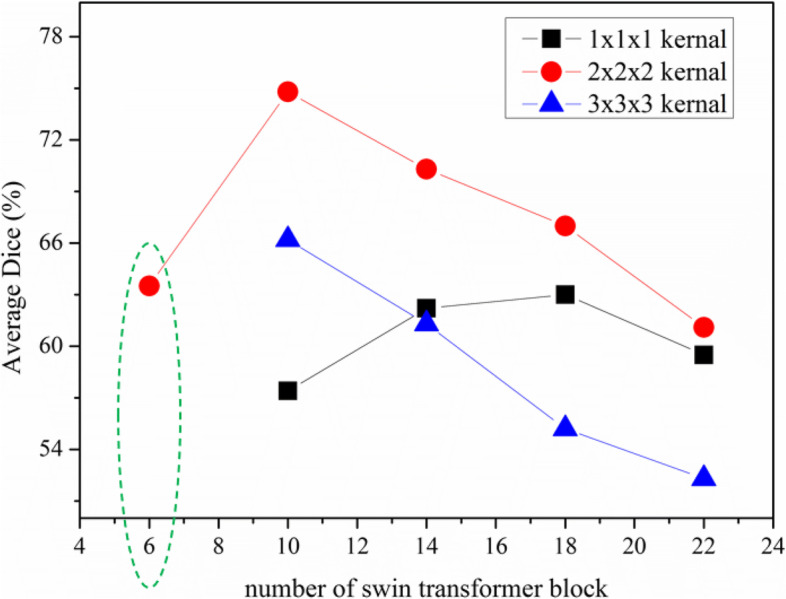
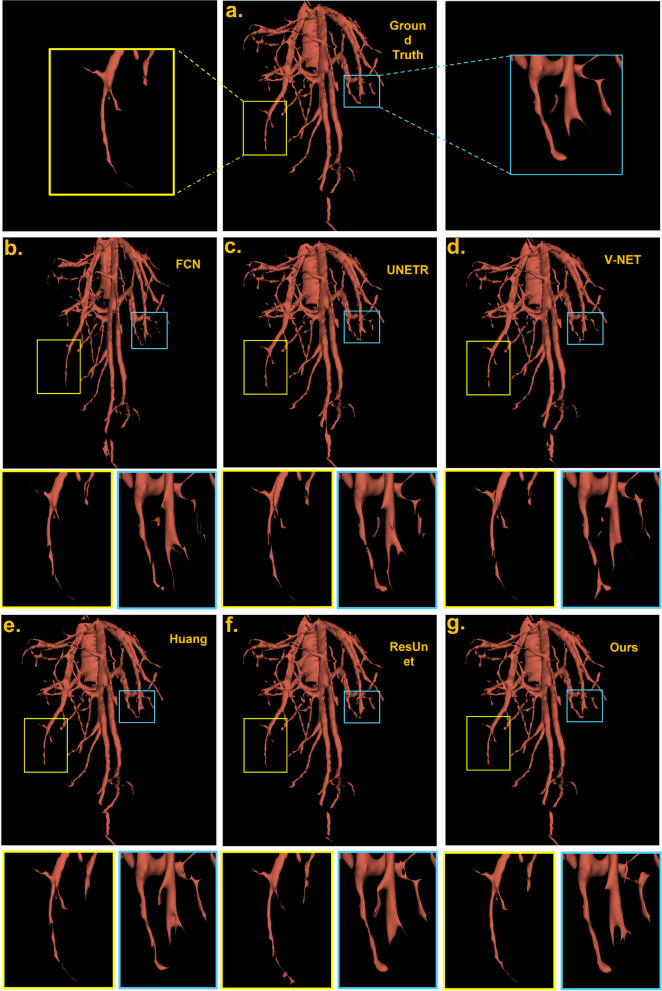
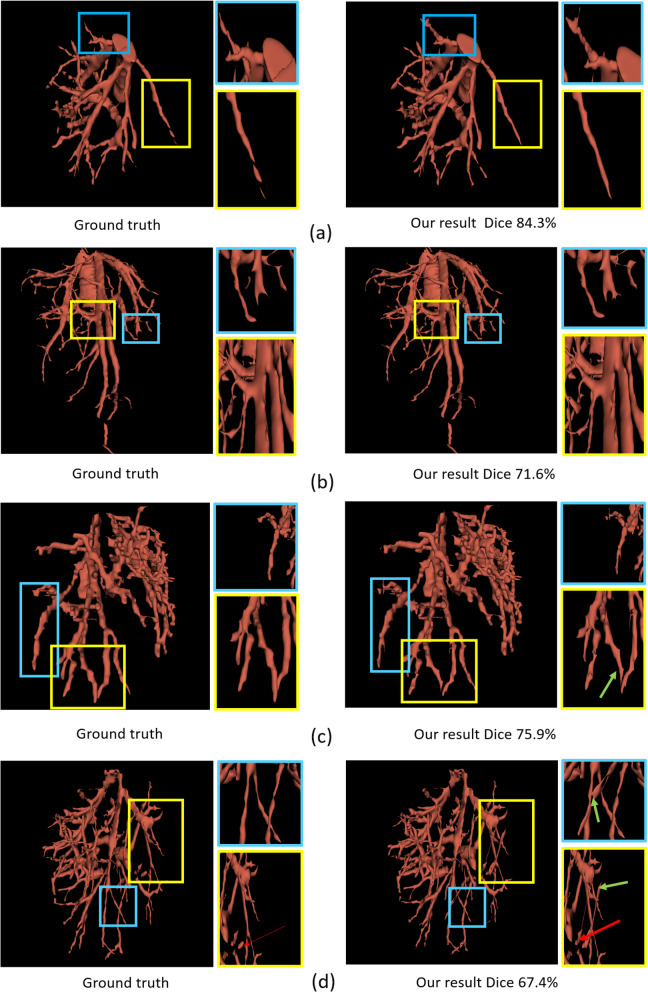
We conducted experiments on the 3DIRCADb dataset. The average dice and sensitivity of the four tested cases were 74.8[Formula: see text] and 77.5[Formula: see text], which exceed the results of existing deep learning methods and improved graph cuts method. The Branches Detected(BD)/Tree-length Detected(TD) indexes also proved the global/local feature capture ability better than other methods.
The proposed model IBIMHAV-Net provides an automatic, accurate 3D liver vessel segmentation with an interleaved architecture that better utilizes both global and local spatial features in CT volumes. It can be further extended for other clinical data.
在手术规划之前,对 CT 图像中的肝血管进行分割是必不可少的,这引起了医学图像分析界的广泛关注。由于结构复杂、背景对比度低,自动肝血管分割仍然具有很大的挑战性。大多数相关研究都采用 FCN、U-net 和 V-net 变体作为骨干网络。然而,这些方法主要侧重于捕捉多尺度局部特征,由于卷积算子的有限局部接收域,可能会产生错误分类的体素。
我们提出了一种名为 Inductive BIased Multi-Head Attention Vessel Net(IBIMHAV-Net)的稳健端到端血管分割网络,通过将 Swin Transformer 扩展到 3D,并采用卷积和自注意力的有效组合。在实践中,我们引入了体素级别的嵌入,而不是补丁级别的嵌入,以定位精确的肝血管体素,并采用多尺度卷积算子获取局部空间信息。另一方面,我们提出了诱导偏置多头自注意力,它从初始化的绝对位置嵌入中学习诱导偏置的相对位置嵌入。基于此,我们可以获得更可靠的查询和键矩阵。
我们在 3DIRCADb 数据集上进行了实验。四个测试案例的平均骰子系数和灵敏度分别为 74.8%和 77.5%,超过了现有深度学习方法和改进的图割方法的结果。分支检测(BD)/树长检测(TD)指标也证明了该模型比其他方法具有更好的全局/局部特征捕获能力。
所提出的模型 IBIMHAV-Net 提供了一种自动、准确的 3D 肝血管分割方法,具有交错的架构,更好地利用了 CT 容积中的全局和局部空间特征。它可以进一步扩展到其他临床数据。