Ma Lijuan, Li Boyi, Ma Jinchen, Wu Chunyuan, Li Nan, Zhou Kailin, Yan Yun, Li Mingshuang, Hu Xiaoyan, Yan Hao, Wang Qi, Zheng Yanfei, Wu Zhisheng
Beijing University of Chinese Medicine, School of Chinese Materia Medica, Beijing 100029, China.
Beijing University of Chinese Medicine, School of Traditional Chinese Medicine, Beijing 100029, China.
Acta Pharm Sin B. 2023 Jun;13(6):2765-2777. doi: 10.1016/j.apsb.2023.01.004. Epub 2023 Jan 10.
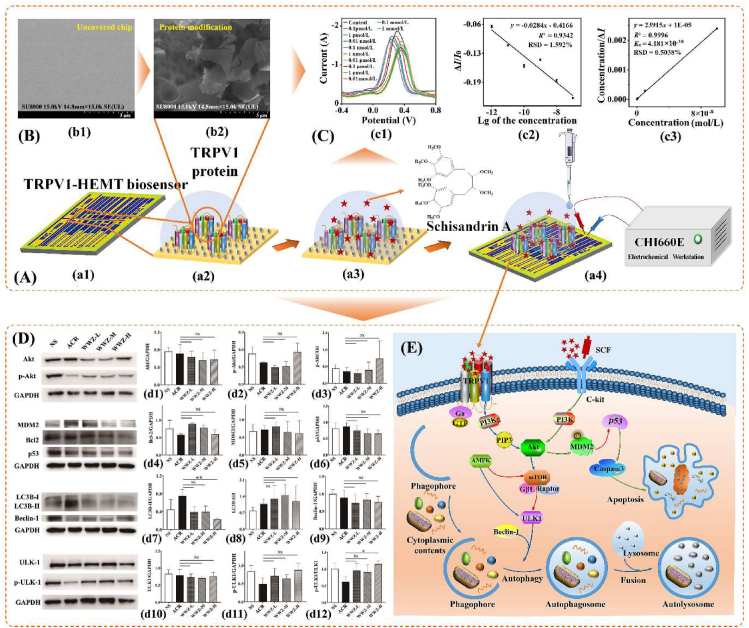
Oligoasthenospermia is the primary cause of infertility. However, there are still enormous challenges in the screening of critical candidates and targets of oligoasthenospermia owing to its complex mechanism. In this study, stem cell factor (SCF), c-kit, and transient receptor potential vanilloid 1 (TRPV1) biosensors were successfully established and applied to studying apoptosis and autophagy mechanisms. Interestingly, the detection limit reached 2.787 × 10 g/L, and the quantitative limit reached 1.0 × 10 g/L. Furthermore, biosensors were used to investigate the interplay between autophagy and apoptosis. Schisandrin A is an excellent candidate to form a system with c-kit similar to SCF/c-kit with a detection constant () of 5.701 × 10 mol/L, whereas it had no affinity for SCF. In addition, it also inhibited autophagy in oligoasthenospermia through antagonizing TRPV1 with a of up to 4.181 × 10 mol/L. In addition, and experiments were highly consistent with the biosensor. In summary, high-potency schisandrin A and two potential targets were identified, through which schisandrin A could reverse the apoptosis caused by excessive autophagy during oligoasthenospermia. Our study provides promising insights into the discovery of effective compounds and potential targets a well-established - strategy.
少弱精子症是不孕不育的主要原因。然而,由于其机制复杂,在少弱精子症关键候选因素和靶点的筛选方面仍面临巨大挑战。在本研究中,成功构建了干细胞因子(SCF)、c-kit和瞬时受体电位香草酸亚型1(TRPV1)生物传感器,并将其应用于研究细胞凋亡和自噬机制。有趣的是,检测限达到2.787×10 g/L,定量限达到1.0×10 g/L。此外,利用生物传感器研究了自噬与凋亡之间的相互作用。五味子甲素是与c-kit形成类似于SCF/c-kit系统的优秀候选物,其检测常数()为5.701×10 mol/L,而它对SCF没有亲和力。此外,它还通过拮抗TRPV1抑制少弱精子症中的自噬,解离常数高达4.181×10 mol/L。此外,和实验结果与生物传感器高度一致。综上所述,确定了高效的五味子甲素和两个潜在靶点,通过这些靶点,五味子甲素可以逆转少弱精子症期间过度自噬引起的细胞凋亡。我们的研究为通过成熟的-策略发现有效化合物和潜在靶点提供了有前景的见解。