Abdulai Abdul-Fatawu, Howard A Fuchsia, Yong Paul J, Currie Leanne M
School of Nursing, University of British Columbia, T201-2211 Westbrook Mall, Vancouver, BC, Canada.
Department of Obstetrics and Gynaecology, University of British Columbia, Vancouver, BC, Canada.
PLOS Digit Health. 2023 Jul 12;2(7):e0000223. doi: 10.1371/journal.pdig.0000223. eCollection 2023 Jul.
Stigma has been recognized as a significant issue in sexual health, yet no specific guidelines exist to support digital health development teams in creating stigma-alleviating sexual health digital platforms. The purpose of this study was to develop a set of design guidelines that would serve as a reference point for addressing stigma during the design of sexual health-related digital platforms.
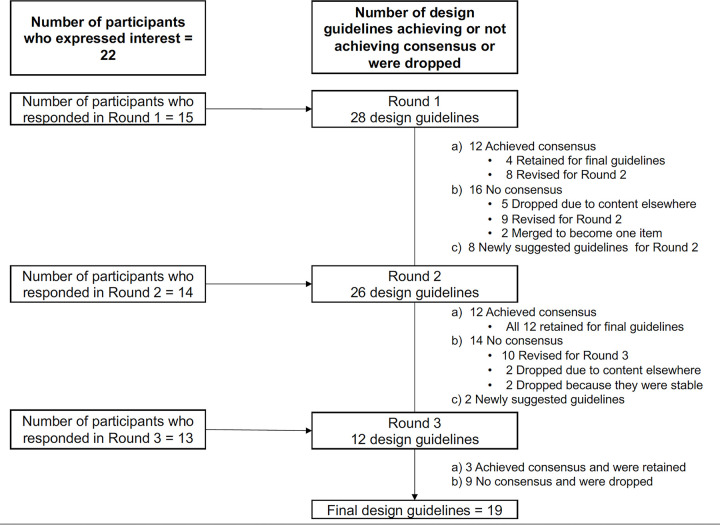
We conducted a 3-round Delphi study among 14 researchers in stigma and sexual health. A preliminary list of 28 design guidelines was generated from a literature review. Participants appraised and critiqued the clarity and usefulness of the preliminary list and provided comments for each item and for the overall group of items at each round. At each round, a content validity index and an interquartile range were calculated to determine the level of consensus regarding the clarity and usefulness of each guideline. Items were retained if there was high consensus or were dropped if there was no consensus after the three rounds.
Nineteen design guidelines achieved consensus. Most of them were content-related guidelines and sought to address the emotional concerns of patients that could potentially aggravate stigma. The findings also reflected modern stigma management strategies of making stigma a societal attribute by challenging, exposing, and normalizing stigma attributes via web platforms.
To address stigma via digital platforms, developers should not just concentrate on technical solutions but seriously consider content-related and emotional design components that are likely to result in stigma.
耻辱感已被公认为性健康领域的一个重要问题,但目前尚无具体指南来支持数字健康开发团队创建减轻耻辱感的性健康数字平台。本研究的目的是制定一套设计指南,作为在设计性健康相关数字平台时应对耻辱感的参考依据。
我们对14名耻辱感与性健康领域的研究人员进行了三轮德尔菲研究。通过文献综述生成了一份包含28条设计指南的初步清单。参与者对初步清单的清晰度和实用性进行评估和批判,并在每一轮为每个项目以及整个项目组提供意见。在每一轮中,计算内容效度指数和四分位间距,以确定对每条指南的清晰度和实用性的共识程度。如果达成高度共识,则保留项目;如果三轮后仍未达成共识,则删除项目。
19条设计指南达成了共识。其中大多数是与内容相关的指南,旨在解决可能加剧耻辱感的患者情感问题。研究结果还反映了现代耻辱感管理策略,即通过网络平台挑战、揭露和使耻辱感属性正常化,将耻辱感转变为一种社会属性。
为了通过数字平台解决耻辱感问题,开发者不应只专注于技术解决方案,还应认真考虑可能导致耻辱感的与内容相关的和情感方面的设计要素。