Dell'Osso Liliana, Nardi Benedetta, Bonelli Chiara, Gravina Davide, Benedetti Francesca, Del Prete Luca, Massimetti Gabriele, Amatori Giulia, Carpita Barbara, Cremone Ivan Mirko
Department of Clinical and Experimental Medicine, University of Pisa, Pisa, Italy.
Front Psychol. 2023 Jun 27;14:1157636. doi: 10.3389/fpsyg.2023.1157636. eCollection 2023.
In the recent years, a rising amount of research has stressed the importance of a dimensional perspective on mental disorders. In particular, the conceptualization of an obsessive-compulsive spectrum appears to be in line with the very first descriptions of Obsessive-Compulsive Disorder and has been partially acknowledged by the inclusion of the "OCD-spectrum related syndromes and disorders" section in the DSM-5. The goal of the current study is to ascertain the psychometric characteristics of the Obsessive-Compulsive Spectrum-Short Version (OBS-SV), a novel questionnaire designed to measure the complete range of obsessive-compulsive symptoms, from severe full blown to subthreshold ones.
Forty three subjects with a clinical diagnosis of OCD according to the Diagnostic and Statistical Manual of Mental Disorders (DSM-5); 42 subjects with a clinical diagnosis of social anxiety disorder (SAD), and 60 individuals without current or lifetime mental disorders (HC) were recruited from the Psychiatric Clinic of the University of Pisa. Subjects were assessed with the SCID-5, the Yale Brown Obsessive Compulsive Scale (Y-BOCS) and the OBS-SV.
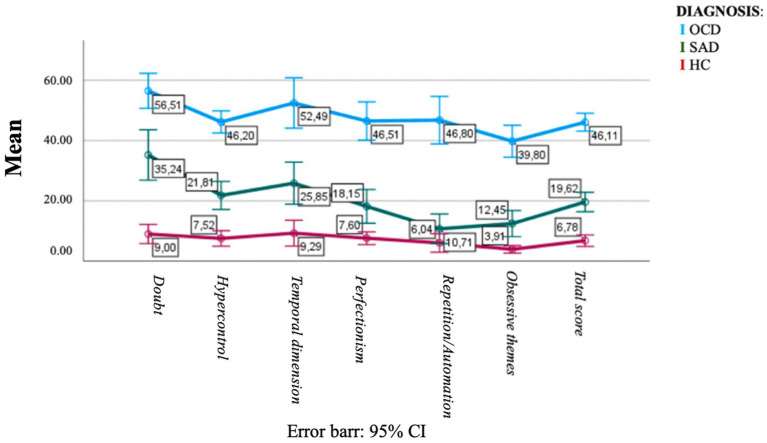
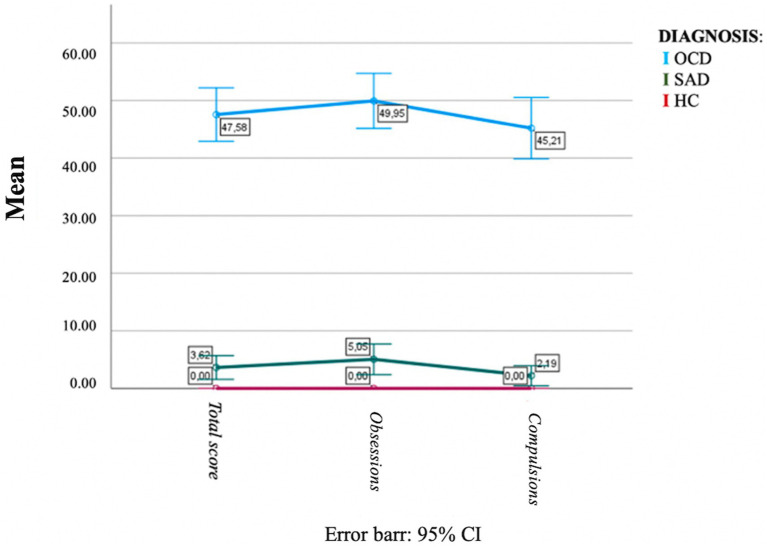
OBS-SV showed strong test-retest reliability for both the total and the domains scores, as well as a high level of internal consistency. The Pearson's coefficients for the OBS-SV domain scores ranged from 0.771 to 0.943, and they were positively and strongly linked with one another ( < 0.001). The OBS-SV total score had a strong correlation with each of the OBS-SV domain scores. All correlation coefficients between OBS-SV and additional measures of OCS were observed to be strong, significant and positive. Both OBS-SV domain and overall score differences between diagnostic groups were found to be statistically significant. From HCs, to the SAD, up to the OC group, which had the highest values, the OBS-SV total score grew dramatically and progressively.
The OBS-SV demonstrated significant convergent validity with other dimensional OCD measures, excellent internal consistency, and test-retest reliability. Across the three diagnostic categories, the questionnaire functioned differently, with a rising score gradient from healthy controls through SAD patients to OCD subjects.
近年来,越来越多的研究强调了从维度视角看待精神障碍的重要性。特别是,强迫谱系的概念化似乎与强迫症的最初描述一致,并且在《精神疾病诊断与统计手册》(DSM - 5)中纳入“与强迫症谱系相关的综合征和障碍”部分已得到部分认可。本研究的目的是确定强迫谱系简版(OBS - SV)的心理测量特征,这是一份旨在测量从严重的典型到阈下强迫症状全范围的新型问卷。
从比萨大学精神病诊所招募了43名根据《精神疾病诊断与统计手册》(DSM - 5)临床诊断为强迫症的受试者;42名临床诊断为社交焦虑障碍(SAD)的受试者,以及60名目前或终生无精神障碍的个体(健康对照)。受试者接受了SCID - 5、耶鲁布朗强迫量表(Y - BOCS)和OBS - SV评估。
OBS - SV在总分和各领域得分方面均显示出很强的重测信度,以及高水平的内部一致性。OBS - SV领域得分的皮尔逊系数范围为0.771至0.943,它们彼此之间呈显著正相关(<0.001)。OBS - SV总分与每个OBS - SV领域得分都有很强的相关性。观察到OBS - SV与强迫症其他测量指标之间的所有相关系数均为强、显著且正相关。发现诊断组之间的OBS - SV领域和总分差异具有统计学意义。从健康对照到社交焦虑障碍组,再到得分最高的强迫症组,OBS - SV总分急剧且逐步上升。
OBS - SV与其他维度的强迫症测量方法显示出显著的收敛效度、出色的内部一致性和重测信度。在这三个诊断类别中,该问卷的表现不同,从健康对照到社交焦虑障碍患者再到强迫症受试者,得分呈上升梯度。