School of Medicine, Serra Talhada Campus, University of Pernambuco, Pernambuco, Brazil.
Department of Epidemiology and Quantitative Methods in Health, National School of Public Health Sergio Arouca, Oswaldo Cruz Foundation, Pernambuco, Brazil.
BMC Public Health. 2023 Jul 13;23(1):1351. doi: 10.1186/s12889-023-16289-0.
Estimate the effects of age, period, and birth cohort on suicide mortality in Brazil by major geographic region in the overall population and by sex.
This was a time trend ecological study. National and regional suicide mortality data from 1981 to 2020 were analyzed for the overall population and by sex. Age, period, and cohort effects were calculated with a Poisson regression model using estimable functions with the Epi package of the R statistical program, version 4.2.1.
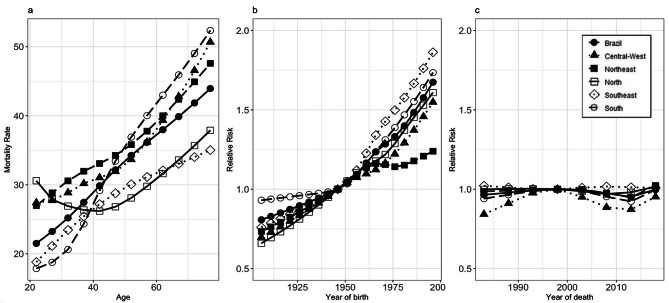
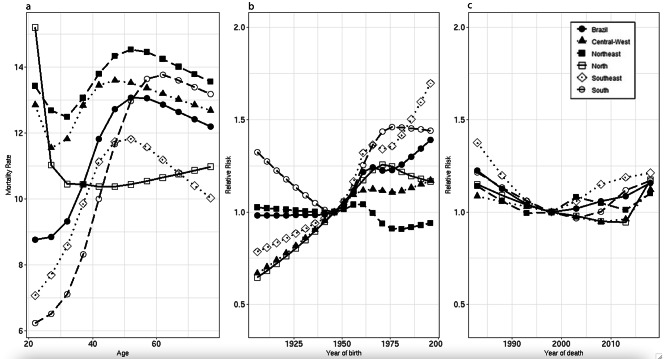
There were 272,716 suicides in individuals ranging from 20 to 79 years old. In the overall population, the age model-adjusted suicide mortality rates showed an upward pattern for Brazil. The most recent cohort showed the highest associated risk, 1.67 (95%CI 1.63; 1.71), while for the reference period, it was the highest risk among all the periods.
Suicide mortality rates have shown an upward trend with advancing age in both men and women in the Brazilian population. However, the behavior of the period effect and cohort depends on the population analyzed and regional distribution.
通过主要地理区域和性别,估计年龄、时期和出生队列对巴西全人群自杀死亡率的影响。
这是一项时间趋势生态学研究。对 1981 年至 2020 年的全国和地区自杀死亡率数据进行了分析,分析对象为全人群和性别。使用 R 统计程序版本 4.2.1 的 Epi 包中的可估计函数,通过泊松回归模型计算年龄、时期和队列效应。
20 至 79 岁人群中有 272716 人自杀。在全人群中,年龄模型调整后的自杀死亡率呈上升趋势。最新队列显示的相关风险最高,为 1.67(95%CI 1.63;1.71),而参考时期则是所有时期中风险最高的。
巴西人口中,男性和女性的自杀死亡率均随年龄增长呈上升趋势。然而,时期效应和队列的行为取决于分析的人群和区域分布。