Liutkus Jokubas, Kriukas Arturas, Stragyte Dominyka, Mazeika Erikas, Raudonis Vidas, Galetzka Wolfgang, Stang Andreas, Valiukeviciene Skaidra
Department of Skin and Venereal Diseases, Lithuanian University of Health Sciences, 44307 Kaunas, Lithuania.
Department of Skin and Venereal Diseases, Hospital of Lithuanian University of Health Sciences Kauno Klinikos, 50161 Kaunas, Lithuania.
Diagnostics (Basel). 2023 Jun 21;13(13):2139. doi: 10.3390/diagnostics13132139.
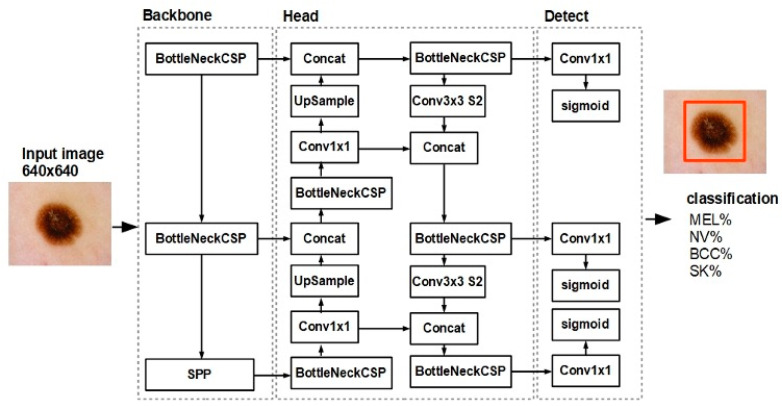
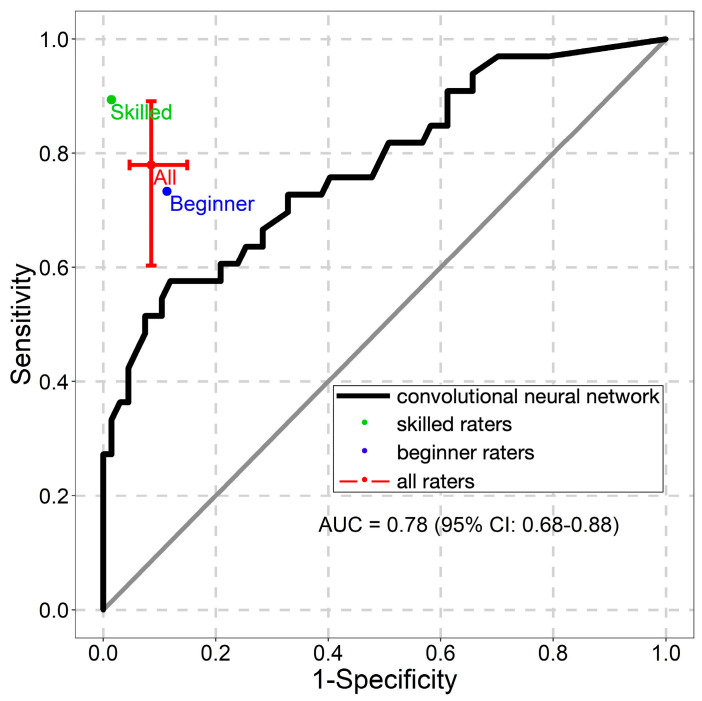
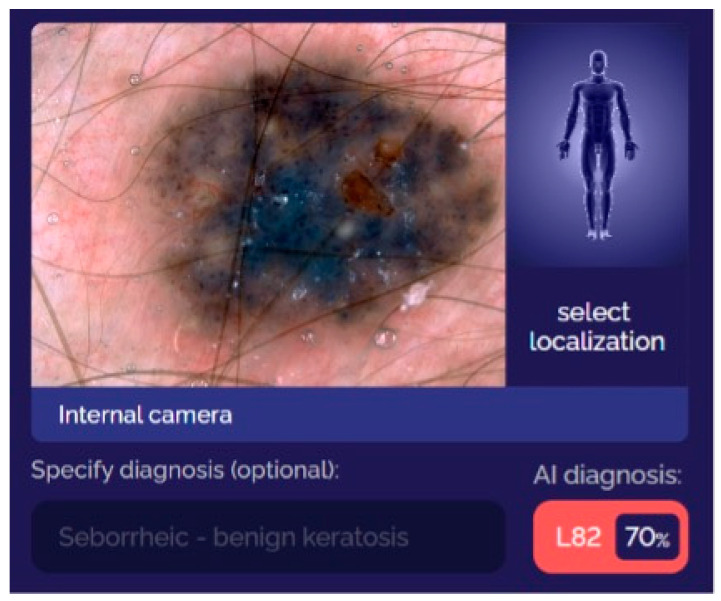
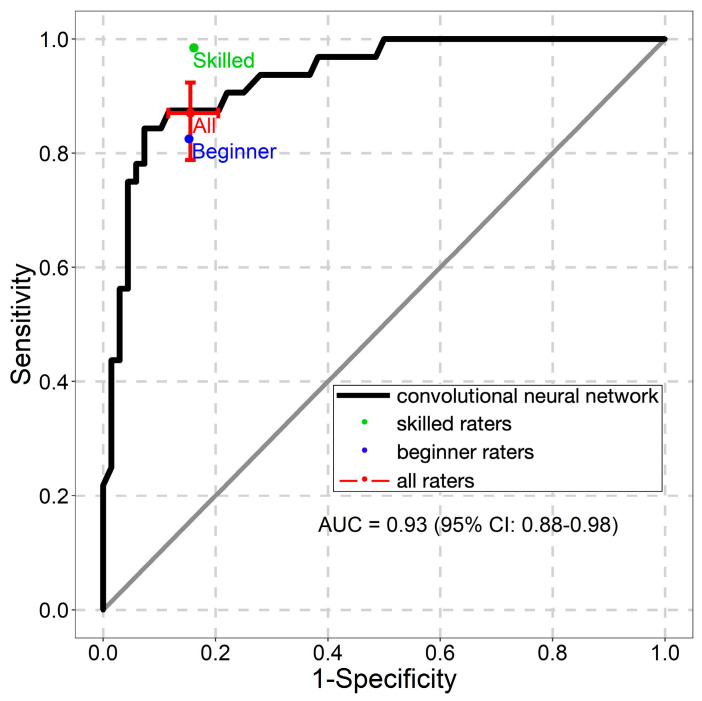
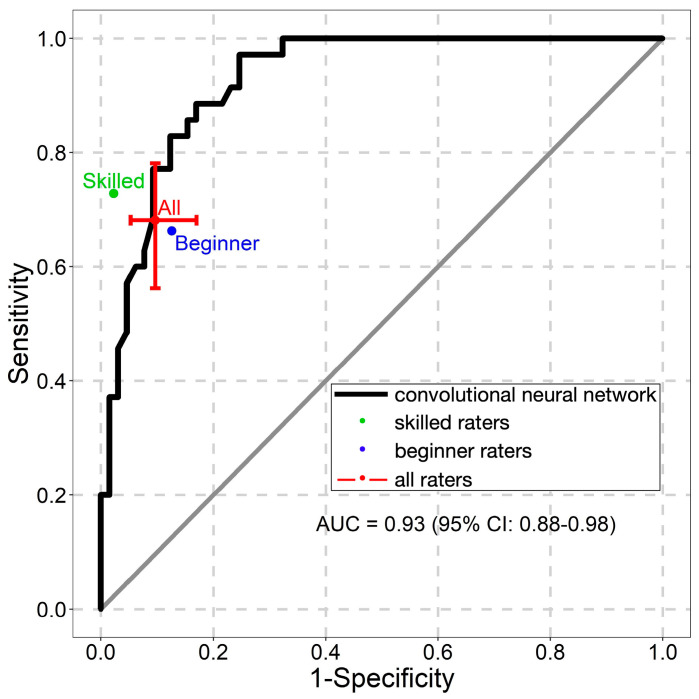
Current artificial intelligence algorithms can classify melanomas at a level equivalent to that of experienced dermatologists. The objective of this study was to assess the accuracy of a smartphone-based "You Only Look Once" neural network model for the classification of melanomas, melanocytic nevi, and seborrheic keratoses. The algorithm was trained using 59,090 dermatoscopic images. Testing was performed on histologically confirmed lesions: 32 melanomas, 35 melanocytic nevi, and 33 seborrheic keratoses. The results of the algorithm's decisions were compared with those of two skilled dermatologists and five beginners in dermatoscopy. The algorithm's sensitivity and specificity for melanomas were 0.88 (0.71-0.96) and 0.87 (0.76-0.94), respectively. The algorithm surpassed the beginner dermatologists, who achieved a sensitivity of 0.83 (0.77-0.87). For melanocytic nevi, the algorithm outclassed each group of dermatologists, attaining a sensitivity of 0.77 (0.60-0.90). The algorithm's sensitivity for seborrheic keratoses was 0.52 (0.34-0.69). The smartphone-based "You Only Look Once" neural network model achieved a high sensitivity and specificity in the classification of melanomas and melanocytic nevi with an accuracy similar to that of skilled dermatologists. However, a bigger dataset is required in order to increase the algorithm's sensitivity for seborrheic keratoses.
当前的人工智能算法在对黑色素瘤进行分类时,其水平与经验丰富的皮肤科医生相当。本研究的目的是评估基于智能手机的“你只看一次”神经网络模型对黑色素瘤、黑素细胞痣和脂溢性角化病进行分类的准确性。该算法使用59,090张皮肤镜图像进行训练。对经组织学确诊的病变进行测试:32例黑色素瘤、35例黑素细胞痣和33例脂溢性角化病。将该算法的诊断结果与两位经验丰富的皮肤科医生和五位皮肤科新手的诊断结果进行比较。该算法对黑色素瘤的敏感性和特异性分别为0.88(0.71 - 0.96)和0.87(0.76 - 0.94)。该算法超过了皮肤科新手,他们的敏感性为0.83(0.77 - 0.87)。对于黑素细胞痣,该算法优于每组皮肤科医生,敏感性达到0.77(0.60 - 0.90)。该算法对脂溢性角化病的敏感性为0.52(0.34 - 0.69)。基于智能手机的“你只看一次”神经网络模型在黑色素瘤和黑素细胞痣的分类中实现了高敏感性和特异性,其准确性与经验丰富的皮肤科医生相似。然而,需要更大的数据集来提高该算法对脂溢性角化病的敏感性。