Lazar Michelle, De La Garza Henriette, Vashi Neelam A
Department of Dermatology, Boston University School of Medicine, 609 Albany St, J502, Boston, MA 02118, USA.
J Clin Med. 2023 Jun 28;12(13):4341. doi: 10.3390/jcm12134341.
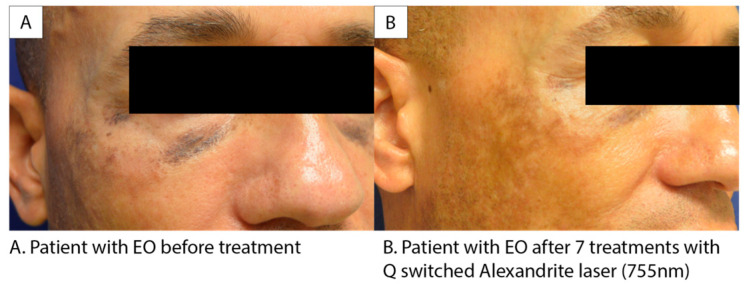
Exogenous ochronosis is a rare dyschromia that primarily impacts those with skin of color. It is characterized by blue-black pigmentation and is associated with the long-term application of skin-lightening creams containing hydroquinone. Commonly confused with other dyschromias, the use of skin lightening topicals can cause paradoxical skin darkening in patients with known exogenous ochronosis. This is highly distressing to patients, often worsening the underlying dyschromia and making treatment more difficult. A 10-year retrospective analysis was conducted that revealed 25 patients with exogenous ochronosis. The average patient used a skin lightening cream for 9.2 years, with exogenous ochronosis most commonly arising on the cheeks (68%), forehead (24%), and temples (20%). Furthermore, this study identified that patients with exogenous ochronosis may respond well to treatment with Q-switched Alexandrite laser and microneedling. The incidence of exogenous ochronosis is likely to increase as demographics shift and access to a wide range of over-the-counter topicals becomes more available, both in the United States and worldwide. Therefore, it is imperative to better characterize exogenous ochronosis to identify best treatment practices for all patients.
外源性褐黄病是一种罕见的色素沉着异常,主要影响有色人种。其特征为蓝黑色色素沉着,与长期使用含对苯二酚的美白面霜有关。由于常与其他色素沉着异常相混淆,对于已知患有外源性褐黄病的患者,使用美白外用剂可能会导致矛盾性皮肤变黑。这给患者带来极大困扰,往往会加重潜在的色素沉着异常,使治疗更加困难。一项为期10年的回顾性分析显示,有25例外源性褐黄病患者。患者平均使用美白面霜9.2年,外源性褐黄病最常见于脸颊(68%)、额头(24%)和太阳穴(20%)。此外,该研究还发现,外源性褐黄病患者可能对调Q紫翠宝石激光和微针治疗反应良好。随着美国和全球人口结构的变化以及非处方外用剂的获取更加容易,外源性褐黄病的发病率可能会上升。因此,必须更好地描述外源性褐黄病,以便为所有患者确定最佳治疗方法。