Ou Ying-Ju, Lee Jia-In, Huang Shu-Pin, Chen Szu-Chia, Geng Jiun-Hung, Su Chia-Hung
Department of Pharmacy, Kaohsiung Medical University Hospital, Kaohsiung 80756, Taiwan.
Department of Pharmacology, Graduate Institute of Medicine, College of Medicine, Kaohsiung Medical University, Kaohsiung 80756, Taiwan.
J Clin Med. 2023 Jun 30;12(13):4435. doi: 10.3390/jcm12134435.
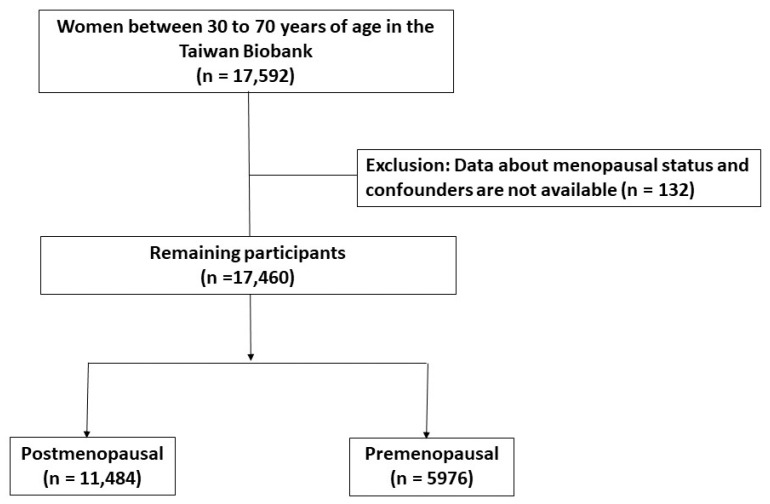
(1) Background: We aimed to explore the associations between menopause, postmenopausal hormone therapy, and metabolic syndrome in a large community-based group of Asian women. (2) Methods: This is a cross-sectional study in which we enrolled women aged 30 to 70 years with sufficient information about menopausal status from the Taiwan Biobank. The definition for metabolic syndrome used in this study aligns with the Bureau of Health Promotion's (Taiwan) proposed definition. (3) Results: A total of 17,460 women were recruited. The postmenopausal group had a higher metabolic syndrome prevalence (30% vs. 14%) and 1.17 times higher odds ratio (OR) than the premenopausal group (95% confidence interval [CI] = 1.02 to 1.33). Regarding the types of menopause, surgical menopause was associated with metabolic syndrome (OR = 1.40; 95% CI = 1.20 to 1.63); however, natural menopause was not associated with metabolic syndrome. Interestingly, postmenopausal hormone therapy was associated with a lower risk of metabolic syndrome in the women with natural menopause (OR = 0.79; 95% CI = 0.70 to 0.89), but not in those with surgical menopause. (4) Conclusions: Our results suggest that menopause is associated with an increased prevalence of metabolic syndrome, while postmenopausal hormone therapy is associated with a lower prevalence of metabolic syndrome in women with natural menopause.
(1) 背景:我们旨在探讨在一个以社区为基础的大型亚洲女性群体中,绝经、绝经后激素治疗与代谢综合征之间的关联。(2) 方法:这是一项横断面研究,我们从台湾生物银行纳入了年龄在30至70岁之间且有足够绝经状态信息的女性。本研究中使用的代谢综合征定义与台湾卫生促进局提出的定义一致。(3) 结果:共招募了17460名女性。绝经后组的代谢综合征患病率更高(30% 对14%),且比值比(OR)比绝经前组高1.17倍(95%置信区间[CI]=1.02至1.33)。关于绝经类型,手术绝经与代谢综合征相关(OR = 1.40;95% CI = 1.20至1.63);然而,自然绝经与代谢综合征无关。有趣的是,绝经后激素治疗与自然绝经女性患代谢综合征的风险较低相关(OR = 0.79;95% CI = 0.70至0.89),但与手术绝经女性无关。(4) 结论:我们的结果表明,绝经与代谢综合征患病率增加相关,而绝经后激素治疗与自然绝经女性代谢综合征患病率较低相关。