State Key Laboratory of Digital Medical Engineering, School of Biological Science and Medical Engineering, Southeast University, 2# Sipailou, Nanjing 210096, China.
Department of Materials Science and Engineering, CAS Key Laboratory of Materials for Energy Conversion, iChEM (Collaborative Innovation Center of Chemistry for Energy Materials), CAS Center for Excellence in Nanoscience, University of Science and Technology of China, Hefei 230026, China.
Molecules. 2023 Jun 28;28(13):5062. doi: 10.3390/molecules28135062.
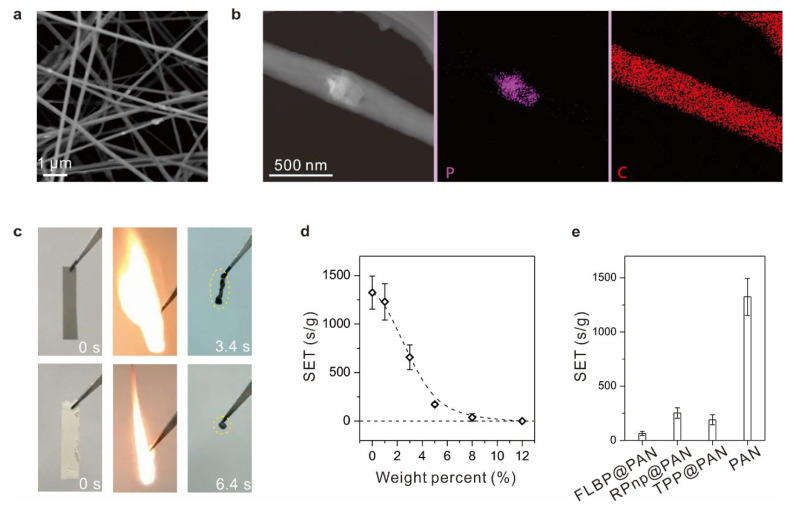
The usage of flame retardants in flammable polymers has been an effective way to protect both lives and material goods from accidental fires. Phosphorus flame retardants have the potential to be follow-on flame retardants after halogenated variants, because of their low toxicity, high efficiency and compatibility. Recently, the emerging allotrope of phosphorus, two-dimensional black phosphorus, as a flame retardant has been developed. To further understand its performance in flame-retardant efficiency among phosphorus flame retardants, in this work, we built model materials to compare the flame-retardant performances of few-layer black phosphorus, red phosphorus nanoparticles, and triphenyl phosphate as flame-retardant additives in cellulose and polyacrylonitrile. Aside from the superior flame retardancy in polyacrylonitrile, few-layer black phosphorus in cellulose showed the superior flame-retardant efficiency in self-extinguishing, 1.8 and ~4.4 times that of red phosphorus nanoparticles and triphenyl phosphate with similar lateral size and mass load (2.54.8 wt%), respectively. The char layer in cellulose coated with the few-layer black phosphorus after combustion was more continuous and smoother than that with red phosphorus nanoparticles, triphenyl phosphate and blank, and the amount of residues of cellulose coated with the few-layer black phosphorus in thermogravimetric analysis were 10 wt%, 14 wt% and 14 wt% more than that with red phosphorus nanoparticles, triphenyl phosphate and blank, respectively. In addition, although exothermic reactions, the combustion enthalpy changes in the few-layer black phosphorus (-127.1 kJ mol) are one third of that of red phosphorus nanoparticles (-381.3 kJ mol). Based on a joint thermodynamic, spectroscopic, and microscopic analysis, the superior flame retardancy of the few-layer black phosphorus was attributed to superior combustion reaction suppression from the two-dimensional structure and thermal nature of the few-layer black phosphorus.
在易燃聚合物中使用阻燃剂是保护生命和物质财产免受意外火灾的有效方法。磷系阻燃剂由于其低毒性、高效率和相容性,有望成为卤代变体的后续阻燃剂。最近,作为阻燃剂的磷的新兴同素异形体二维黑磷已经被开发出来。为了进一步了解其在阻燃效率方面作为磷系阻燃剂的性能,在这项工作中,我们构建了模型材料,以比较少层黑磷、红磷纳米粒子和三苯基膦作为阻燃添加剂在纤维素和聚丙烯腈中的阻燃性能。除了在聚丙烯腈中的优异阻燃性外,少层黑磷在纤维素中的自熄阻燃效率更高,分别是红磷纳米粒子和三苯基膦的 1.8 倍和 4.4 倍,具有相似的横向尺寸和质量负载(2.5-4.8wt%)。燃烧后纤维素涂层中少层黑磷的炭层比红磷纳米粒子、三苯基膦和空白更连续和光滑,热重分析中纤维素涂层的少层黑磷残留量比红磷纳米粒子、三苯基膦和空白分别多 10wt%、14wt%和 14wt%。此外,尽管存在放热反应,但少层黑磷(-127.1kJmol)的燃烧焓变化是红磷纳米粒子(-381.3kJmol)的三分之一。基于热力学、光谱学和微观分析的联合分析,少层黑磷的优异阻燃性归因于二维结构和少层黑磷的热性质对燃烧反应的抑制作用。