French Military Health Service Academy, Paris, France.
Normandie Université, UNICAEN, PSL Research University, EPHE, INSERM, U1077, CHU de Caen, GIP Cyceron, Neuropsychologie et Imagerie de la Mémoire Humaine, Caen, France.
Eur J Psychotraumatol. 2023;14(2):2225154. doi: 10.1080/20008066.2023.2225154.
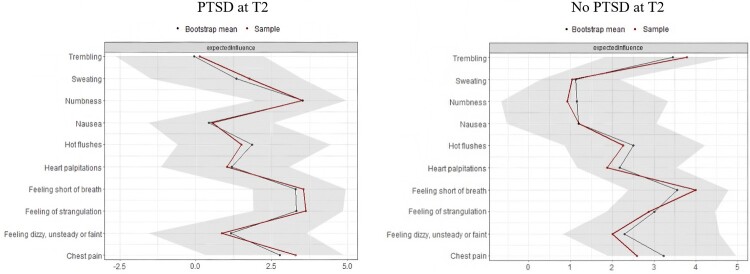
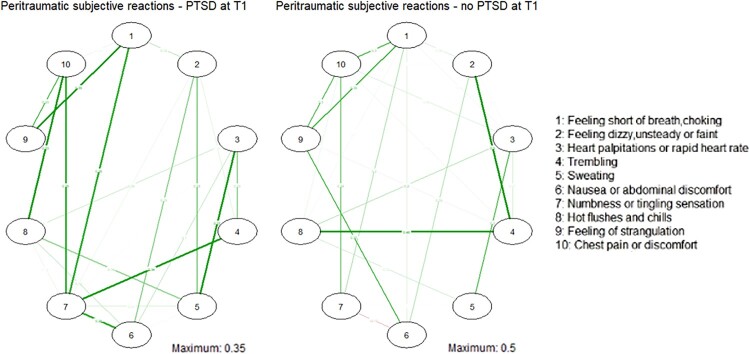
Following a mass casualty event, such as the Paris terrorist attacks of 13 November 2015, first responders need to identify individuals at risk of PTSD. Physical peritraumatic symptoms involving the autonomic nervous system may be useful in this task. We sought to determine the trajectory of physical response intensity in individuals exposed to the Paris terrorist attacks using repeated measures, and to examine its associations with PTSD. Using network modelling, we examined whether peritraumatic physical symptom associations differed by PTSD status. Physical reactions were assessed using the Subjective Physical Reactions Scale at three time points: peritraumatic by retrospective recall, then current at one year (8-18 months) and three years (30-42 months) after the attacks. Interaction networks between peritraumatic physical reactions were compared according to PTSD status. On the one hand, the reported intensity of physical reactions was significantly higher in the PTSD group at all time points. On the other hand, using the dynamic approach, more robust positive interactions between peritraumatic physical reactions were found in the PTSD group one and three years after the attacks. Negative interactions were found in the no-PTSD group at one year. Peritraumatic physical numbness was found to be the most central network symptom in the PTSD group, whereas it was least central in the no-PTSD group. Network analysis of the interaction between peritraumatic physical subjective responses, particularly physical numbness, may provide insight into the clinical course of PTSD. Our knowledge of the brain regions involved in dissociation supports the hypothesis that the periaqueductal grey may contribute to the process leading to physical numbing. Our findings highlight the role of peritraumatic somatic symptoms in the course of PTSD. Peritraumatic physical numbness appears to be a key marker of PTSD and its identification may help to improve early triage.
在大规模伤亡事件(如 2015 年 11 月 13 日巴黎恐怖袭击事件)发生后,急救人员需要识别出有 PTSD 风险的个体。涉及自主神经系统的躯体创伤前症状可能对此类任务有用。我们试图使用重复测量法确定暴露于巴黎恐怖袭击事件个体的躯体反应强度的轨迹,并研究其与 PTSD 的关联。使用网络建模,我们检验了创伤前躯体症状的关联是否因 PTSD 状态而异。使用主观躯体反应量表在三个时间点评估躯体反应:创伤前通过回顾性回忆,然后在一年(8-18 个月)和三年(30-42 个月)后评估当前反应。根据 PTSD 状态比较创伤前躯体反应的交互网络。一方面,在所有时间点,PTSD 组报告的躯体反应强度均明显更高。另一方面,使用动态方法,在创伤后一年和三年,PTSD 组中发现了更稳健的创伤前躯体反应之间的正交互作用。在无 PTSD 组中发现了一年时的负交互作用。在 PTSD 组中,创伤前躯体麻木被发现是网络中最核心的症状,而在无 PTSD 组中则是最不核心的症状。对创伤前躯体主观反应(特别是躯体麻木)之间的相互作用进行网络分析,可能有助于深入了解 PTSD 的临床病程。我们对参与分离的大脑区域的了解支持了这样的假设,即导水管周围灰质可能有助于导致躯体麻木的过程。我们的研究结果突出了创伤前躯体症状在 PTSD 病程中的作用。创伤前躯体麻木似乎是 PTSD 的一个关键标志物,其识别可能有助于改善早期分诊。