Crocco Paolina, Vecchie Denise, Gopalkrishna Sreejit, Dato Serena, Passarino Giuseppe, Young Martin E, Nagareddy Prabhakara R, Rose Giuseppina, De Luca Maria
Department of Biology, Ecology, and Earth Sciences, University of Calabria, Rende, 87036, Italy.
Department of Nutrition Sciences, University of Alabama at Birmingham, Birmingham, AL, 35294, USA.
Diabetol Metab Syndr. 2023 Jul 17;15(1):156. doi: 10.1186/s13098-023-01132-8.
Syndecan-4 (SDC4) is a member of the heparan sulfate proteoglycan family of cell-surface receptors. We and others previously reported that variation in the SDC4 gene was associated with several components of the metabolic syndrome, including intra-abdominal fat, fasting glucose and triglyceride levels, and hypertension, in human cohorts. Additionally, we demonstrated that high fat diet (HFD)-induced obese female mice with a Sdc4 genetic deletion had higher visceral adiposity and a worse metabolic profile than control mice. Here, we aimed to first investigate whether the mouse Sdc4 null mutation impacts metabolic phenotypes in a sex- and diet-dependent manner. We then tested whether SDC4 polymorphisms are related to the metabolic syndrome (MetS) in humans.
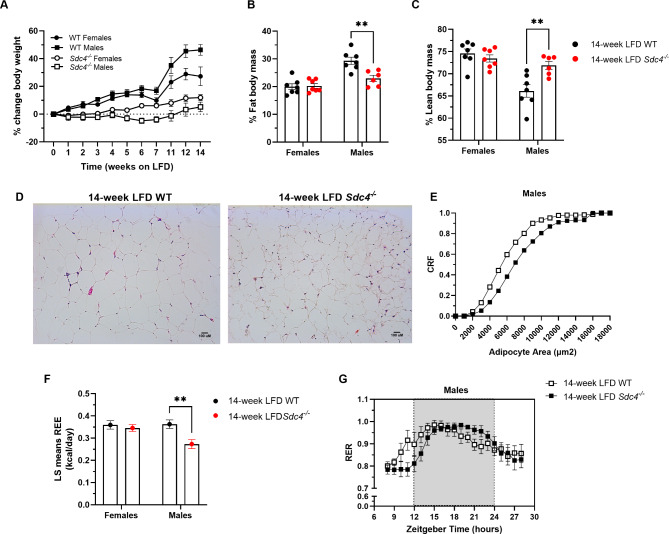
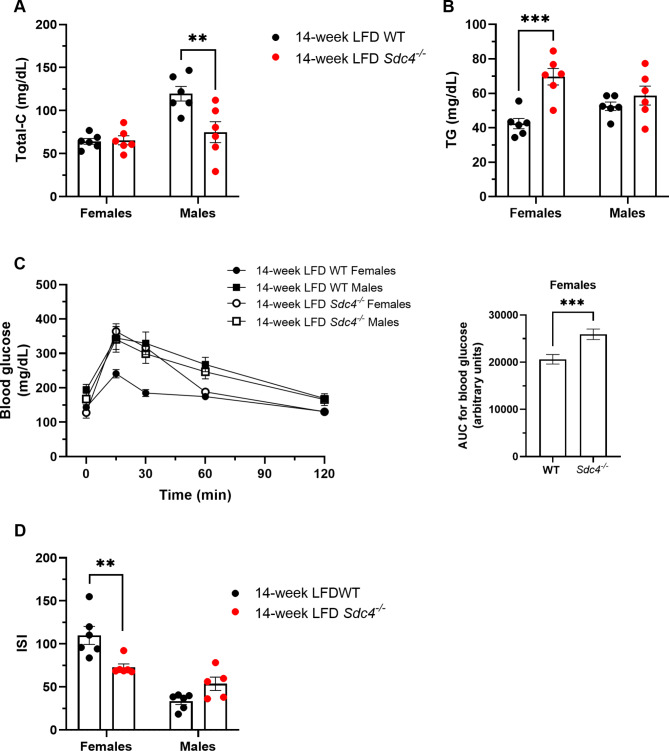
For the mouse experiment, Sdc4-deficient (Sdc4) and wild-type (WT) mice were treated with 14-weeks of low-fat diet (LFD). Body composition, energy balance, and selected metabolic phenotypes were assessed. For the human genetic study, we used logistic regression models to test 11 SDC4 SNPs for association with the MetS and its components in a cohort of 274 (113 with MetS) elderly subjects from southern Italy.
Following the dietary intervention in mice, we observed that the effects of the Sdc4 null mutation on several phenotypes were different from those previously reported in the mice kept on an HFD. Nonetheless, LFD-fed female Sdc4 mice, but not males, displayed higher levels of triglycerides and lower insulin sensitivity at fasting than WT mice, as seen earlier in the HFD conditions. In the parallel human study, we found that carriers of SDC4 rs2228384 allele C and rs2072785 allele T had reduced risk of MetS. The opposite was true for carriers of the SDC4 rs1981429 allele G. Additionally, the SNPs were found related to fasting triglyceride levels and triglyceride glucose (TyG) index, a reliable indicator of insulin resistance, with sex-stratified analysis detecting the association of rs1981429 with these phenotypes only in females.
Altogether, our results suggest that SDC4 is an evolutionary conserved genetic determinant of MetS and that its genetic variation is associated with fasting triglyceride levels in a female-specific manner.
Syndecan-4(SDC4)是细胞表面受体硫酸乙酰肝素蛋白聚糖家族的成员。我们和其他人之前报道,在人类队列中,SDC4基因的变异与代谢综合征的几个组成部分相关,包括腹内脂肪、空腹血糖和甘油三酯水平以及高血压。此外,我们证明,与对照小鼠相比,高脂饮食(HFD)诱导的Sdc4基因缺失的肥胖雌性小鼠具有更高的内脏脂肪和更差的代谢状况。在这里,我们旨在首先研究小鼠Sdc4基因无效突变是否以性别和饮食依赖的方式影响代谢表型。然后,我们测试了SDC4基因多态性是否与人类的代谢综合征(MetS)相关。
对于小鼠实验,对Sdc4基因缺陷(Sdc4)和野生型(WT)小鼠进行为期14周的低脂饮食(LFD)处理。评估身体组成、能量平衡和选定的代谢表型。对于人类基因研究,我们使用逻辑回归模型在来自意大利南部的274名(113名患有MetS)老年受试者队列中测试11个SDC4单核苷酸多态性(SNP)与MetS及其组成部分的关联。
在对小鼠进行饮食干预后,我们观察到Sdc4基因无效突变对几种表型的影响与之前在高脂饮食喂养的小鼠中报道的不同。尽管如此,与野生型小鼠相比,低脂饮食喂养的雌性Sdc4小鼠(而非雄性)在空腹时甘油三酯水平更高,胰岛素敏感性更低,这与之前在高脂饮食条件下观察到的情况相似。在平行的人类研究中,我们发现SDC4 rs2228384等位基因C和rs2072785等位基因T的携带者患MetS的风险降低。SDC4 rs1981429等位基因G的携带者情况则相反。此外,发现这些SNP与空腹甘油三酯水平和甘油三酯葡萄糖(TyG)指数相关,TyG指数是胰岛素抵抗的可靠指标,性别分层分析仅在女性中检测到rs1981429与这些表型的关联。
总之,我们的结果表明,SDC4是MetS的一个进化保守的遗传决定因素,其基因变异以女性特异性方式与空腹甘油三酯水平相关。