School of Nursing, Shaanxi University of Chinese Medicine, Xianyang, China.
Department of Nursing, Fourth Military Medical University, No.169 Changle West Road, Xi'an, 710032, Shaanxi, China.
BMC Psychiatry. 2023 Jul 18;23(1):516. doi: 10.1186/s12888-023-04923-5.
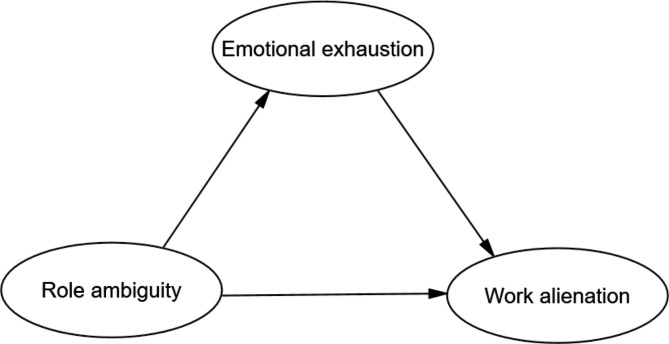
work alienation is receiving increasing attention as a psychological risk at work, and little is known about the mechanisms of role ambiguity and work alienation in nurses in the context of the COVID-19 pandemic. This article aims to examine how role ambiguity affects work alienation among Chinese nurses during the two years after COVID-19 pandemic and verify emotional exhaustion as mediators.
A cross-sectional study design was used to recruit 281 Chinese nurses. Nurses completed online questionnaires containing demographic characteristics, role ambiguity, emotional exhaustion, and work alienation, and SPSS 26.0 and AMOS 24.0 were used for data analysis and structural equation modelling.
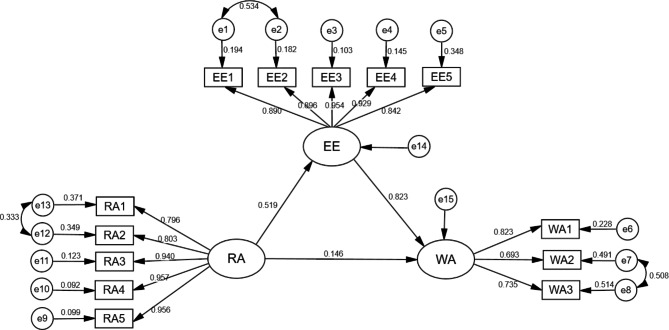
work alienation scores were (34.64 ± 10.09), work alienation was correlated with role ambiguity and emotional exhaustion (r1 = 0.521, r2 = 0.755; p < .01), and role ambiguity was positively correlated with emotional exhaustion (r = 0.512; p < .01). A mediating effect of emotional exhaustion between role ambiguity and work alienation held (mediating effect of 0.288, 95% CI: 0.221-0.369, accounting for 74.8% of the total effect).
Role ambiguity has a significant direct effect on nurses' feelings of alienation and exacerbates alienation through emotional exhaustion. Clarifying roles at work and being less emotionally drained are effective ways to reduce nurses' feelings of alienation.
工作疏离作为工作场所的一种心理风险,正受到越来越多的关注,而在 COVID-19 大流行背景下,关于护士角色模糊和工作疏离的机制知之甚少。本文旨在探讨角色模糊如何影响 COVID-19 大流行后两年中国护士的工作疏离感,并验证情绪耗竭作为其中的中介因素。
采用横断面研究设计,招募了 281 名中国护士。护士通过在线问卷完成人口统计学特征、角色模糊、情绪耗竭和工作疏离感的调查,使用 SPSS 26.0 和 AMOS 24.0 进行数据分析和结构方程建模。
工作疏离感得分为(34.64±10.09),工作疏离感与角色模糊和情绪耗竭呈正相关(r1=0.521,r2=0.755;p<.01),角色模糊与情绪耗竭呈正相关(r=0.512;p<.01)。情绪耗竭在角色模糊与工作疏离感之间存在中介效应(中介效应为 0.288,95%CI:0.221-0.369,占总效应的 74.8%)。
角色模糊对护士的疏离感有显著的直接影响,并通过情绪耗竭加剧疏离感。明确工作角色和减少情绪耗竭是降低护士疏离感的有效途径。