Rural Health Research Institute, Charles Sturt University, Orange, New South Wales, Australia.
School of Health and Society, University of Wollongong, Wollongong, New South Wales, Australia.
PLoS One. 2023 Jul 19;18(7):e0285103. doi: 10.1371/journal.pone.0285103. eCollection 2023.
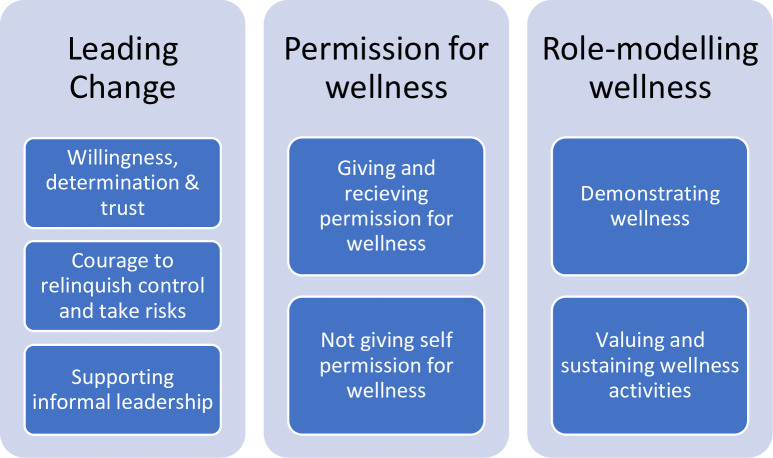
Ways of dealing with workplace stress and enhancing healthcare workers wellness are sought globally. The aim of this study was to explore healthcare leaders' practice in relation to the implementation of a workplace wellness program called SEED in the context of multiple crises (bushfires and COVID-19) affecting a local health district in New South Wales, Australia. Practice theory informed interviews (n = 23), focus groups (n = 2) and co-analysis reflexive discussions (n = 2) that were conducted with thirteen leaders and twenty healthcare workers. A pragmatic approach to program implementation for healthcare workers' wellness explored the process and actions that resulted from leadership practice in an inductive thematic analysis. Preliminary themes were presented in the co-analysis sessions to ensure the lived experiences of the SEED program were reflected and co-interpretation of the data was included in the analysis. Three key themes were identified. 1) Leading change-implementing a wellness program required leaders to try something new and be determined to make change happen. 2) Permission for wellness-implicit and explicit permission from leaders to engage in wellness activities during worktime was required. 3) Role-modelling wellness-leaders viewed SEED as a way to demonstrate leadership in supporting and caring for healthcare workers. SEED provided a platform for leaders who participated to demonstrate their leadership practices in supporting wellness activities. Leadership practices are critical to the implementation of healthcare wellness programs. The implementation of SEED at a time of unprecedented crisis gave leaders and healthcare workers opportunities to experience something new including leadership that was courageous, responsive and authentic. The study highlighted the need for workplace wellness programs to intentionally include leaders rather than only expect them to implement them. The practices documented in this study provide guidance to others developing, implementing and researching workplace wellness programs.
全球都在寻求应对工作场所压力和提高医疗保健工作者健康的方法。本研究的目的是探讨医疗保健领导者在澳大利亚新南威尔士州当地卫生区受到多重危机(丛林大火和 COVID-19)影响的情况下实施名为 SEED 的工作场所健康计划的实践情况。采用实践理论指导的访谈(n = 23)、焦点小组(n = 2)和共同分析反思性讨论(n = 2),对 13 名领导者和 20 名医疗保健工作者进行了研究。在一项针对医疗保健工作者健康的计划实施的实用主义方法中,探讨了领导力实践产生的过程和行动,对其进行了归纳主题分析。在共同分析会议上展示了初步主题,以确保反映 SEED 计划的亲身体验,并包括对数据的共同解释。确定了三个关键主题。1)领导变革-实施健康计划需要领导者尝试新事物并决心实现变革。2)允许健康-领导者明确或暗示允许在工作时间进行健康活动。3)健康示范-领导者认为 SEED 是展示领导能力以支持和关心医疗保健工作者的一种方式。SEED 为参与的领导者提供了一个平台,展示他们在支持健康活动方面的领导实践。领导实践对于医疗保健健康计划的实施至关重要。在前所未有的危机时期实施 SEED 为领导者和医疗保健工作者提供了体验新事物的机会,包括勇敢、响应和真实的领导。该研究强调了需要有目的的将领导者纳入工作场所健康计划,而不仅仅是期望他们实施。本研究记录的实践为其他开发、实施和研究工作场所健康计划提供了指导。