Cognitive Neuroscience Program, Department of Psychology, Florida International University, Miami, FL, 33199, USA.
Center for Complex Systems and Brain Sciences, Florida Atlantic University, Boca Raton, FL, 33431, USA.
Nat Commun. 2023 Jul 19;14(1):4326. doi: 10.1038/s41467-023-40044-z.
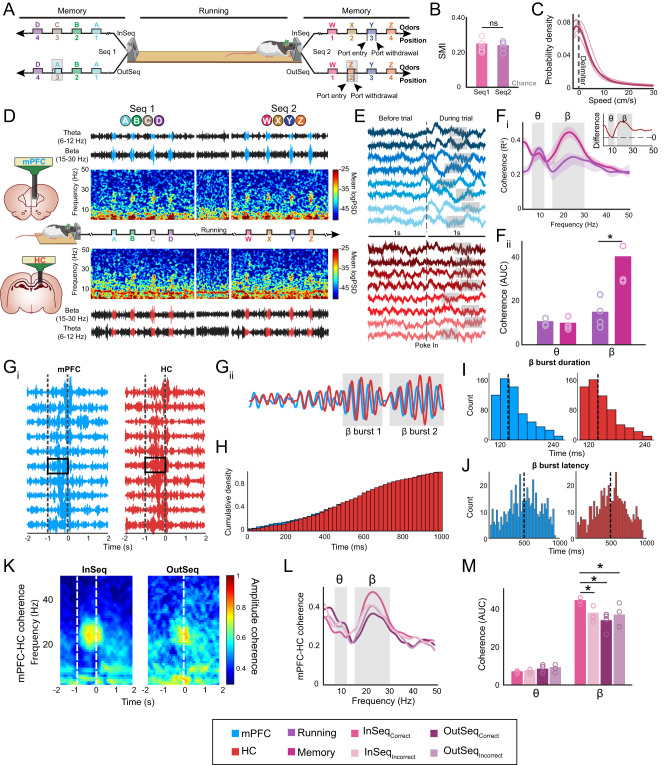
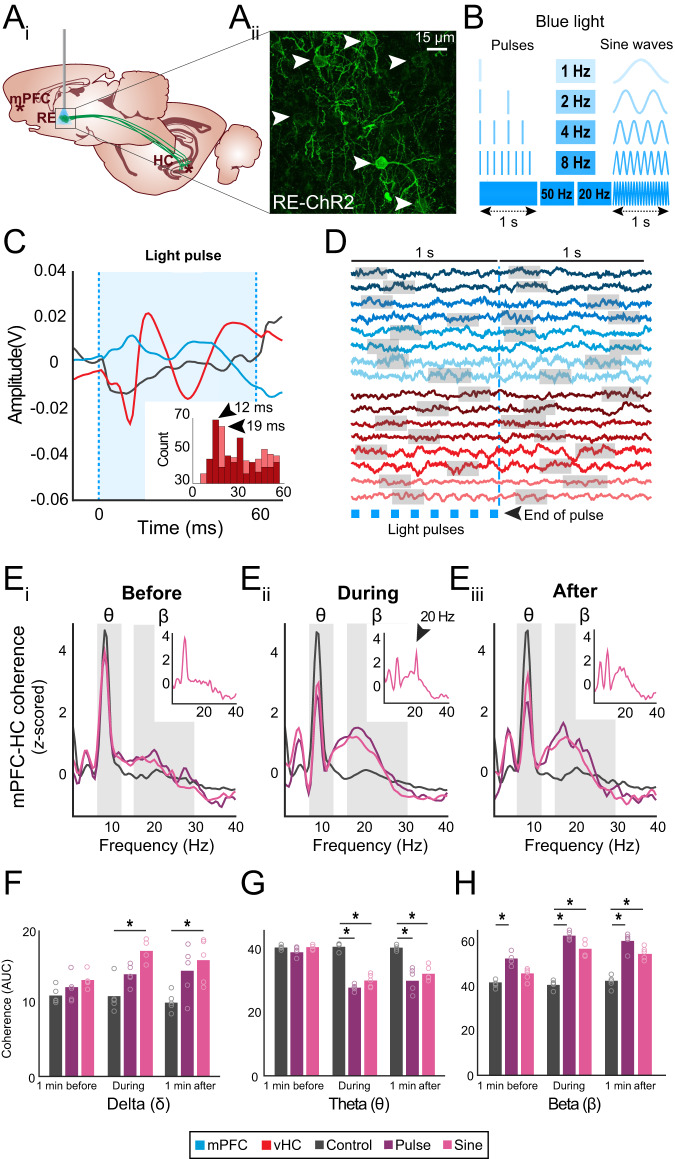
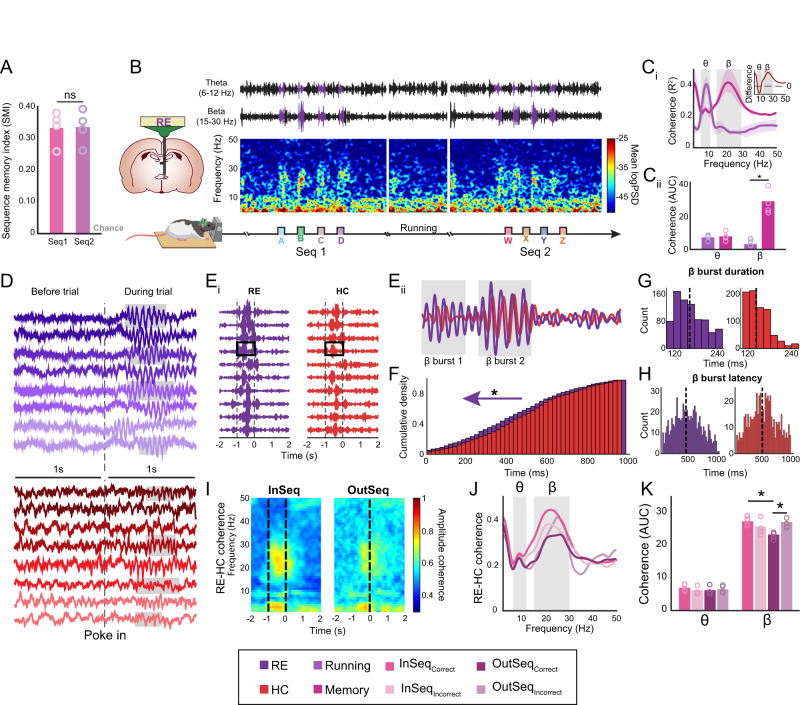
Episodic memory-based decision-making requires top-down medial prefrontal cortex and hippocampal interactions. This integrated prefrontal-hippocampal memory state is thought to be organized by synchronized network oscillations and mediated by connectivity with the thalamic nucleus reuniens (RE). Whether and how the RE synchronizes prefrontal-hippocampal networks in memory, however, remains unknown. Here, we recorded local field potentials from the prefrontal-RE-hippocampal network while rats engaged in a nonspatial sequence memory task, thereby isolating memory-related activity from running-related oscillations. We found that synchronous prefrontal-hippocampal beta bursts (15-30 Hz) dominated during memory trials, whereas synchronous theta activity (6-12 Hz) dominated during non-memory-related running. Moreover, RE beta activity appeared first, followed by prefrontal and hippocampal synchronized beta, suggesting that prefrontal-hippocampal beta could be driven by the RE. To test whether the RE is capable of driving prefrontal-hippocampal beta synchrony, we used an optogenetic approach (retroAAV-ChR2). RE activation induced prefrontal-hippocampal beta coherence and reduced theta coherence, matching the observed memory-driven network state in the sequence task. These findings are the first to demonstrate that the RE contributes to memory by driving transient synchronized beta in the prefrontal-hippocampal system, thereby facilitating interactions that underlie memory-based decision-making.
基于情景记忆的决策需要额顶叶内侧前额叶皮层和海马体的相互作用。这种整合的前额叶-海马体记忆状态被认为是由同步的网络振荡组织的,并通过与丘脑 reuniens 核(RE)的连接来介导。然而,RE 是否以及如何在记忆中同步前额叶-海马体网络仍然未知。在这里,我们在大鼠进行非空间序列记忆任务时记录了前额叶-RE-海马体网络的局部场电位,从而将与记忆相关的活动与与跑步相关的振荡分离出来。我们发现,在记忆试验中,同步的前额叶-海马体β爆发(15-30 Hz)占主导地位,而在与记忆无关的跑步期间,同步的θ活动(6-12 Hz)占主导地位。此外,RE 的β活动首先出现,随后是前额叶和海马体的同步β,表明前额叶-海马体的β可能是由 RE 驱动的。为了测试 RE 是否能够驱动前额叶-海马体β同步,我们使用了光遗传学方法(逆行 AAV-ChR2)。RE 的激活诱导了前额叶-海马体的β相干性,并降低了θ相干性,与序列任务中观察到的记忆驱动的网络状态相匹配。这些发现首次表明,RE 通过驱动前额叶-海马体系统中的短暂同步β来促进记忆,从而促进了基于记忆的决策的相互作用。