Zuber Sascha, Bechtiger Laura, Bodelet Julien Stéphane, Golin Marta, Heumann Jens, Kim Jung Hyun, Klee Matthias, Mur Jure, Noll Jennie, Voll Stacey, O'Keefe Patrick, Steinhoff Annekatrin, Zölitz Ulf, Muniz-Terrera Graciela, Shanahan Lilly, Shanahan Michael J, Hofer Scott M
Institute On Aging & Lifelong Health, University of Victoria, Victoria, BC Canada.
Center for the Interdisciplinary Study of Gerontology and Vulnerability, University of Geneva, Geneva, Switzerland.
Discov Soc Sci Health. 2023;3(1):14. doi: 10.1007/s44155-023-00044-2. Epub 2023 Jul 17.
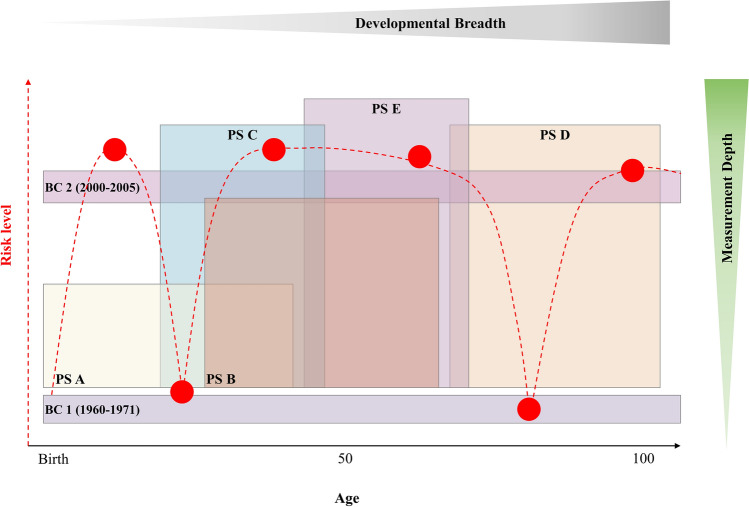
Life course epidemiology seeks to understand the intricate relationships between risk factors and health outcomes across different stages of life to inform prevention and intervention strategies to optimize health throughout the lifespan. However, extant evidence has predominantly been based on separate analyses of data from individual birth cohorts or panel studies, which may not be sufficient to unravel the complex interplay of risk and health across different contexts. We highlight the importance of a multi-study perspective that enables researchers to: (a) Compare and contrast findings from different contexts and populations, which can help identify generalizable patterns and context-specific factors; (b) Examine the robustness of associations and the potential for effect modification by factors such as age, sex, and socioeconomic status; and (c) Improve statistical power and precision by pooling data from multiple studies, thereby allowing for the investigation of rare exposures and outcomes. This integrative framework combines the advantages of multi-study data with a life course perspective to guide research in understanding life course risk and resilience on adult health outcomes by: (a) Encouraging the use of harmonized measures across studies to facilitate comparisons and synthesis of findings; (b) Promoting the adoption of advanced analytical techniques that can accommodate the complexities of multi-study, longitudinal data; and (c) Fostering collaboration between researchers, data repositories, and funding agencies to support the integration of longitudinal data from diverse sources. An integrative approach can help inform the development of individualized risk scores and personalized interventions to promote health and well-being at various life stages.
生命历程流行病学旨在了解生命不同阶段风险因素与健康结果之间的复杂关系,为预防和干预策略提供依据,以在整个生命周期内优化健康。然而,现有证据主要基于对单个出生队列或面板研究数据的单独分析,这可能不足以揭示不同背景下风险与健康之间的复杂相互作用。我们强调多研究视角的重要性,它能使研究人员:(a) 比较和对比不同背景和人群的研究结果,这有助于识别可推广的模式和特定背景因素;(b) 检验关联的稳健性以及年龄、性别和社会经济地位等因素对效应的修饰作用;(c) 通过合并多个研究的数据提高统计功效和精度,从而能够研究罕见的暴露因素和结果。这个综合框架将多研究数据的优势与生命历程视角相结合,通过以下方式指导关于理解生命历程风险和恢复力对成人健康结果影响的研究:(a) 鼓励在各项研究中使用统一的测量方法,以促进研究结果的比较和综合;(b) 推动采用能够适应多研究纵向数据复杂性的先进分析技术;(c) 促进研究人员、数据存储库和资助机构之间的合作,以支持整合来自不同来源的纵向数据。综合方法有助于为制定个性化风险评分和个性化干预措施提供信息,以促进不同生命阶段的健康和福祉。