Wang Jiaqi, Tian Yu, Zhou Tianshu, Tong Danyang, Ma Jing, Li Jingsong
Research Center for Healthcare Data Science, Zhejiang Laboratory, Hangzhou 311121, Zhejiang Province, China.
Engineering Research Center of EMR and Intelligent Expert System, Ministry of Education, Key Laboratory for Biomedical Engineering of Ministry of Education, College of Biomedical Engineering and Instrument Science, Zhejiang University, Hangzhou 310027, Zhejiang Province, China.
Rheumatol Immunol Res. 2023 Jul 22;4(2):69-77. doi: 10.2478/rir-2023-0011. eCollection 2023 Jun.
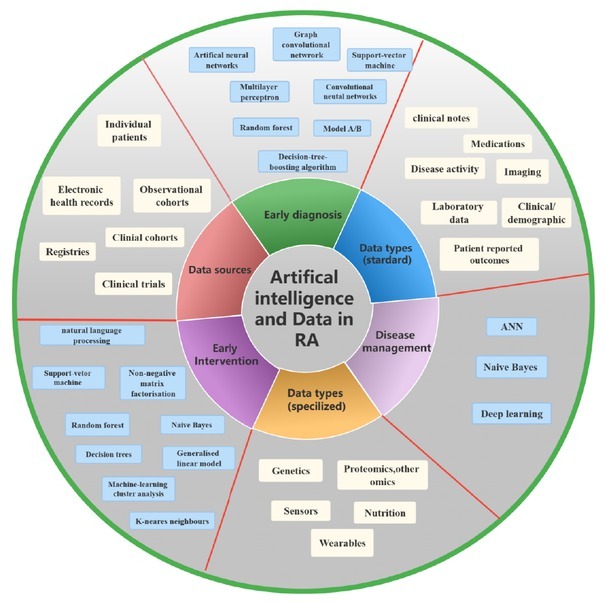
The article offers a survey of currently notable artificial intelligence methods (released between 2019-2023), with a particular emphasis on the latest advancements in detecting rheumatoid arthritis (RA) at an early stage, providing early treatment, and managing the disease. We discussed challenges in these areas followed by specific artificial intelligence (AI) techniques and summarized advances, relevant strengths, and obstacles. Overall, the application of AI in the fields of RA has the potential to enable healthcare professionals to detect RA at an earlier stage, thereby facilitating timely intervention and better disease management. However, more research is required to confirm the precision and dependability of AI in RA, and several problems such as technological and ethical concerns related to these approaches must be resolved before their widespread adoption.
本文对当前(2019年至2023年间发布)值得关注的人工智能方法进行了综述,特别强调了在类风湿性关节炎(RA)早期检测、早期治疗及疾病管理方面的最新进展。我们讨论了这些领域中的挑战,随后介绍了具体的人工智能(AI)技术,并总结了进展、相关优势及障碍。总体而言,AI在RA领域的应用有可能使医疗保健专业人员在更早阶段检测到RA,从而促进及时干预和更好的疾病管理。然而,需要更多研究来证实AI在RA中的准确性和可靠性,并且在这些方法广泛应用之前,必须解决与这些方法相关的技术和伦理等若干问题。