Health Economics and Outcomes Research, Pfizer Inc, New York, NY, USA.
CVS Health, Woonsocket, RI, USA.
J Patient Rep Outcomes. 2023 Jul 24;7(1):77. doi: 10.1186/s41687-023-00616-5.
Longitudinal estimates of long COVID burden during Omicron remain limited. This study characterized long-term impacts of COVID-19 and booster vaccination on symptoms, Health-Related Quality of Life (HRQoL), and Work Productivity Activity Impairment (WPAI).
Outpatients with ≥ 1 self-reported symptom and positive SARS-CoV-2 test at CVS Health United States test sites were recruited between 01/31 and 04/30/2022. Symptoms, EQ-5D and WPAI were collected via online surveys until 6 months following infection. Both observed and model-based estimates were analyzed. Effect sizes based on Cohen's d quantified the magnitude of outcome changes over time, within and between vaccination groups. Mixed models for repeated measures were conducted for multivariable analyses, adjusting for covariates. Logistic regression assessed odds ratio (OR) of long COVID between vaccination groups.
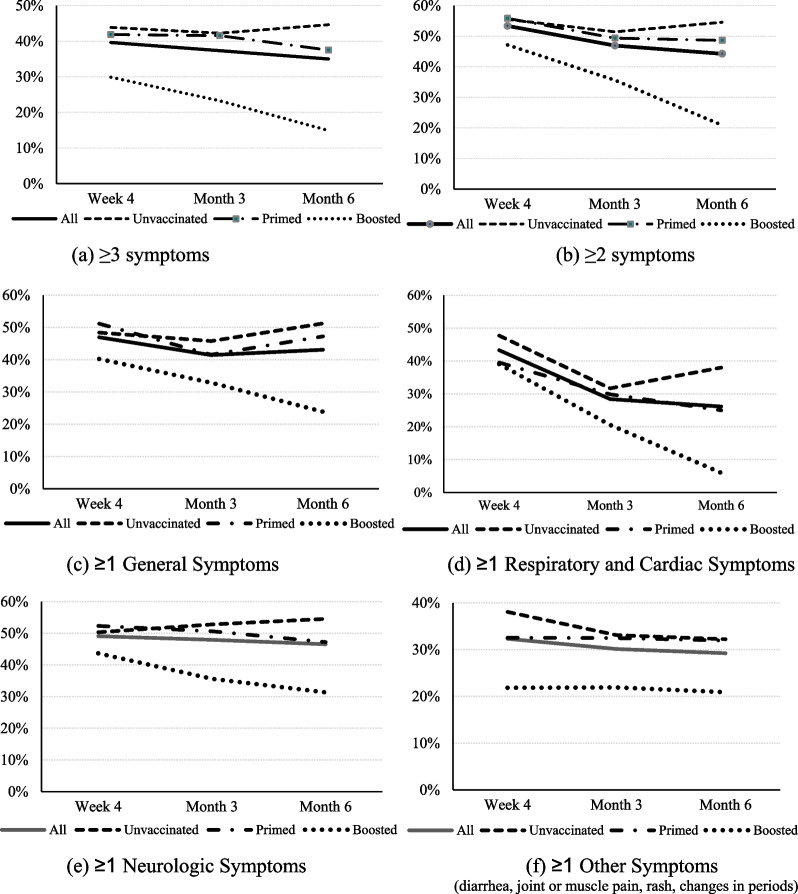
At long COVID start (Week 4), 328 participants included 87 (27%) Boosted with BNT162b2, 86 (26%) with a BNT162b2 primary series (Primed), and 155 (47%) Unvaccinated. Mean age was 42.0 years, 73.8% were female, 26.5% had ≥ 1 comorbidity, 36.9% prior infection, and 39.6% reported ≥ 3 symptoms (mean: 3.1 symptoms). At Month 6, among 260 participants, Boosted reported a mean of 1.1 symptoms versus 3.4 and 2.8 in Unvaccinated and Primed, respectively (p < 0.001). Boosted had reduced risks of ≥ 3 symptoms versus Unvaccinated (observed: OR 0.22, 95% CI 0.10-0.47, p < 0.001; model-based: OR 0.36, 95% CI 0.15-0.87, p = 0.019) and Primed (observed: OR 0.29, 95% CI 0.13-0.67, p = 0.003; model-based: OR 0.59, 95% CI 0.21-1.65, p = 0.459). Results were consistent using ≥ 2 symptoms. Regarding HRQoL, among those with long COVID, Boosted had higher EQ-5D Utility Index (UI) than Unvaccinated (observed: 0.922 vs. 0.731, p = 0.014; model-based: 0.910 vs. 0.758, p-value = 0.038) and Primed (0.922 vs. 0.648, p = 0.014; model-based: 0.910 vs. 0.708, p-value = 0.008). Observed and model-based estimates for EQ-VAS and UI among Boosted were comparable with pre-COVID since Month 3. Subjects vaccinated generally reported better WPAI scores.
Long COVID negatively impacted HRQoL and WPAI. The BNT162b2 booster could have a beneficial effect in reducing the risk and burden of long COVID. Boosted participants reported fewer and less durable symptoms, which contributed to improve HRQoL and maintain WPAI levels. Limitations included self-reported data and small sample size for WPAI.
Omicron 期间长新冠负担的纵向估计仍然有限。本研究旨在描述 COVID-19 和加强针接种对症状、健康相关生活质量(HRQoL)和工作生产力活动障碍(WPAI)的长期影响。
在 CVS Health 美国检测点,招募了≥1 例自我报告症状和 SARS-CoV-2 检测阳性的门诊患者。在感染后 6 个月内,通过在线调查收集症状、EQ-5D 和 WPAI。观察和基于模型的估计都进行了分析。基于 Cohen's d 的效应量量化了随着时间的变化,在接种组内和接种组之间的结果变化的幅度。对于多变量分析,采用重复测量混合模型进行调整。逻辑回归评估了接种组之间长新冠的比值比(OR)。
在长新冠开始时(第 4 周),328 名参与者包括 87 名(27%)接种了 BNT162b2 的加强针、86 名(26%)接种了 BNT162b2 的基础针(Primed)和 155 名(47%)未接种。平均年龄为 42.0 岁,73.8%为女性,26.5%有≥1 种合并症,36.9%有既往感染,39.6%报告≥3 种症状(平均 3.1 种症状)。在第 6 个月,在 260 名参与者中,加强针组报告的平均症状数为 1.1 种,而未接种和 Primed 组分别为 3.4 种和 2.8 种(p<0.001)。与未接种组相比,加强针组有更低的发生≥3 种症状的风险(观察性:OR 0.22,95%CI 0.10-0.47,p<0.001;基于模型的:OR 0.36,95%CI 0.15-0.87,p=0.019)和 Primed 组(观察性:OR 0.29,95%CI 0.13-0.67,p=0.003;基于模型的:OR 0.59,95%CI 0.21-1.65,p=0.459)。使用≥2 种症状时结果一致。关于 HRQoL,在有长新冠的患者中,加强针组的 EQ-5D 效用指数(UI)高于未接种组(观察性:0.922 比 0.731,p=0.014;基于模型的:0.910 比 0.758,p 值=0.038)和 Primed 组(观察性:0.922 比 0.648,p=0.014;基于模型的:0.910 比 0.708,p 值=0.008)。在第 3 个月后,观察性和基于模型的估计的 EQ-VAS 和 UI 中,加强针组的数值与 COVID-19 前相似。接种疫苗的患者一般报告更好的 WPAI 分数。
长新冠对 HRQoL 和 WPAI 产生负面影响。BNT162b2 加强针可能在降低长新冠的风险和负担方面具有有益的效果。加强针组报告的症状较少且持续时间较短,这有助于提高 HRQoL 和维持 WPAI 水平。局限性包括自我报告的数据和 WPAI 的样本量小。