Centre for Research on Diabetes Metabolism, and Nutrition of Third Faculty of Medicine, Charles University, Prague, Czech Republic.
Department of Internal Medicine, University Hospital Královské Vinohrady and Third Faculty of Medicine, Charles University, Prague, Czech Republic.
Eur J Clin Nutr. 2023 Nov;77(11):1061-1070. doi: 10.1038/s41430-023-01312-9. Epub 2023 Jul 24.
The intake and homeostasis of iodine, an essential micronutrient that plays a vital role in thyroid physiology, is of particular concern with the increasing popularity of vegetarian (VG) and vegan (VN) diets. Children on these restrictive diets may be at risk of possible adverse effects on growth and development, but there is currently a lack of recent epidemiological studies on this topic.
We gathered clinical, anthropometric, and blood/urine data on iodine status and thyroid function from children aged 0-18 years who followed either a VG diet (n = 91), VN diet (n = 75), or omnivore diet (OM, n = 52). Cross-sectional comparison of the groups and linear regression was used. Stratified analyses were performed based on age (according to WHO): 0-5 years and 6-18 years.
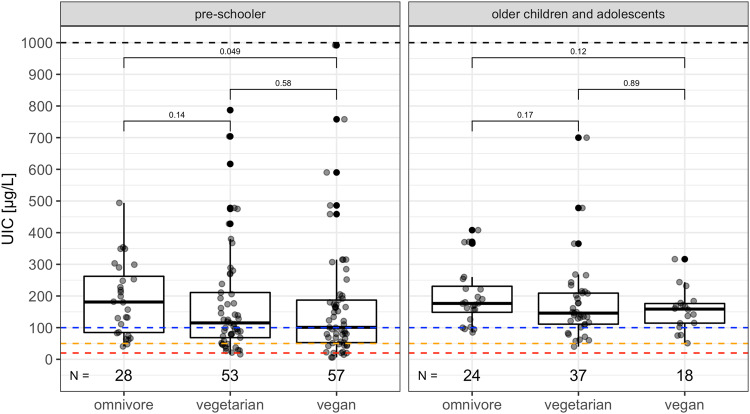
Our study revealed no significant differences in levels of thyroid-stimulating hormone (TSH), triiodothyronine (fT3), thyroglobulin (TG) or anti-thyroid peroxidase antibody (ATPOc) between the VG, VN, and OM groups. However, thyroxine (fT4) levels were found to be higher in the VN group compared to the OM group (15.00 ± 1.73 vs. 16.17 ± 1.82 pmol/l, p < 0.001). The presence of anti-thyroglobulin antibodies (AhTGc) was notably more common in the VG (18.2%)/VN (35.0%) groups than in the OM group (2.1%) (p < 0.001). Regarding iodine status, the concentration of iodine in spot urine (UIC) was found to be highest in the OM group (197.28 ± 105.35 vs. VG: 177.95 ± 155.88 vs. VN: 162.97 ± 164.51 µg/l, p < 0.001). Notably, the lowest (5.99 µg/l) and highest (991.80 µg/l) levels were measured in the VN group. Of the participants, 31 VN, 31 VG and 10 OM children met the criteria for iodine deficiency (i.e., UIC < 100 µg/l). We found that children with regular iodine supplementation had higher UIC (p < 0.001). Importantly, the median UIC was above 100 µg/l in all three groups, through the recommended intake (RDI) of iodine was rarely met throughout the groups.
We have observed a trend to lower UIC values in VN as compared to OM. This trend is also reflected in the median UIC values, even though the median UIC values were above the WHO cut-off (e.g., 100 µg/l) for iodine deficiency in all dietary groups. These results suggest that VN and VG children may be more at higher risk of iodine deficiency, this theory is also supported by higher prevalence of AhTGc positivity. Further research is needed to investigate the long-term impact of these dietary patterns on iodine status and thyroid function in children. Given our findings, it may also be necessary to consider new guidelines for supplementing children following VG and VN diets to ensure their iodine needs are met.
碘是一种必需的微量元素,对甲状腺生理功能至关重要,其摄入量和体内平衡尤其受到关注。随着素食(VG)和纯素(VN)饮食的日益普及,儿童可能有摄入碘不足的风险,从而可能对其生长发育产生不良影响,但目前关于这一主题的流行病学研究很少。
我们收集了 0-18 岁儿童的临床、人体测量学和碘状态及甲状腺功能的血/尿数据,他们遵循 VG 饮食(n=91)、VN 饮食(n=75)或杂食(OM)饮食(n=52)。采用横断面比较各组和线性回归的方法。根据世界卫生组织(WHO)的年龄(0-5 岁和 6-18 岁)进行分层分析。
我们的研究结果显示,TSH、三碘甲状腺原氨酸(fT3)、甲状腺球蛋白(TG)或抗甲状腺过氧化物酶抗体(ATPOc)在 VG、VN 和 OM 组之间无显著差异。然而,与 OM 组相比,VN 组的 fT4 水平更高(15.00±1.73 vs. 16.17±1.82 pmol/l,p<0.001)。VG(18.2%)/VN(35.0%)组抗甲状腺球蛋白抗体(AhTGc)的阳性率明显高于 OM 组(2.1%)(p<0.001)。在碘状态方面,点尿碘浓度(UIC)在 OM 组最高(197.28±105.35 vs. VG:177.95±155.88 vs. VN:162.97±164.51µg/l,p<0.001)。值得注意的是,VN 组的 UIC 最低(5.99µg/l),最高(991.80µg/l)。在所有参与者中,31 名 VN、31 名 VG 和 10 名 OM 儿童符合碘缺乏的标准(即 UIC<100µg/l)。我们发现,定期补充碘的儿童 UIC 更高(p<0.001)。重要的是,尽管各组很少达到碘的推荐摄入量(RDI),但在所有三组中,UIC 的中位数均在 100µg/l 以上。
与 OM 相比,我们观察到 VN 组 UIC 值呈下降趋势。这种趋势也反映在 UIC 的中位数上,即使在所有饮食组中,UIC 的中位数都高于 WHO 碘缺乏的截止值(如 100µg/l)。这些结果表明,VN 和 VG 儿童可能面临更高的碘缺乏风险,这种理论也得到了 AhTGc 阳性率更高的支持。需要进一步研究来调查这些饮食模式对儿童碘状态和甲状腺功能的长期影响。鉴于我们的研究结果,可能有必要为遵循 VG 和 VN 饮食的儿童制定新的补充指南,以确保满足他们的碘需求。