Department of Infectious Disease Epidemiology and Prevention, Statens Serum Institut, Copenhagen S, Denmark.
TestCentre Denmark, Statens Serum Institut, Copenhagen S, Denmark.
PLoS One. 2023 Jul 25;18(7):e0281972. doi: 10.1371/journal.pone.0281972. eCollection 2023.
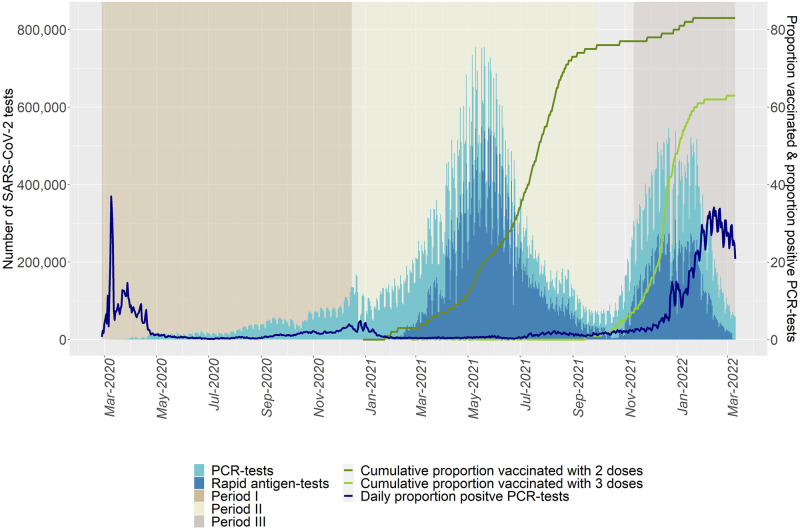
The Danish national SARS-CoV-2 mass test system was among the most ambitious worldwide. We describe its set-up and analyse differences in patterns of testing per demography and time period in relation to the three waves of SARS-CoV-2 transmission in Denmark.
We included all reported PCR- and rapid antigen-tests performed between 27 February 2020 and 10 March 2022 among all residents aged 2 years or above. Descriptive statistics and Poisson regression models were used to analyse characteristics of individuals tested for SARS-CoV-2 using a national cohort study design.
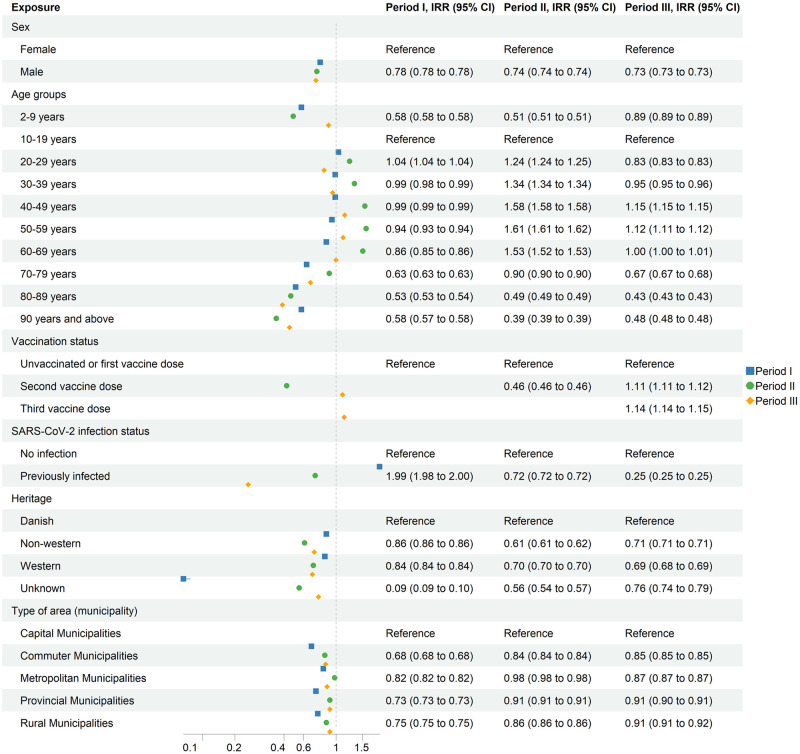
A total of 63.7 million PCR-tests and 60.0 million rapid antigen-tests were performed in the study period, testing 90.9% and 78.8% of the Danish population at least once by PCR or antigen, respectively. Female sex, younger age, Danish heritage and living in the capital area were all factors positively associated with the frequency of PCR-testing. The association between COVID-19 vaccination and PCR-testing changed from negative to positive over time.
We provide details of the widely available, free-of-charge, national SARS-CoV-2 test system, which served to identify infected individuals, assist isolation of infectious individuals and contact tracing, and thereby mitigating the spread of SARS-CoV-2 in the Danish population. The test system was utilized by nearly the entire population at least once, and widely accepted across different demographic groups. However, demographic differences in the test uptake did exist and should be considered in order not to cause biases in studies related to SARS-CoV-2, e.g., studies of transmission and vaccine effectiveness.
丹麦全国性 SARS-CoV-2 大规模检测系统是全球最具雄心的系统之一。我们描述了它的建立,并分析了在与丹麦 SARS-CoV-2 三次传播波相关的时间内,按人口统计学特征和时间划分的检测模式差异。
我们纳入了 2020 年 2 月 27 日至 2022 年 3 月 10 日期间所有 2 岁及以上居民报告的所有 PCR 和快速抗原检测。使用全国队列研究设计,对 SARS-CoV-2 检测个体的特征进行描述性统计和泊松回归模型分析。
在研究期间,共进行了 6370 万次 PCR 检测和 6000 万次快速抗原检测,分别有 90.9%和 78.8%的丹麦人口至少接受过一次 PCR 或抗原检测。女性、年龄较小、丹麦血统和居住在首都地区均与 PCR 检测频率呈正相关。COVID-19 疫苗接种与 PCR 检测之间的相关性随着时间的推移从负相关变为正相关。
我们提供了广泛可用、免费的全国性 SARS-CoV-2 检测系统的详细信息,该系统用于识别感染个体,协助隔离传染性个体和接触者追踪,从而减轻 SARS-CoV-2 在丹麦人群中的传播。该检测系统几乎被所有人群至少使用过一次,并且在不同的人口统计学群体中得到广泛接受。然而,检测利用率确实存在人口统计学差异,在研究 SARS-CoV-2 相关问题时应考虑这些差异,例如传播和疫苗效力研究。