Spiering Barry A, Weakley Jonathon, Mujika Iñigo
Sports Research Laboratory, New Balance Athletics, Inc., Boston, MA, USA.
School of Behavioural and Health Sciences, Australian Catholic University, McAuley at Banyo, Brisbane, QLD, Australia.
Sports Med. 2023 Nov;53(11):2135-2146. doi: 10.1007/s40279-023-01889-y. Epub 2023 Jul 26.
Athletes can face scenarios in which they are confined to bed rest (e.g., due to injury or illness). Existing research in otherwise healthy individuals indicates that those entering bed rest with the greatest physical performance level might experience the greatest performance decrements, which indirectly suggests that athletes might be more susceptible to the detrimental consequences of bed rest than general populations. Therefore, a comprehensive understanding of the effects of bed rest might help guide the medical care of athletes during and following bed rest.
This systematic and narrative review aimed to (1) establish the evidence for the effects of bed rest on physical performance in athletes; (2) discuss potential countermeasures to offset these negative consequences; and (3) identify the time-course of recovery following bed rest to guide return-to-sport rehabilitation.
This review was performed using the Preferred Reporting Items for Systematic Reviews and Meta-Analyses (PRISMA) guidelines. Four databases were searched (SPORTDiscus, Web of Science, Scopus, and MEDLINE/PubMed) in October of 2022, and studies were included if they were peer-reviewed investigations, written in English, and investigated the effects of horizontal bed rest on changes in physical capacities and qualities in athletes (defined as Tier 3-5 participants). The reporting quality of the research was assessed using a modified version of the Downs & Black checklist. Furthermore, findings from studies that involved participants in Tiers 1-2 were presented and synthesized using a narrative approach.
Our systematic review of the literature using a rigorous criterion of 'athletes' revealed zero scientific publications. Nevertheless, as a by-product of our search, seven studies were identified that involved apparently healthy individuals who performed specific exercise training prior to bed rest.
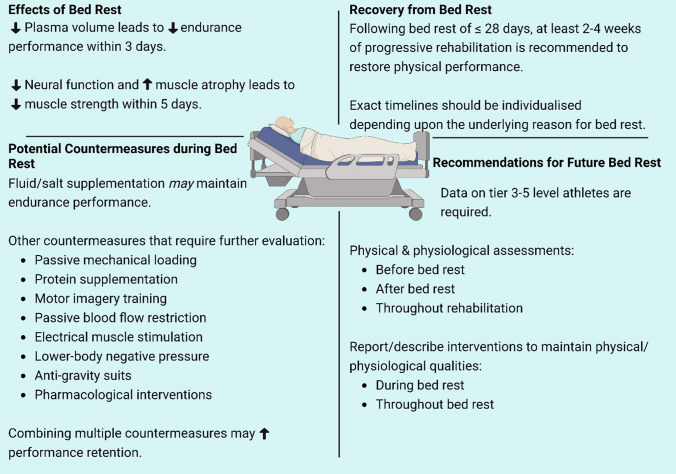
Based on the limited evidence from studies involving non-athletes who were otherwise healthy prior to bed rest, we generally conclude that (1) bed rest rapidly (within 3 days) decreases upright endurance exercise performance, likely due to a rapid loss in plasma volume; whereas strength is reduced within 5 days, likely due to neural factors as well as muscle atrophy; (2) fluid/salt supplementation may be an effective countermeasure to protect against decrements in endurance performance during bed rest; while a broader array of potentially effective countermeasures exists, the efficacy of these countermeasures for previously exercise-trained individuals requires further study; and (3) athletes likely require at least 2-4 weeks of progressive rehabilitation following bed rest of ≤ 28 days, although the timeline of recovery might need to be extended depending on the underlying reason for bed rest (e.g., injury or illness). Despite these general conclusions from studies involving non-athletes, our primary conclusion is that substantial effort and research is still required to quantify the effects of bed rest on physical performance, identify effective countermeasures, and provide return-to-sport timelines in bona fide athletes.
Registration ID: osf.io/d3aew; Date: October 24, 2022.

运动员可能会面临须卧床休息的情况(例如,因受伤或患病)。针对其他方面健康的个体开展的现有研究表明,那些卧床休息前身体机能水平最高的人,其机能下降幅度可能最大,这间接表明运动员可能比一般人群更容易受到卧床休息的不利影响。因此,全面了解卧床休息的影响可能有助于指导运动员在卧床休息期间及之后的医疗护理。
本系统综述和叙述性综述旨在(1)确定卧床休息对运动员身体机能影响的证据;(2)讨论抵消这些负面影响的潜在对策;(3)确定卧床休息后的恢复时间进程,以指导重返运动的康复训练。
本综述按照系统评价和Meta分析的首选报告项目(PRISMA)指南进行。2022年10月检索了四个数据库(体育大全数据库、科学网、Scopus和MEDLINE/ PubMed),纳入的研究须为同行评审的调查研究、英文撰写,并调查了水平卧床休息对运动员身体能力和素质变化的影响(将运动员定义为3-5级参与者)。使用唐斯&布莱克清单的修改版评估研究的报告质量。此外,采用叙述性方法呈现并综合了涉及1-2级参与者的研究结果。
我们对文献进行的以“运动员”为严格标准的系统综述未发现任何科学出版物。然而,作为检索的一个附带结果,我们确定了七项研究,这些研究涉及在卧床休息前进行过特定运动训练的明显健康的个体。
基于涉及卧床休息前其他方面健康的非运动员的研究的有限证据,我们总体得出以下结论:(1)卧床休息会迅速(在3天内)降低直立耐力运动表现,这可能是由于血浆量迅速减少;而力量在5天内会下降,这可能是由于神经因素以及肌肉萎缩;(2)补充液体/盐分可能是一种有效的对策,可防止卧床休息期间耐力表现下降;虽然存在一系列可能有效的对策,但这些对策对先前接受过运动训练的个体的效果需要进一步研究;(3)卧床休息≤28天的运动员在卧床休息后可能需要至少2-4周的渐进性康复训练,不过恢复时间可能需要根据卧床休息的根本原因(例如,受伤或患病)延长。尽管这些是来自涉及非运动员的研究的一般结论,但我们的主要结论是,仍需要付出大量努力并开展研究,以量化卧床休息对身体机能的影响、确定有效的对策,并为真正的运动员提供重返运动的时间安排。
注册号:osf.io/d3aew;日期:2022年10月24日。