State Key Laboratory of Digital Medical Engineering, School of Biological Science and Medical Engineering, Southeast University, Nanjing 210096, China.
OPLI (Suzhou) Biotechnology Co., Ltd., New District, Suzhou 215163, China.
Biosensors (Basel). 2023 Jul 13;13(7):730. doi: 10.3390/bios13070730.
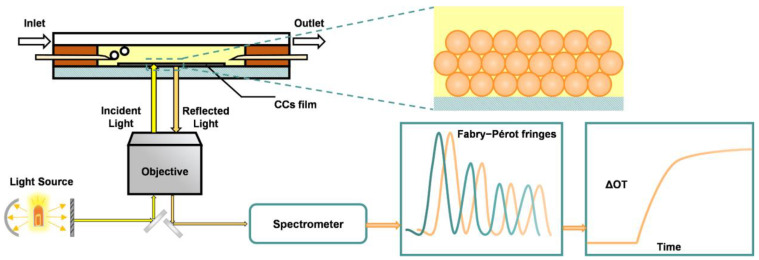
Interferometry-based, reflectometric, label-free biosensors have made significant progress in the analysis of molecular interactions after years of development. The design of interference substrates is a key research topic for these biosensors, and many studies have focused on porous films prepared by top-down methods such as porous silicon and anodic aluminum oxide. Lately, more research has been conducted on ordered porous layer interferometry (OPLI), which uses ordered porous colloidal crystal films as interference substrates. These films are made using self-assembly techniques, which is the bottom-up approach. They also offer several advantages for biosensing applications, such as budget cost, adjustable porosity, and high structural consistency. This review will briefly explain the fundamental components of self-assembled materials and thoroughly discuss various self-assembly techniques in depth. We will also summarize the latest studies that used the OPLI technique for label-free biosensing applications and divide them into several aspects for further discussion. Then, we will comprehensively evaluate the strengths and weaknesses of self-assembly techniques and discuss possible future research directions. Finally, we will outlook the upcoming challenges and opportunities for label-free biosensing using the OPLI technique.
基于干涉测量法的反射式无标记生物传感器经过多年的发展,在分析分子相互作用方面取得了重大进展。干涉基底的设计是这些生物传感器的一个关键研究课题,许多研究都集中在多孔硅和阳极氧化铝等自上而下方法制备的多孔膜上。最近,更多的研究集中在有序多孔层干涉(OPLI)上,它使用有序多孔胶体晶体膜作为干涉基底。这些薄膜是使用自组装技术制备的,属于自下而上的方法。它们还为生物传感应用带来了几个优势,例如预算成本低、可调节的孔隙率和高结构一致性。本综述将简要解释自组装材料的基本组成部分,并深入彻底地讨论各种自组装技术。我们还将总结最新使用 OPLI 技术进行无标记生物传感应用的研究,并将其分为几个方面进行进一步讨论。然后,我们将全面评估自组装技术的优缺点,并讨论可能的未来研究方向。最后,我们将展望使用 OPLI 技术进行无标记生物传感的即将到来的挑战和机遇。