Eckstein Jan, Moghadasi Negin, Körperich Hermann, Akkuzu Rehsan, Sciacca Vanessa, Sohns Christian, Sommer Philipp, Berg Julian, Paluszkiewicz Jerzy, Burchert Wolfgang, Piran Misagh
Institute for Radiology, Nuclear Medicine and Molecular Imaging, Heart and Diabetes Center North Rhine Westphalia, Bad Oeynhausen, University of Bochum, 32545 Bochum, Germany.
Department of Engineering Systems & Environment, University of Virginia, Charlottesville, VA 22904, USA.
Diagnostics (Basel). 2023 Jul 20;13(14):2426. doi: 10.3390/diagnostics13142426.
Hindered by its unspecific clinical and phenotypical presentation, cardiac sarcoidosis (CS) remains a challenging diagnosis.
Utilizing cardiac magnetic resonance imaging (CMR), we acquired multi-chamber volumetrics and strain feature tracking for a support vector machine learning (SVM)-based diagnostic approach to CS.
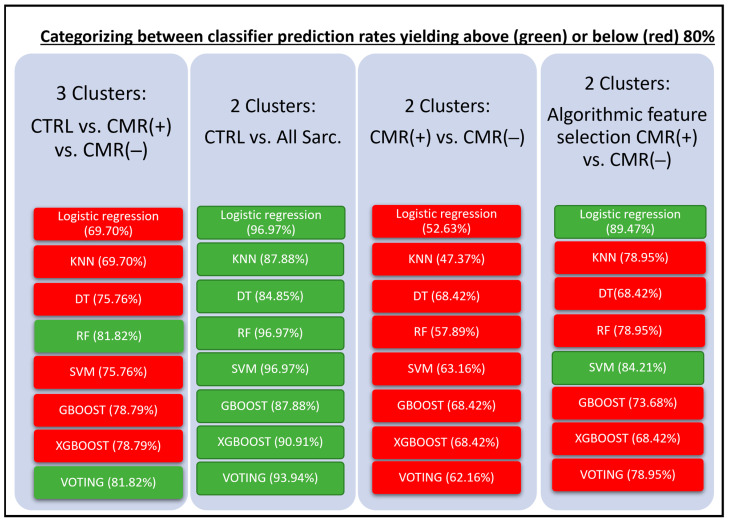
Forty-five CMR-negative (CMR(-), 56.5(53.0;63.0)years), eighteen CMR-positive (CMR(+), 64.0(57.8;67.0)years) sarcoidosis patients and forty-four controls (CTRL, 56.5(53.0;63.0)years)) underwent CMR examination. Cardiac parameters were processed using the classifiers of logistic regression, KNN(K-nearest-neighbor), DT (decision tree), RF (random forest), SVM, GBoost, XGBoost, Voting and feature selection.
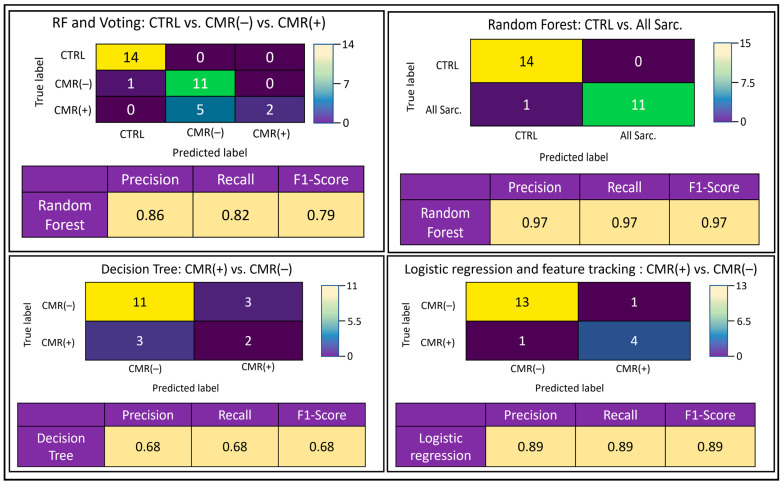
In a three-cluster analysis of CTRL versus vs. CMR(+) vs. CMR(-), RF and Voting classifier yielded the highest prediction rates (81.82%). The two-cluster analysis of CTRL vs. all sarcoidosis (All Sarc.) yielded high prediction rates with the classifiers logistic regression, RF and SVM (96.97%), and low prediction rates for the analysis of CMR(+) vs. CMR(-), which were augmented using feature selection with logistic regression (89.47%).
Multi-chamber cardiac function and strain-based supervised machine learning provides a non-contrast approach to accurately differentiate between healthy individuals and sarcoidosis patients. Feature selection overcomes the algorithmically challenging discrimination between CMR(+) and CMR(-) patients, yielding high accuracy predictions. The study findings imply higher prevalence of cardiac involvement than previously anticipated, which may impact clinical disease management.
由于心脏结节病(CS)临床表现和表型缺乏特异性,其诊断仍然具有挑战性。
利用心脏磁共振成像(CMR),我们获取了多腔室容积和应变特征跟踪数据,用于基于支持向量机学习(SVM)的CS诊断方法。
45例CMR阴性(CMR(-),年龄56.5(53.0;63.0)岁)、18例CMR阳性(CMR(+),年龄64.0(57.8;67.0)岁)的结节病患者和44例对照(CTRL,年龄56.5(53.0;63.0)岁)接受了CMR检查。使用逻辑回归、K近邻(KNN)、决策树(DT)、随机森林(RF)、支持向量机(SVM)、梯度提升(GBoost)、极端梯度提升(XGBoost)、投票和特征选择等分类器处理心脏参数。
在对照组与CMR(+)组与CMR(-)组的三聚类分析中,随机森林(RF)和投票分类器的预测率最高(81.82%)。对照组与所有结节病(所有结节病)的二聚类分析中,逻辑回归、随机森林(RF)和支持向量机(SVM)分类器的预测率较高(96.97%),而CMR(+)组与CMR(-)组分析的预测率较低,通过逻辑回归特征选择可提高预测率(89.47%)。
基于多腔室心脏功能和应变的监督机器学习提供了一种非对比方法,可准确区分健康个体和结节病患者。特征选择克服了CMR(+)和CMR(-)患者之间算法上具有挑战性的区分,产生了高精度预测。研究结果表明心脏受累的患病率高于先前预期,这可能会影响临床疾病管理。