Institute of Clinical Medicine, University of Tartu, L. Puusepa 8, 50406 Tartu, Estonia.
Internal Medicine Clinic, Tartu University Hospital, L. Puusepa 8, 50406 Tartu, Estonia.
Medicina (Kaunas). 2023 Jul 18;59(7):1324. doi: 10.3390/medicina59071324.
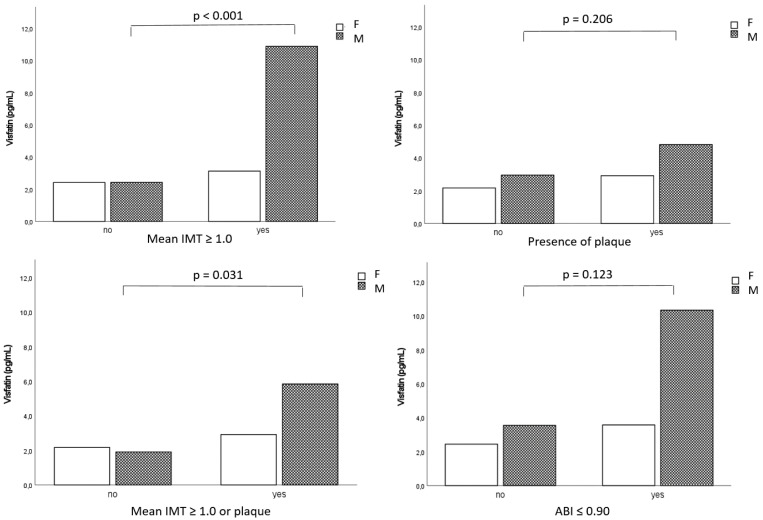
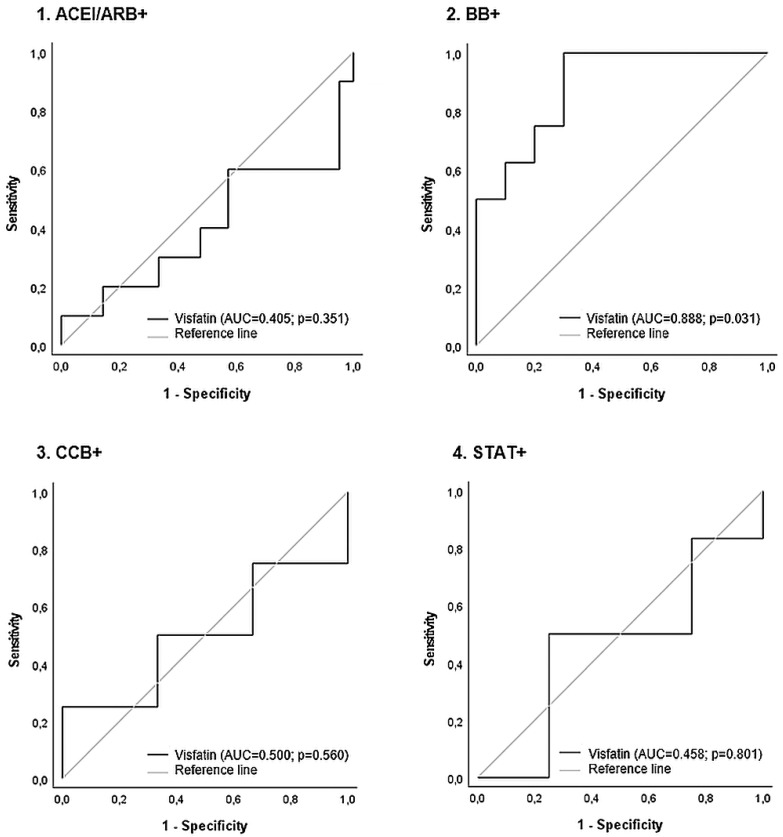
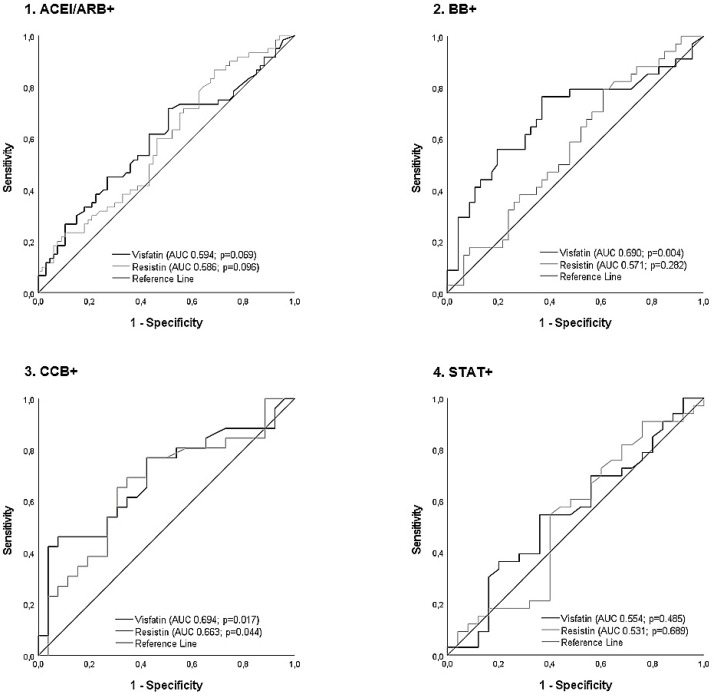
: The role of adipokines in the development of atherosclerosis in type 2 diabetes (T2DM) has not yet been fully elucidated. The effects of drugs on adipokine concentrations have only been evaluated in very few studies, although they may be of clinical importance. This study aimed to assess whether the concentrations of circulating adipokines could predict subclinical atherosclerosis in patients with T2DM, as well as their interactions with commonly used cardiovascular drugs. : Our population-based cross-sectional multicentric study included 216 participants with T2DM but without previously diagnosed atherosclerosis. The carotid artery intima-media thickness (IMT), plaque and ankle-brachial index (ABI) metrics were measured. Resistin, visfatin, retinol-binding protein 4, high molecular weight adiponectin and leptin levels were evaluated using Luminex's xMAP technology. : Visfatin and resistin concentrations correlated positively with IMT ( = 0.002 and = 0.009, respectively). The correlation of visfatin to IMT ≥ 1.0 mm was significant in males ( < 0.001). Visfatin had a positive correlation with IMT ≥ 1.0 mm or plaque ( = 0.008) but resistin only correlated with plaque ( = 0.049). Visfatin predicted IMT ≥ 1.0 mm or plaque in patients on β-blocker monotherapy ( = 0.031). Visfatin lost its ability to predict subclinical atherosclerosis in patients taking angiotensin-converting enzyme inhibitors, angiotensin receptor blockers, calcium channel blockers or statins. After adjustments for risk factors for atherosclerosis and cardiovascular drugs, visfatin maintained an independent association with mean IMT ( = 0.003), IMT ≥ 1.0 mm or plaque ( = 0.005) and ABI ≤ 0.9 ( = 0.029). Visfatin could be used as a marker of subclinical atherosclerosis in patients with T2DM, especially in males. The assessment of visfatin concentration could aid in identifying individuals who could benefit from implementing preventive measures against atherosclerosis.
脂联素在 2 型糖尿病(T2DM)患者动脉粥样硬化的发展中的作用尚未完全阐明。尽管这些药物对脂联素浓度的影响仅在极少数研究中进行了评估,但它们可能具有临床重要性。本研究旨在评估循环脂联素浓度是否可以预测 T2DM 患者的亚临床动脉粥样硬化,以及它们与常用心血管药物的相互作用。
我们的基于人群的横断面多中心研究包括 216 名患有 T2DM 但无先前诊断的动脉粥样硬化的患者。测量颈动脉内膜中层厚度(IMT)、斑块和踝臂指数(ABI)。使用 Luminex 的 xMAP 技术评估抵抗素、内脏脂肪素、视黄醇结合蛋白 4、高分子量脂联素和瘦素水平。
内脏脂肪素和抵抗素浓度与 IMT 呈正相关(分别为 0.002 和 0.009)。内脏脂肪素与男性 IMT≥1.0mm 的相关性具有统计学意义(<0.001)。内脏脂肪素与 IMT≥1.0mm 或斑块呈正相关(=0.008),而抵抗素仅与斑块呈正相关(=0.049)。内脏脂肪素可预测β受体阻滞剂单药治疗患者的 IMT≥1.0mm 或斑块(=0.031)。在服用血管紧张素转换酶抑制剂、血管紧张素受体阻滞剂、钙通道阻滞剂或他汀类药物的患者中,内脏脂肪素失去了预测亚临床动脉粥样硬化的能力。在调整动脉粥样硬化和心血管药物的危险因素后,内脏脂肪素与平均 IMT(=0.003)、IMT≥1.0mm 或斑块(=0.005)和 ABI≤0.9(=0.029)仍呈独立相关。
内脏脂肪素可作为 T2DM 患者亚临床动脉粥样硬化的标志物,尤其是男性。评估内脏脂肪素浓度可有助于识别可能受益于实施动脉粥样硬化预防措施的个体。