Castro David Tsuyoshi Hiramatsu, Leite Daniel Ferreira, da Silva Baldivia Debora, Dos Santos Helder Freitas, Balogun Sikiru Olaitan, da Silva Denise Brentan, Carollo Carlos Alexandre, de Picoli Souza Kely, Dos Santos Edson Lucas
Research Group on Biotechnology and Bioprospecting Applied to Metabolism (GEBBAM), Universidade Federal da Grande Dourados, Dourados 79804-970, Brazil.
Programa de Pós-Graduação em Ciências da Saúde, Universidade Federal da Grande Dourados, Dourados 79804-970, Brazil.
Pharmaceuticals (Basel). 2023 Jul 1;16(7):951. doi: 10.3390/ph16070951.
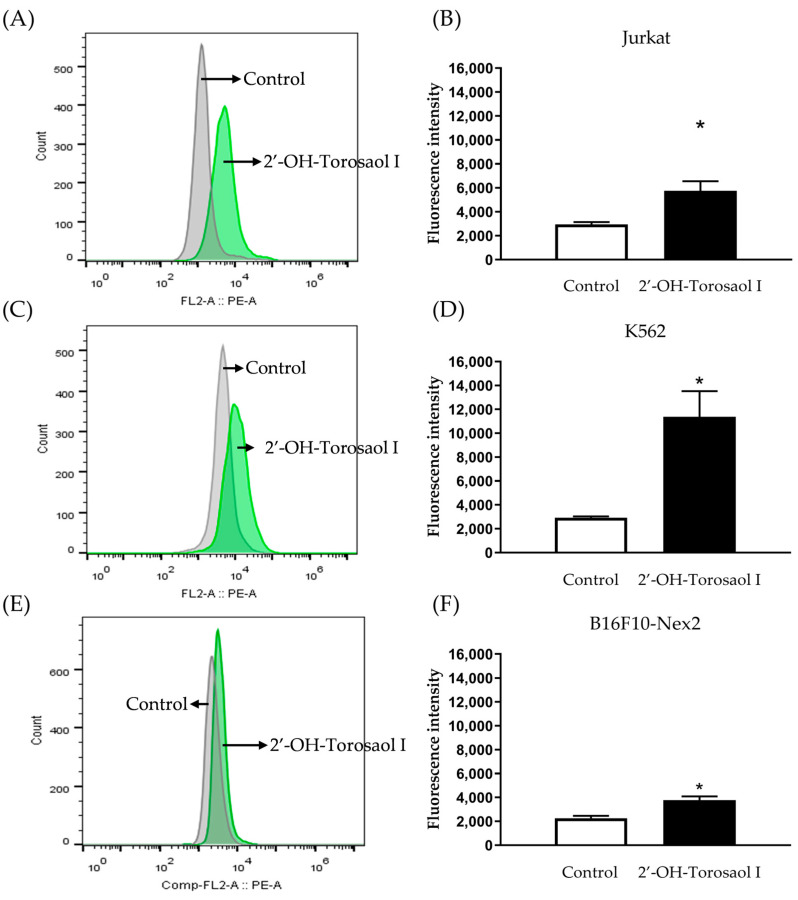
In this study, a novel compound was isolated, identified, and its chemical structure was determined from the extract of the roots of . In addition, we sought to evaluate the anticancer potential of this molecule against melanoma and leukemic cell lines and identify the pathways of cell death involved. To this end, a novel anthraquinone was isolated from the barks of the roots of , analyzed by HPLC-DAD, and its molecular structure was determined by nuclear magnetic resonance (NMR). Subsequently, their cytotoxic activity was evaluated by the (3-(4,5-dimethylthiazol-2-yl)-2,5-diphenyl-2H-tetrazolium bromide (MTT) method against non-cancerous, melanoma, and leukemic cells. The migration of melanoma cells was evaluated by the scratch assay. The apoptosis process, caspase-3 activation, analysis of mitochondrial membrane potential, and measurement of ROS were evaluated by flow cytometry technique. In addition, the pharmacological cell death inhibitors NEC-1, RIP-1, BAPTA, Z-VAD, and Z-DEVD were used to confirm the related cell death mechanisms. With the results, it was possible to elucidate the novel compound characterized as 2'-OH-Torosaol I. In normal cells, the compound showed no cytotoxicity in PBMC but reduced the cell viability of all melanoma and leukemic cell lines evaluated. 2'-OH-Torosaol I inhibited chemotaxis of B16F10-Nex2, SK-Mel-19, SK-Mel-28 and SK-Mel-103. The cytotoxicity of the compound was induced by apoptosis via the intrinsic pathway with reduced mitochondrial membrane potential, increased levels of reactive oxygen species, and activation of caspase-3. In addition, the inhibitors demonstrated the involvement of necroptosis and Ca in the death process and confirmed caspase-dependent apoptosis death as one of the main programmed cell death pathways induced by 2'-OH-Torosaol I. Taken together, the data characterize the novel anthraquinone 2'-OH-Torosaol I, demonstrating its anticancer activity and potential application in cancer therapy.
在本研究中,从……根部提取物中分离、鉴定出一种新型化合物,并确定了其化学结构。此外,我们试图评估该分子对黑色素瘤和白血病细胞系的抗癌潜力,并确定所涉及的细胞死亡途径。为此,从……根部树皮中分离出一种新型蒽醌,通过高效液相色谱-二极管阵列检测法(HPLC-DAD)进行分析,并通过核磁共振(NMR)确定其分子结构。随后,采用(3-(4,5-二甲基噻唑-2-基)-2,5-二苯基-2H-四唑溴盐(MTT)法评估其对非癌细胞、黑色素瘤细胞和白血病细胞的细胞毒性活性。通过划痕试验评估黑色素瘤细胞的迁移情况。采用流式细胞术技术评估凋亡过程、半胱天冬酶-3激活、线粒体膜电位分析和活性氧(ROS)的测量。此外,使用药理学细胞死亡抑制剂NEC-1、RIP-1、BAPTA、Z-VAD和Z-DEVD来确认相关的细胞死亡机制。根据结果,有可能阐明被鉴定为2'-OH-托罗索尔I的新型化合物。在正常细胞中,该化合物在人外周血单个核细胞(PBMC)中未显示细胞毒性,但降低了所有评估的黑色素瘤和白血病细胞系的细胞活力。2'-OH-托罗索尔I抑制了B16F10-Nex2、SK-Mel-19、SK-Mel-28和SK-Mel-103的趋化性。该化合物的细胞毒性是通过内源性途径诱导凋亡,导致线粒体膜电位降低、活性氧水平升高和半胱天冬酶-3激活。此外,抑制剂证明坏死性凋亡和Ca参与了死亡过程,并确认半胱天冬酶依赖性凋亡死亡是2'-OH-托罗索尔I诱导的主要程序性细胞死亡途径之一。综上所述,这些数据表征了新型蒽醌2'-OH-托罗索尔I,证明了其抗癌活性以及在癌症治疗中的潜在应用。