Vorrius Brandon, Qiao Zhen, Ge Jonathan, Chen Qian
Laboratory of Molecular Biology and Nanomedicine, Department of Orthopaedics, Alpert Medical School of Brown University/Rhode Island Hospital, Providence, RI 02903, USA.
Pharmaceuticals (Basel). 2023 Jul 6;16(7):967. doi: 10.3390/ph16070967.
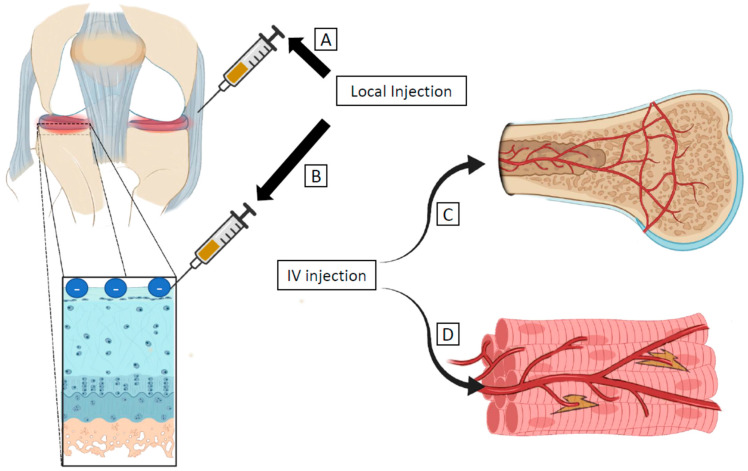
The musculoskeletal system (MSKS) is composed of specialized connective tissues including bone, muscle, cartilage, tendon, ligament, and their subtypes. The primary function of the MSKS is to provide protection, structure, mobility, and mechanical properties to the body. In the process of fulfilling these functions, the MSKS is subject to wear and tear during aging and after injury and requires subsequent repair. MSKS diseases are a growing burden due to the increasing population age. The World Health Organization estimates that 1.71 billon people suffer from MSKS diseases worldwide. MSKS diseases usually involve various dysfunctions in bones, muscles, and joints, which often result in pain, disability, and a decrease in quality of life. The most common MSKS diseases are osteoporosis (loss of bone), osteoarthritis (loss of cartilage), and sarcopenia (loss of skeletal muscle). Because of the disease burden and the need for treatment, regenerative drug therapies for MSKS disorders are increasingly in demand. However, the difficulty of effective drug delivery in the MSKS has become a bottleneck for developing MSKS therapeutics. The abundance of extracellular matrix and its small pore size in the MSKS present a formidable barrier to drug delivery. Differences of vascularity among various MSKS tissues pose complications for drug delivery. Novel strategies are necessary to achieve successful drug delivery in different tissues composing the MSKS. Those considerations include the route of administration, mechanics of surrounding fluids, and biomolecular interactions, such as the size and charge of the particles and targeting motifs. This review focuses on recent advances in challenges to deliver drugs to each tissue of the MSKS, current strategies of drug delivery, and future ideas of how to overcome drug delivery challenges in the MSKS.
肌肉骨骼系统(MSKS)由特殊的结缔组织组成,包括骨骼、肌肉、软骨、肌腱、韧带及其亚型。MSKS的主要功能是为身体提供保护、结构、运动能力和机械性能。在履行这些功能的过程中,MSKS在衰老过程中和受伤后会受到磨损,需要后续修复。由于人口老龄化,MSKS疾病的负担日益加重。世界卫生组织估计,全球有17.1亿人患有MSKS疾病。MSKS疾病通常涉及骨骼、肌肉和关节的各种功能障碍,常导致疼痛、残疾和生活质量下降。最常见的MSKS疾病是骨质疏松症(骨质流失)、骨关节炎(软骨流失)和肌肉减少症(骨骼肌流失)。由于疾病负担和治疗需求,针对MSKS疾病的再生药物疗法的需求日益增加。然而,在MSKS中有效给药的困难已成为开发MSKS治疗方法的瓶颈。MSKS中细胞外基质丰富且孔径小,这对药物递送构成了巨大障碍。不同MSKS组织之间血管分布的差异给药物递送带来了并发症。需要新的策略来在构成MSKS的不同组织中成功实现药物递送。这些考虑因素包括给药途径、周围流体的力学以及生物分子相互作用,如颗粒的大小和电荷以及靶向基序。本综述重点关注向MSKS的每个组织递送药物所面临挑战的最新进展、当前的药物递送策略以及如何克服MSKS中药物递送挑战的未来设想。