Ester Edward F, Nouri Asal
Department of Psychology and Integrative Neuroscience Program, University of Nevada, Reno, NV, USA.
Center for Complex Systems & Brain Sciences, Florida Atlantic University, 777 Glades Road, Boca Raton, FL, USA.
iScience. 2023 Jul 3;26(7):107259. doi: 10.1016/j.isci.2023.107259. eCollection 2023 Jul 21.
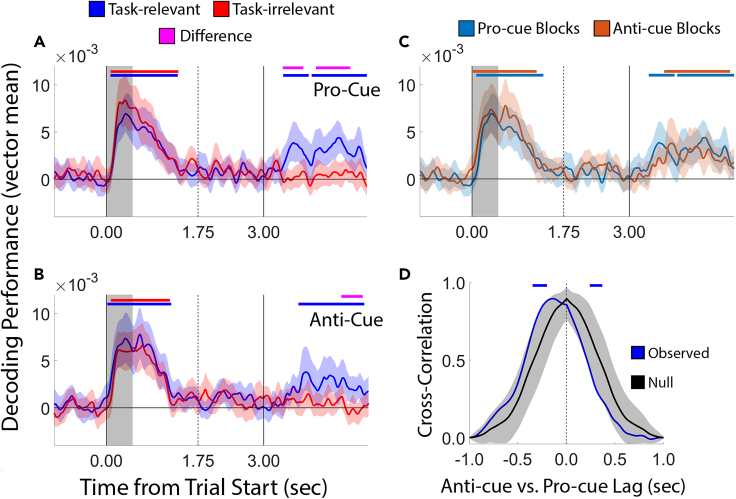
External attention is mediated by competition between endogenous (goal-driven) and exogenous (stimulus-driven) factors, with the balance of competition determining which stimuli are selected. Occasionally, exogenous factors "win" this competition and drive the selection of task-irrelevant stimuli. Endogenous and exogenous selection mechanisms may also compete to control the selection of internal representations (e.g., those stored in working memory), but whether this competition is resolved in the same way as external attention is unknown. Here, we leveraged the high temporal resolution of human EEG to determine how competition between endogenous and exogenous factors influences the selection of internal representations. Unlike external attention, competition did not prompt the selection of task-irrelevant working memory content. Instead, it delayed the endogenous selection of task-relevant working memory content by several hundred milliseconds. Thus, competition between endogenous and exogenous factors influences internal selective attention, but in a different way than external selective attention.
外部注意力由内源性(目标驱动)和外源性(刺激驱动)因素之间的竞争介导,竞争的平衡决定了选择哪些刺激。偶尔,外源性因素会“赢得”这场竞争,并驱动对与任务无关的刺激的选择。内源性和外源性选择机制也可能竞争以控制内部表征(例如,那些存储在工作记忆中的表征)的选择,但这种竞争是否以与外部注意力相同的方式解决尚不清楚。在这里,我们利用人类脑电图的高时间分辨率来确定内源性和外源性因素之间的竞争如何影响内部表征的选择。与外部注意力不同,竞争并没有促使选择与任务无关的工作记忆内容。相反,它将与任务相关的工作记忆内容的内源性选择延迟了几百毫秒。因此,内源性和外源性因素之间的竞争影响内部选择性注意力,但方式与外部选择性注意力不同。