Sapkota Sangeeta, Salem Mohamed, Jahed Khalil R, Artlip Timothy S, Sherif Sherif M
Virginia Agricultural Research and Extension Center, Virginia Tech, Winchester, VA, United States.
Department of Horticulture, Michigan State University, East Lansing, MI, United States.
Front Plant Sci. 2023 Jul 14;14:1194244. doi: 10.3389/fpls.2023.1194244. eCollection 2023.
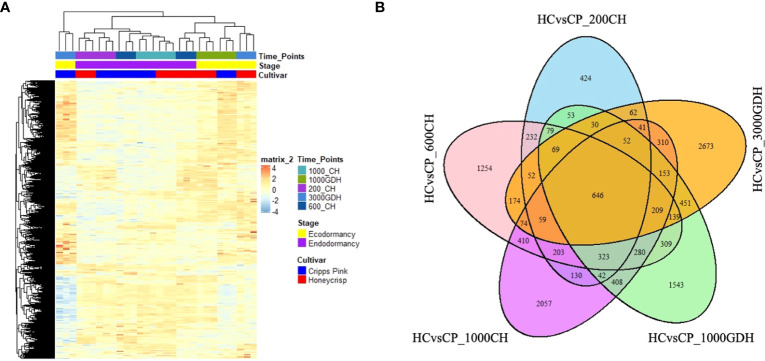
This study endeavors to explore the transcriptomic profiles of two apple cultivars, namely, 'Honeycrisp' and 'Cripps Pink,' which represent late and early-blooming cultivars, respectively. Using RNA-sequencing technology, we analyzed floral bud samples collected at five distinct time intervals during both endodormancy and ecodormancy. To evaluate the transcriptomic profiles of the 30 sequenced samples, we conducted principal component analysis (PCA). PC1 explained 43% of the variance, separating endodormancy and ecodormancy periods, while PC2 explained 16% of the variance, separating the two cultivars. The number of differentially expressed genes (DEGs) increased with endodormancy progression and remained elevated during ecodormancy. The majority of DEGs were unique to a particular time point, with only a few overlapping among or between the time points. This highlights the temporal specificity of gene expression during the dormancy transition and emphasizes the importance of sampling at multiple time points to capture the complete transcriptomic dynamics of this intricate process. We identified a total of 4204 upregulated and 7817 downregulated DEGs in the comparison of endodormancy and ecodormancy, regardless of cultivar, and 2135 upregulated and 2413 downregulated DEGs in the comparison of 'Honeycrisp' versus 'Cripps Pink,' regardless of dormancy stage. Furthermore, we conducted a co-expression network analysis to gain insight into the coordinated gene expression profiles across different time points, dormancy stages, and cultivars. This analysis revealed the most significant module (ME 14), correlated with 1000 GDH and consisting of 1162 genes. The expression of the genes within this module was lower in 'Honeycrisp' than in 'Cripps Pink.' The top 20 DEGs identified in ME 14 were primarily related to jasmonic acid biosynthesis and signaling, lipid metabolism, oxidation-reduction, and transmembrane transport activity. This suggests a plausible role for these pathways in governing bud dormancy and flowering time in apple.
本研究旨在探索两个苹果品种,即‘蜜脆’和‘粉红女士’的转录组图谱,它们分别代表晚花和早花品种。利用RNA测序技术,我们分析了在深休眠和生态休眠期间五个不同时间间隔采集的花芽样本。为了评估30个测序样本的转录组图谱,我们进行了主成分分析(PCA)。主成分1(PC1)解释了43%的方差,区分了深休眠和生态休眠期,而主成分2(PC2)解释了16%的方差,区分了两个品种。差异表达基因(DEG)的数量随着深休眠进程而增加,并在生态休眠期间保持升高。大多数DEG在特定时间点是独特的,只有少数在时间点之间重叠。这突出了休眠转变过程中基因表达的时间特异性,并强调了在多个时间点取样以捕捉这一复杂过程完整转录组动态的重要性。在不考虑品种的情况下,我们在深休眠和生态休眠的比较中总共鉴定出4204个上调的DEG和7817个下调的DEG,在不考虑休眠阶段的情况下,在‘蜜脆’与‘粉红女士’的比较中鉴定出2135个上调的DEG和2413个下调的DEG。此外,我们进行了共表达网络分析,以深入了解不同时间点、休眠阶段和品种之间的协调基因表达谱。该分析揭示了最显著的模块(ME 14),与1000个GDH相关,由1162个基因组成。该模块内基因的表达在‘蜜脆’中低于‘粉红女士’。在ME 14中鉴定出的前20个DEG主要与茉莉酸生物合成和信号传导、脂质代谢、氧化还原和跨膜转运活性有关。这表明这些途径在调控苹果芽休眠和开花时间方面可能发挥作用。