CREAGEN - Environmental, Genetic and Nutritional Epidemiology Research Center, Section of Public Health, Department of Biomedical, Metabolic and Neural Sciences (S.D.F., T.F., M.C., I.I., M.V.), University of Modena and Reggio Emilia, Italy.
School of Public Health, University of California Berkeley, CA (T.F.).
Hypertension. 2023 Oct;80(10):1961-1969. doi: 10.1161/HYPERTENSIONAHA.123.21224. Epub 2023 Jul 31.
Alcohol consumption may increase blood pressure but the details of the relationship are incomplete, particularly for the association at low levels of alcohol consumption, and no meta-analyses are available for nonexperimental cohort studies.
We performed a systematic search of longitudinal studies in healthy adults that reported on the association between alcohol intake and blood pressure. Our end points were the mean differences over time of systolic (SBP) and diastolic blood pressure (DBP), plotted according to baseline alcohol intake, by using a dose-response 1-stage meta-analytic methodology.
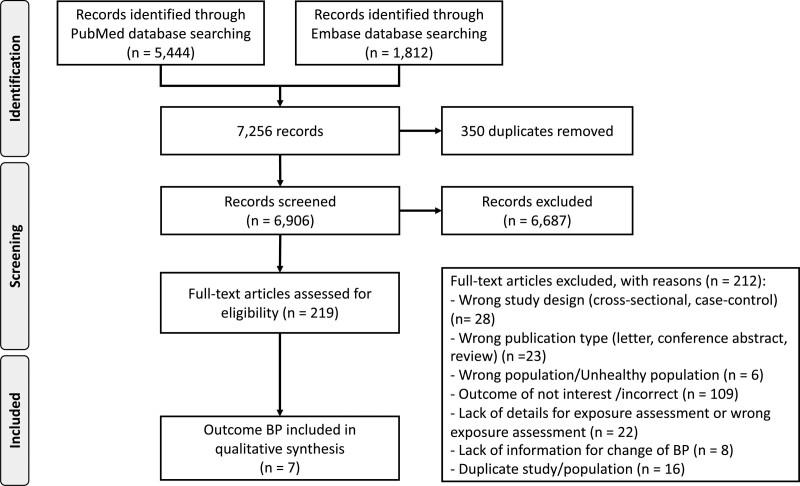
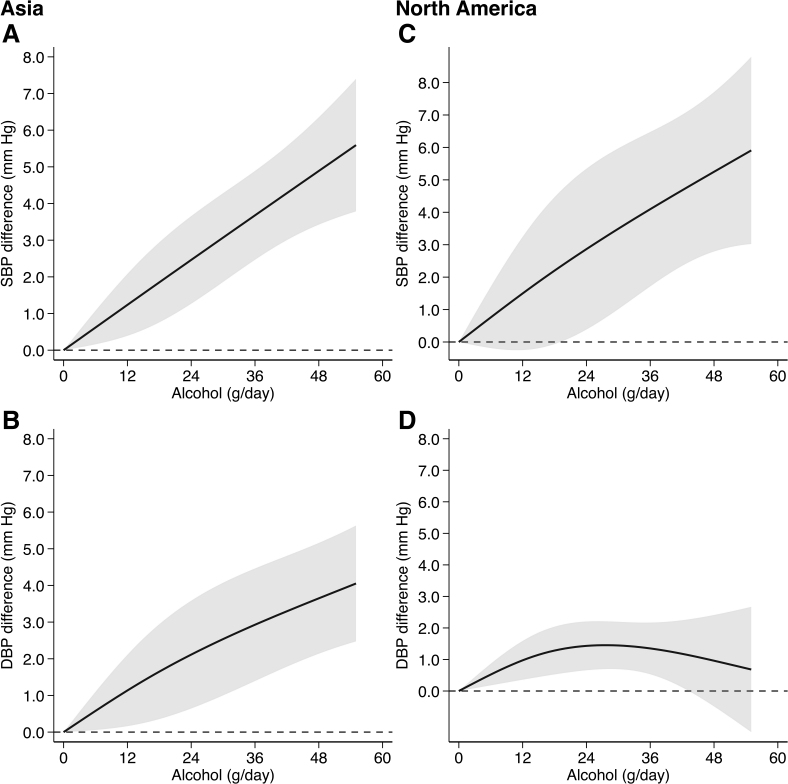
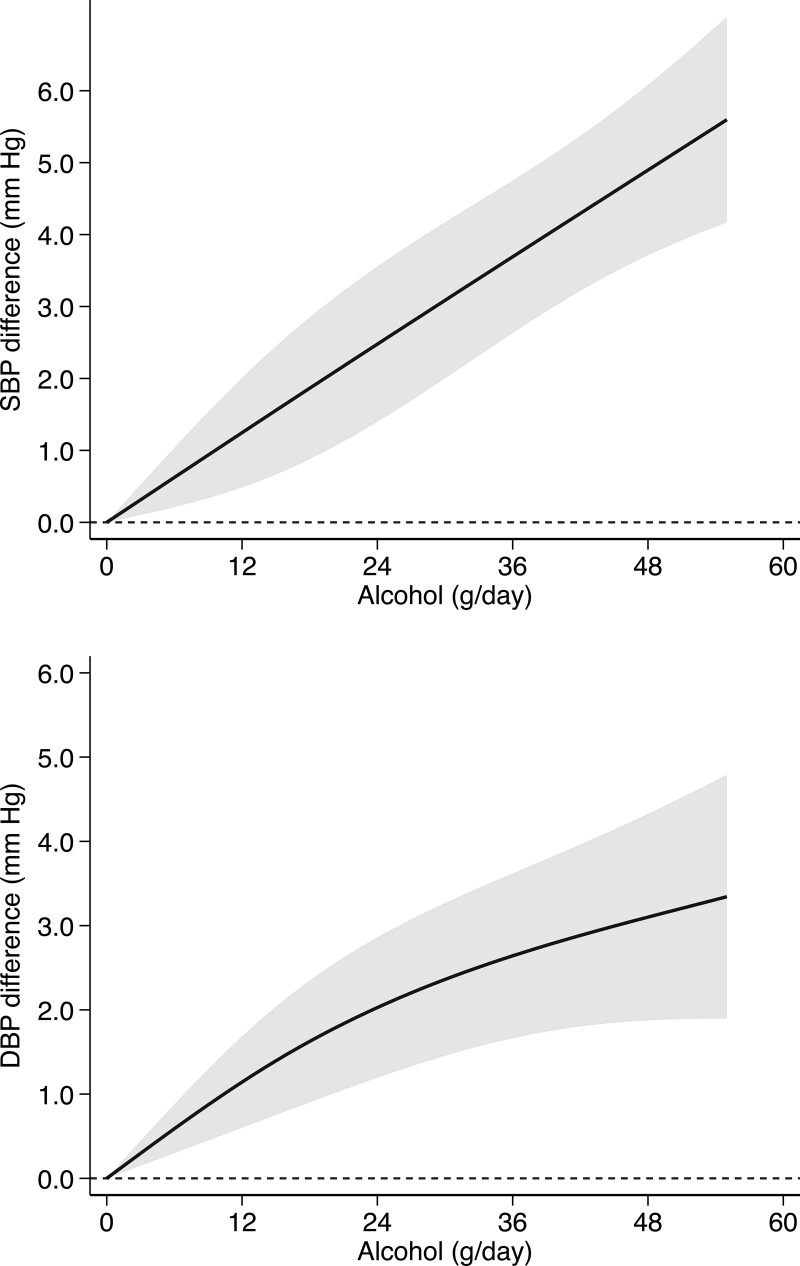
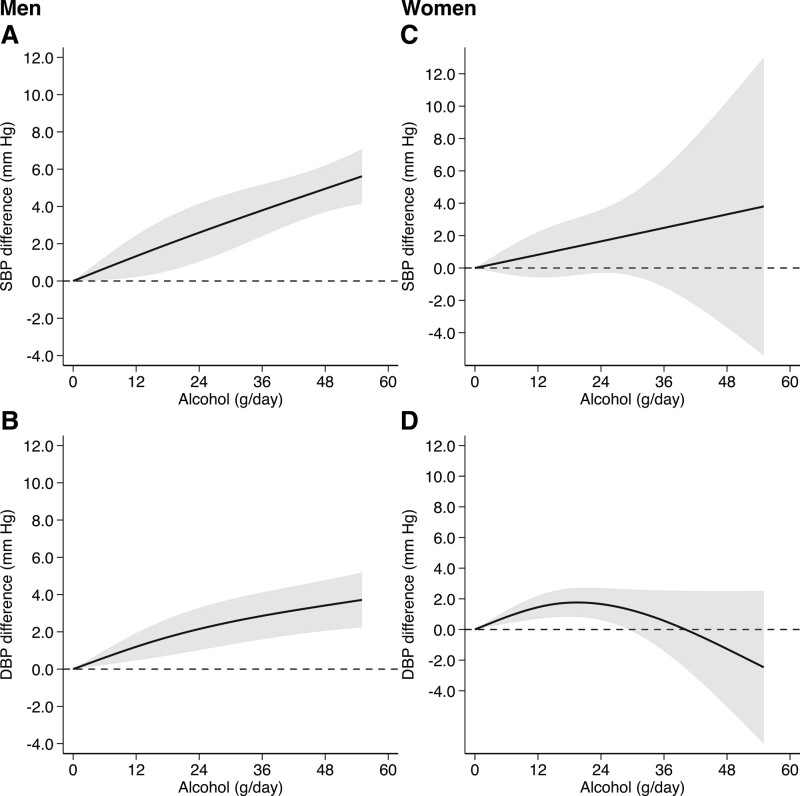
Seven studies, with 19 548 participants and a median follow-up of 5.3 years (range, 4-12 years), were included in the analysis. We observed a substantially linear positive association between baseline alcohol intake and changes over time in SBP and DBP, with no suggestion of an exposure-effect threshold. Overall, average SBP was 1.25 and 4.90 mm Hg higher for 12 or 48 grams of daily alcohol consumption, compared with no consumption. The corresponding differences for DBP were 1.14 and 3.10 mm Hg. Subgroup analyses by sex showed an almost linear association between baseline alcohol intake and SBP changes in both men and women, and for DBP in men while in women we identified an inverted -shaped association. Alcohol consumption was positively associated with blood pressure changes in both Asians and North Americans, apart from DBP in the latter group.
Our results suggest the association between alcohol consumption and SBP is direct and linear with no evidence of a threshold for the association, while for DBP the association is modified by sex and geographic location.
饮酒可能会导致血压升高,但目前对饮酒与血压之间关系的细节仍不完全清楚,尤其是在饮酒量较低的情况下,而且目前尚无针对非实验性队列研究的荟萃分析。
我们系统地检索了健康成年人的纵向研究,这些研究报告了饮酒与血压之间的关联。我们的终点是根据基线饮酒量绘制的收缩压(SBP)和舒张压(DBP)的时间平均差异,使用剂量-反应 1 阶段荟萃分析方法。
共纳入 7 项研究,涉及 19548 名参与者,中位随访时间为 5.3 年(范围,4-12 年)。我们观察到基线饮酒量与 SBP 和 DBP 的时间变化之间存在显著的线性正相关,且没有暴露-效应阈值的提示。总体而言,与不饮酒相比,每天饮酒 12 或 48 克时,SBP 平均升高 1.25 和 4.90mmHg,DBP 相应升高 1.14 和 3.10mmHg。按性别进行的亚组分析显示,基线饮酒量与 SBP 变化之间存在几乎线性的关联,无论男女均如此,而 DBP 仅在男性中存在关联,在女性中则呈倒 U 型关联。除北美人群的 DBP 外,饮酒与血压变化之间呈正相关,无论亚洲人还是北美人都是如此。
我们的研究结果表明,饮酒与 SBP 之间的关系是直接且线性的,没有证据表明存在关联的阈值,而对于 DBP,这种关系受到性别和地理位置的影响。