Epidemiology, Medical Faculty, University of Augsburg, Augsburg, Germany.
Department of Neurology and Clinical Neurophysiology, University Hospital Augsburg, Augsburg, Germany.
Eur J Neurol. 2024 Jan;31(1):e16006. doi: 10.1111/ene.16006. Epub 2023 Aug 9.
High throughput technologies provide new opportunities to further investigate the pathophysiology of ischemic strokes. The present cross-sectional study aimed to evaluate potential associations between the etiologic subtypes of ischemic stroke and blood-based proteins.
We investigated the associations between ischemic stroke subtypes and a panel of circulating inflammation biomarkers in 364 patients included in the Stroke Cohort Augsburg (SCHANA). Stroke etiologies were categorized according to the TOAST (Trial of Org 10172 in Acute Stroke Treatment) classification. Serum concentrations of 52 biomarkers were measured using the Bio-Plex Pro™ Human Cytokine Screening Panel, ICAM-1 set and VCAM-1 set, plus the Pro™ Human TH17 cytokine sCD40L set and IL31 set (all Bio-Rad, USA). Multivariable linear regression models were used to examine associations. Point estimates were calculated as the mean difference in -standardized cytokine levels on the log -scale.
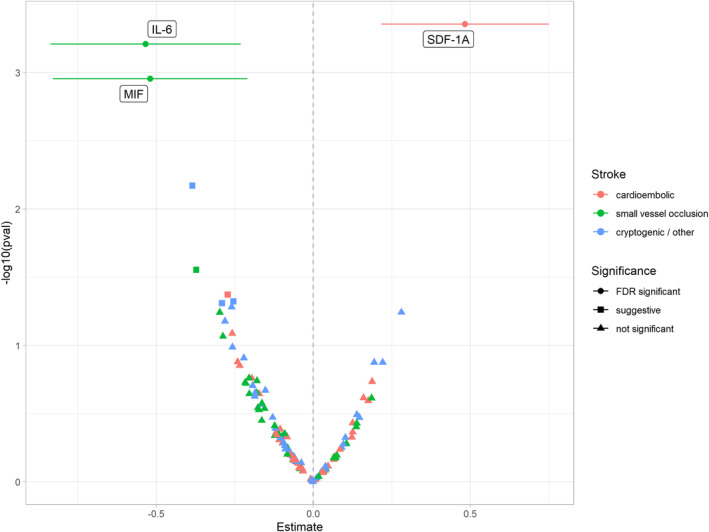
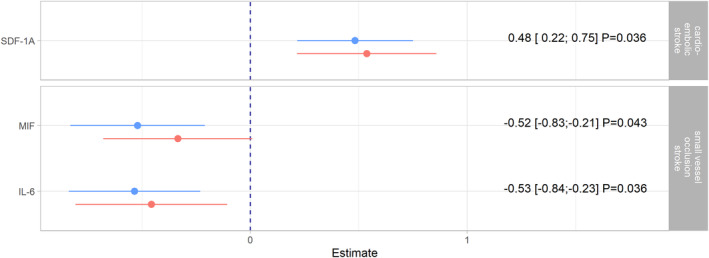
Stromal-cell-derived-factor 1 alpha (SDF-1a) showed significantly higher serum levels in cardioembolic compared with large vessel atherosclerotic stroke (β = 0.48; 95% CI 0.22; 0.75; P = 0.036). Significantly lower levels of interleukin-6 (IL-6) (β = -0.53; 95% CI -0.84; -0.23; P = 0.036) and macrophage migration inhibitory factor (MIF) (β = -0.52; 95% CI -0.84; -0.21; P = 0.043) were found in the small vessel versus large vessel stroke subtype.
Immune dysregulations observed in different stroke subtypes might help uncover pathophysiological mechanisms of the disease. Further studies are needed to validate identified biomarkers in diverse study populations before they can potentially be used in clinical practice to further improve stroke management and patient outcomes.
高通量技术为进一步研究缺血性中风的病理生理学提供了新的机会。本横断面研究旨在评估缺血性中风的病因亚型与血液中蛋白之间的潜在关联。
我们在纳入Stroke Cohort Augsburg(SCHANA)的 364 例患者中,研究了缺血性中风亚型与一系列循环炎症生物标志物之间的关联。根据 TOAST(急性中风治疗试验的 Org 10172)分类对中风病因进行分类。使用 Bio-Plex Pro™人细胞因子筛选试剂盒、ICAM-1 试剂盒和 VCAM-1 试剂盒以及 Pro™人 TH17 细胞因子 sCD40L 试剂盒和 IL31 试剂盒(均为 Bio-Rad,美国)测量 52 种生物标志物的血清浓度。使用多变量线性回归模型检查关联。点估计值计算为 -标准化细胞因子水平的对数尺度上的均值差异。
与大动脉粥样硬化性卒中相比,心源性栓塞性卒中的基质细胞衍生因子 1 阿尔法(SDF-1a)血清水平显著升高(β=0.48;95%CI 0.22;0.75;P=0.036)。与大动脉粥样硬化性卒中相比,小血管性卒中患者的白细胞介素 6(IL-6)(β=-0.53;95%CI -0.84;-0.23;P=0.036)和巨噬细胞移动抑制因子(MIF)(β=-0.52;95%CI -0.84;-0.21;P=0.043)水平显著降低。
不同卒中亚型中观察到的免疫失调可能有助于揭示疾病的病理生理学机制。在将鉴定出的生物标志物在不同的研究人群中进行验证之前,还需要进一步的研究,然后才能将其潜在地用于临床实践,以进一步改善卒中管理和患者结局。