Department of Psychology, Justus Liebig University Giessen, Giessen 35394, Germany.
Center for Mind, Brain and Behavior (CMBB), University of Marburg and Justus Liebig University Giessen, Marburg 35302, Germany.
Proc Natl Acad Sci U S A. 2023 Aug 8;120(32):e2220642120. doi: 10.1073/pnas.2220642120. Epub 2023 Jul 31.
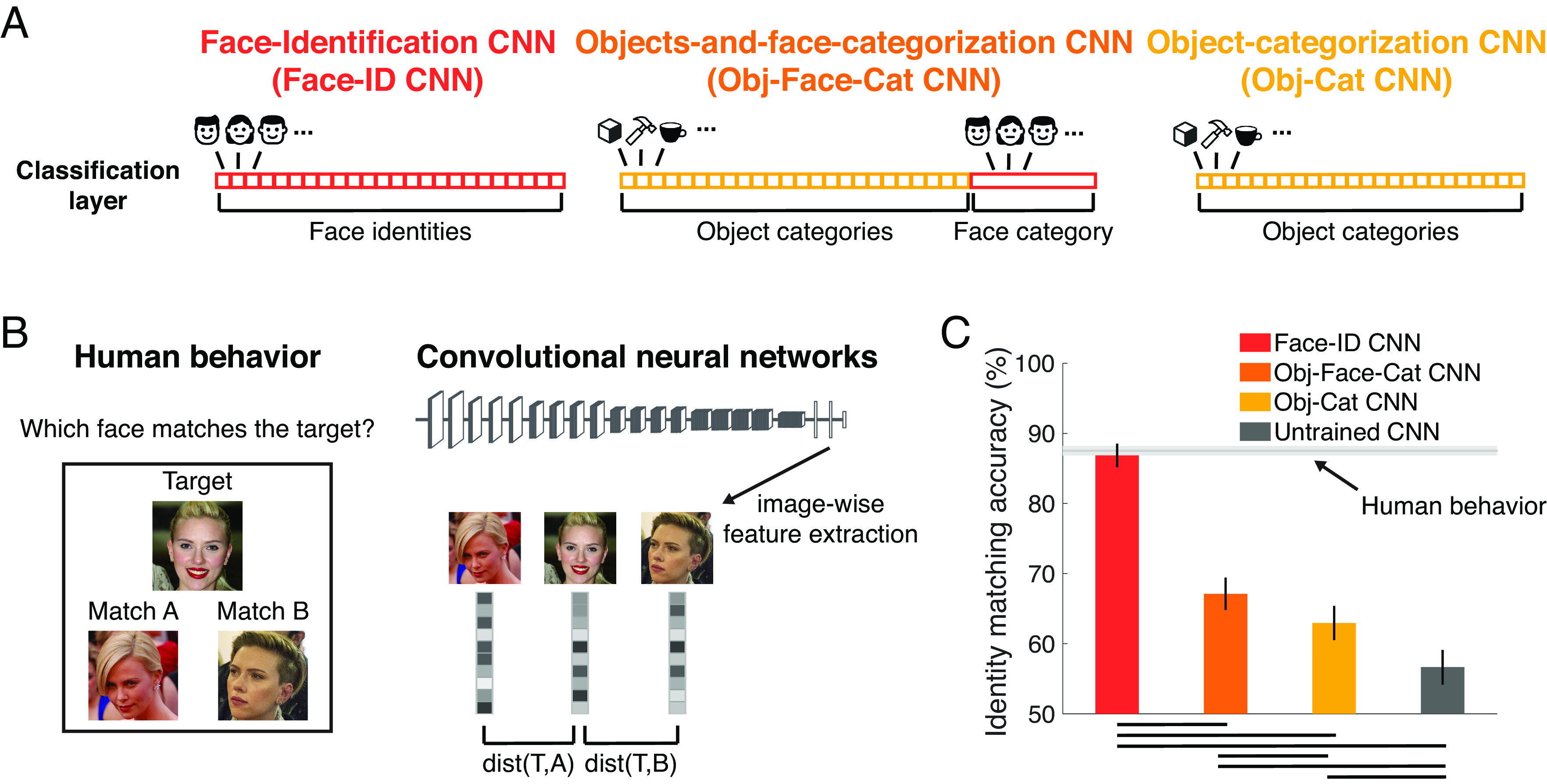
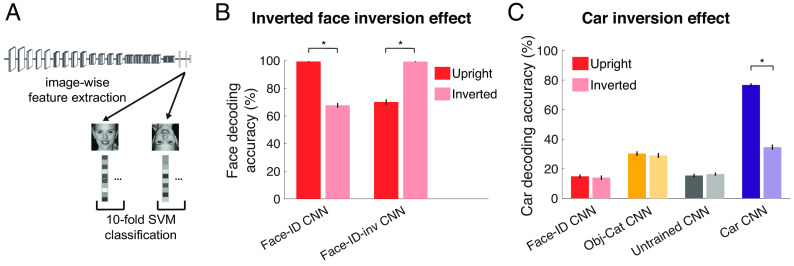
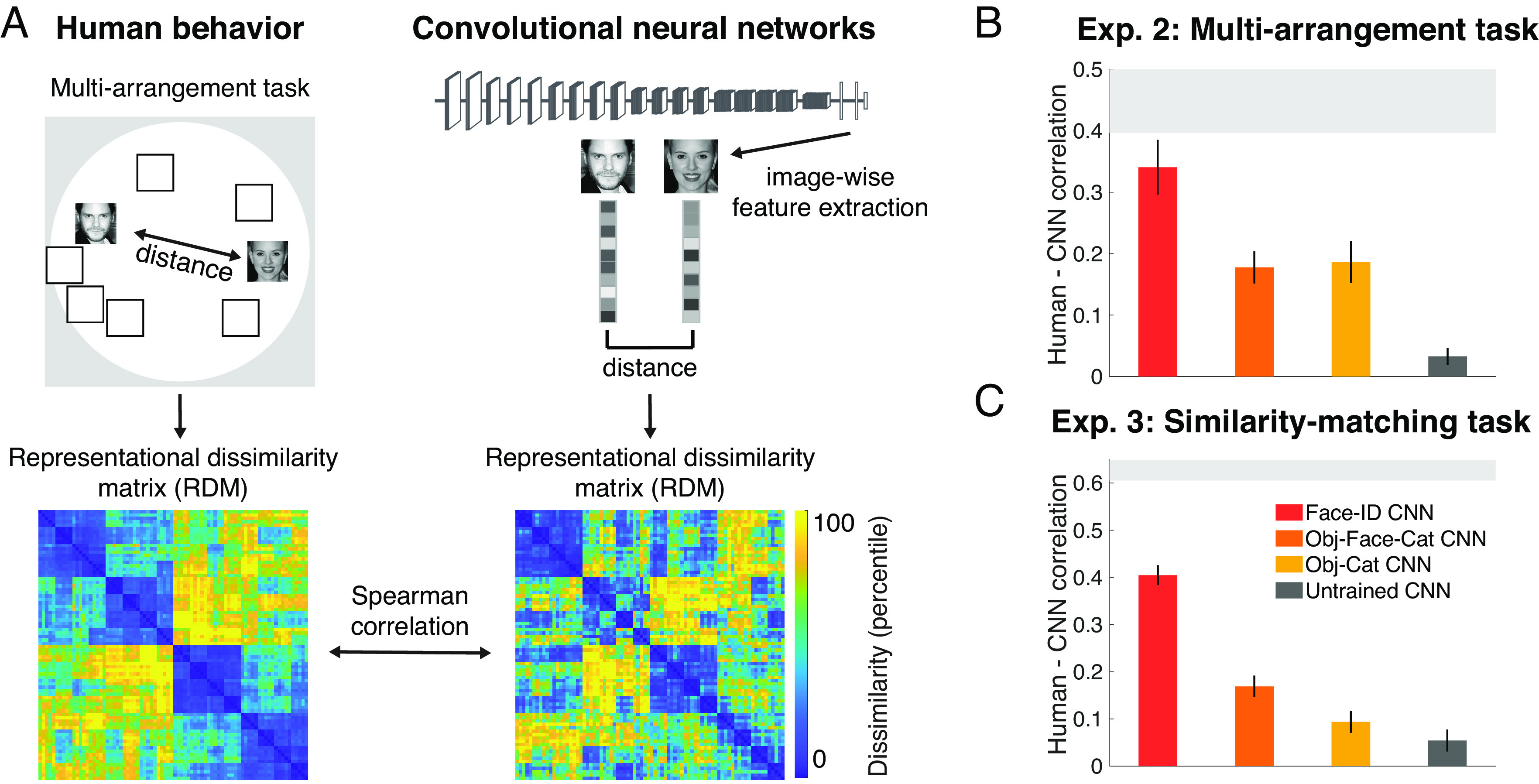
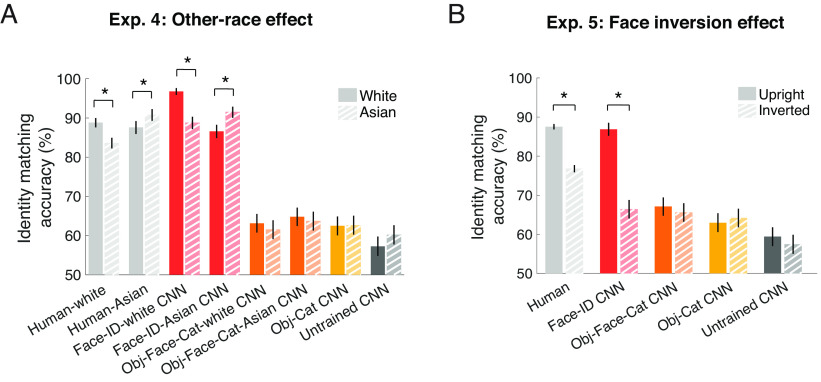
Human face recognition is highly accurate and exhibits a number of distinctive and well-documented behavioral "signatures" such as the use of a characteristic representational space, the disproportionate performance cost when stimuli are presented upside down, and the drop in accuracy for faces from races the participant is less familiar with. These and other phenomena have long been taken as evidence that face recognition is "special". But why does human face perception exhibit these properties in the first place? Here, we use deep convolutional neural networks (CNNs) to test the hypothesis that all of these signatures of human face perception result from optimization for the task of face recognition. Indeed, as predicted by this hypothesis, these phenomena are all found in CNNs trained on face recognition, but not in CNNs trained on object recognition, even when additionally trained to detect faces while matching the amount of face experience. To test whether these signatures are in principle specific to faces, we optimized a CNN on car discrimination and tested it on upright and inverted car images. As we found for face perception, the car-trained network showed a drop in performance for inverted vs. upright cars. Similarly, CNNs trained on inverted faces produced an inverted face inversion effect. These findings show that the behavioral signatures of human face perception reflect and are well explained as the result of optimization for the task of face recognition, and that the nature of the computations underlying this task may not be so special after all.
人类面孔识别具有高度准确性,并表现出许多独特且有充分记录的行为“特征”,例如使用特征表示空间、刺激倒置时表现成本不成比例,以及参与者不太熟悉的种族面孔的准确性下降。这些现象以及其他现象长期以来一直被视为面孔识别“特殊”的证据。但是,人类面孔感知为什么首先表现出这些特性呢?在这里,我们使用深度卷积神经网络 (CNN) 来检验这样一个假设,即人类面孔感知的所有这些特征都源于对面孔识别任务的优化。实际上,正如该假设所预测的那样,这些现象在专门针对面孔识别的 CNN 中都有发现,但在专门针对对象识别的 CNN 中没有发现,即使这些 CNN 额外接受了在匹配面孔经验量的情况下检测面孔的训练。为了测试这些特征是否原则上仅限于面孔,我们在汽车识别上对 CNN 进行了优化,并在直立和倒置的汽车图像上对其进行了测试。正如我们在面孔感知中发现的那样,经过汽车训练的网络在面对直立和倒置的汽车时性能下降。类似地,经过倒置面孔训练的 CNN 产生了倒置面孔的倒置效应。这些发现表明,人类面孔感知的行为特征反映并很好地解释为对面孔识别任务的优化结果,而该任务背后的计算性质可能并不那么特殊。