Département de biologie, Université de Sherbrooke, Sherbrooke, Québec, Canada.
CGI IMT Mines Albi, Albi, France.
Nucleic Acids Res. 2023 Sep 8;51(16):8402-8412. doi: 10.1093/nar/gkad644.
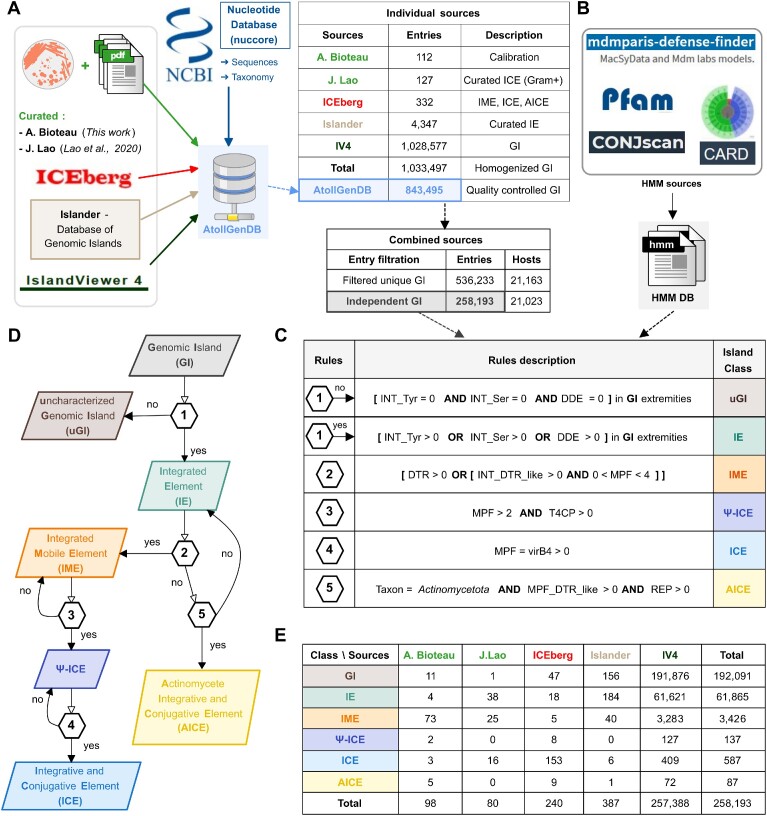
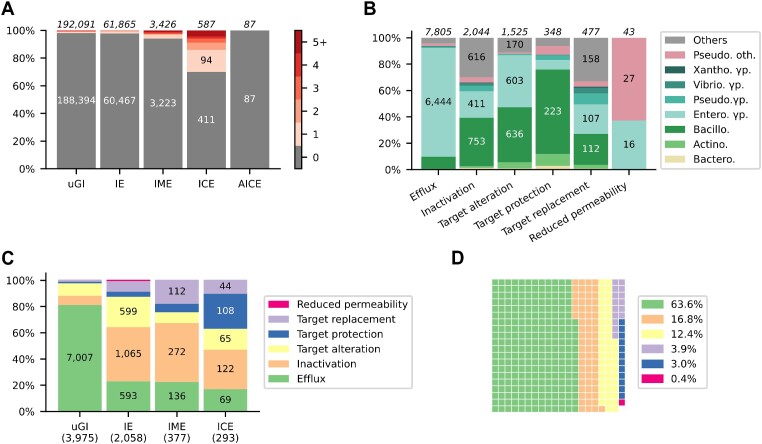
Genomic islands (GIs) play a crucial role in the spread of antibiotic resistance, virulence factors and antiviral defense systems in a broad range of bacterial species. However, the characterization and classification of GIs are challenging due to their relatively small size and considerable genetic diversity. Predicting their intercellular mobility is of utmost importance in the context of the emerging crisis of multidrug resistance. Here, we propose a large-scale classification method to categorize GIs according to their mobility profile and, subsequently, analyze their gene cargo. We based our classification decision scheme on a collection of mobility protein motif definitions available in publicly accessible databases. Our results show that the size distribution of GI classes correlates with their respective structure and complexity. Self-transmissible GIs are usually the largest, except in Bacillota and Actinomycetota, accumulate antibiotic and phage resistance genes, and favour the use of a tyrosine recombinase to insert into a host's replicon. Non-mobilizable GIs tend to use a DDE transposase instead. Finally, although tRNA genes are more frequently targeted as insertion sites by GIs encoding a tyrosine recombinase, most GIs insert in a protein-encoding gene. This study is a stepping stone toward a better characterization of mobile GIs in bacterial genomes and their mechanism of mobility.
基因组岛(Genomic islands,GIs)在广泛的细菌物种中对抗生素耐药性、毒力因子和抗病毒防御系统的传播起着至关重要的作用。然而,由于其相对较小的尺寸和相当大的遗传多样性,GIs 的特征和分类具有挑战性。预测它们的细胞间迁移能力在多药耐药性的新兴危机中至关重要。在这里,我们提出了一种大规模的分类方法,根据其迁移模式对 GIs 进行分类,并随后分析它们的基因货物。我们的分类决策方案基于在公共可访问数据库中可用的移动蛋白基序定义的集合。我们的结果表明,GI 类的大小分布与其各自的结构和复杂性相关。自我可转移的 GIs 通常是最大的,除了在 Bacillota 和 Actinomycetota 中,它们积累抗生素和噬菌体耐药基因,并有利于使用酪氨酸重组酶插入宿主的复制子。不可移动的 GIs 则倾向于使用 DDE 转座酶。最后,尽管编码酪氨酸重组酶的 GIs 更常将 tRNA 基因作为插入位点,但大多数 GIs 插入到编码蛋白质的基因中。这项研究是朝着更好地描述细菌基因组中可移动 GIs 及其迁移机制迈出的一步。