Department of Materials Science, Faculty of Pure and Applied Sciences, University of Tsukuba, 1-1-1 Tennoudai, Tsukuba, Ibaraki, 305-8573, Japan.
University of Tsukuba, 1-1-1 Tennoudai, Tsukuba, Ibaraki, 305-8573, Japan.
Adv Sci (Weinh). 2023 Sep;10(27):e2301159. doi: 10.1002/advs.202301159. Epub 2023 Aug 1.
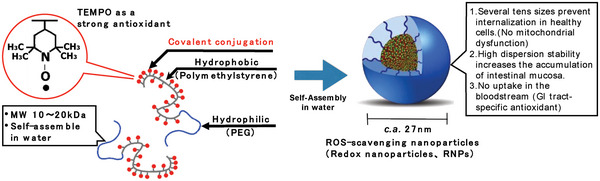
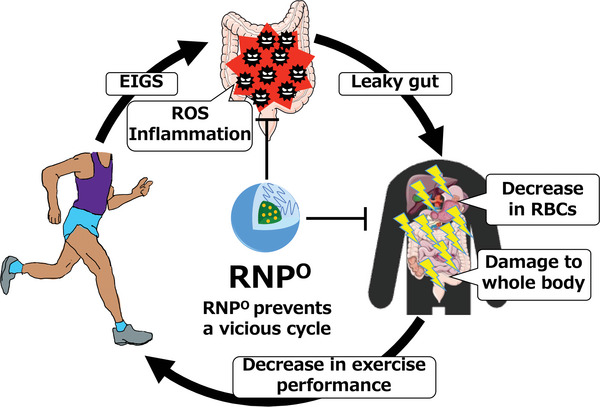
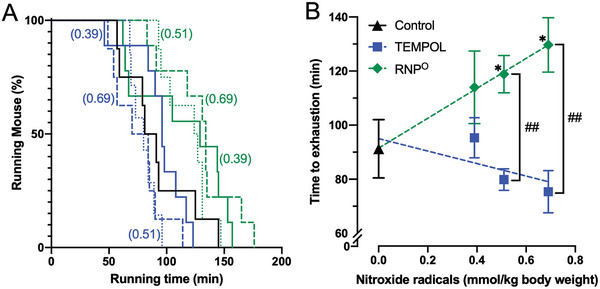
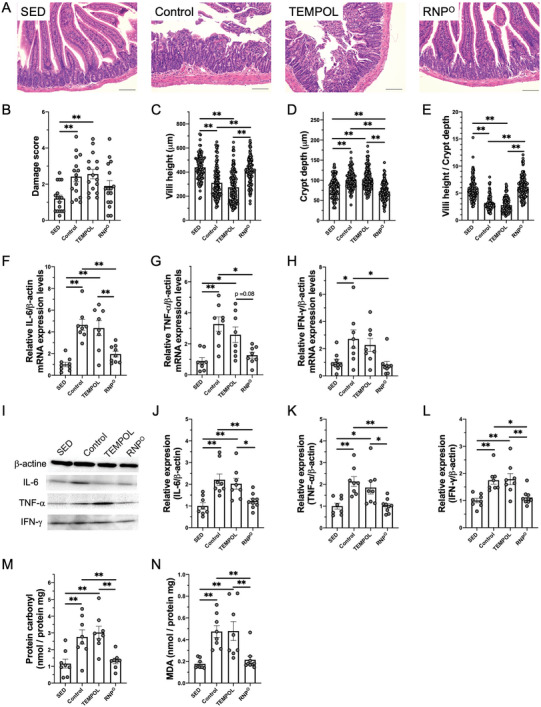
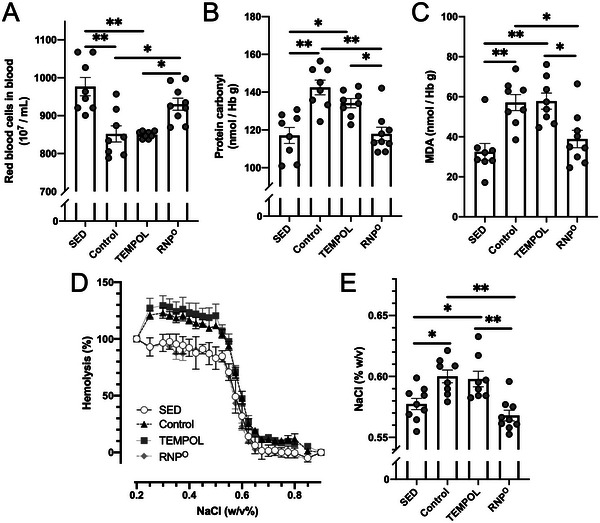
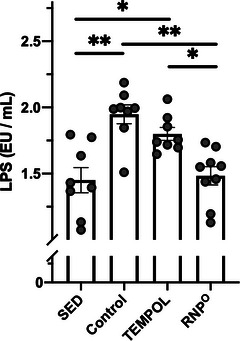
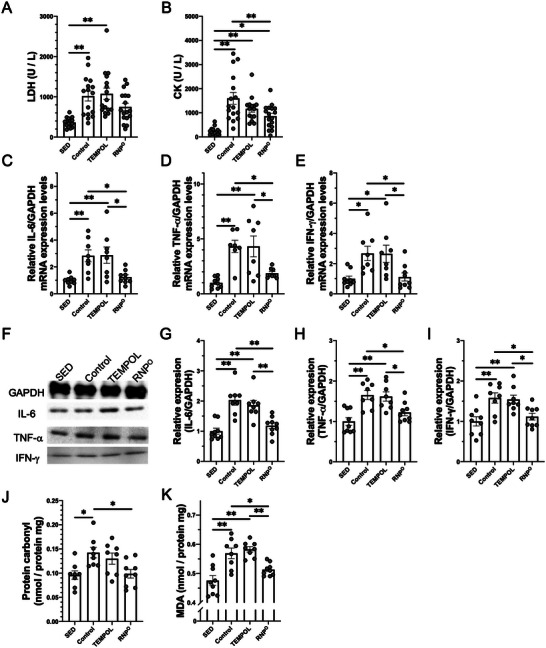
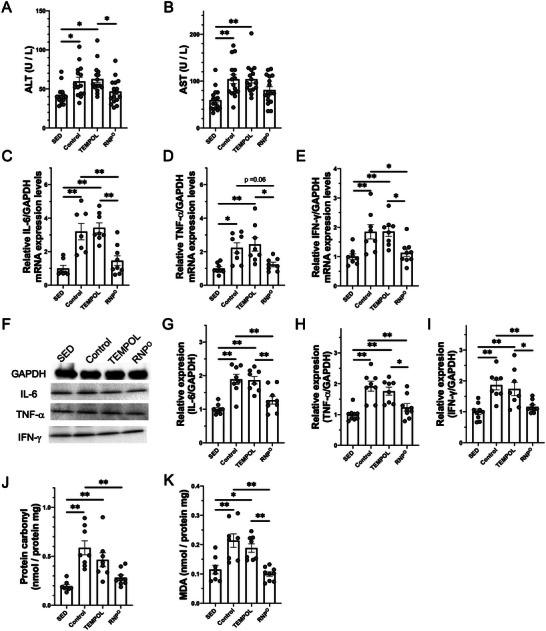
Excess reactive oxygen species (ROS) produced during strong or unfamiliar exercise cause exercise-induced gastrointestinal syndrome (EIGS), leading to poor health and decreased exercise performance. The application of conventional antioxidants can neither ameliorate EIGS nor improve exercise performance because of their rapid elimination and severe side effects on the mitochondria. Hence, a self-assembling nanoparticle-type antioxidant (RNP ) that is selectively located in the gastrointestinal (GI) tract for an extended time after oral administration is developed. Interestingly, orally administered RNP significantly enhances the running time until exhaustion in mice with increasing dosage, whereas conventional antioxidants (TEMPOL) tends to reduce the running time with increasing dosage. The running (control) and TEMPOL groups show severe damage in the GI tract and increased plasma lipopolysaccharide (LPS) levels after 80 min of running, resulting in fewer red blood cells (RBCs) and severe damage to the skeletal muscles and liver. However, the RNP group is protected against GI tract damage and elevation of plasma LPS levels, similar to the nonrunning (sedentary) group, which prevents damage to the whole body, unlike in the control and TEMPOL groups. Based on these results, it is concluded that continuous scavenging of excessive intestinal ROS protects against gut damage and further improves exercise performance.
过量的活性氧(ROS)在剧烈或不熟悉的运动中产生,导致运动诱导的胃肠道综合征(EIGS),从而导致健康状况不佳和运动表现下降。由于传统抗氧化剂的快速消除和对线粒体的严重副作用,它们既不能改善 EIGS,也不能提高运动表现。因此,开发了一种自组装的纳米颗粒型抗氧化剂(RNP),在口服后可以在胃肠道(GI)中长时间选择性定位。有趣的是,口服 RNP 可显著提高小鼠的跑步时间,直至因剂量增加而精疲力竭,而传统抗氧化剂(TEMPOL)则往往会随着剂量的增加而缩短跑步时间。跑步(对照)和 TEMPOL 组在跑步 80 分钟后,胃肠道严重受损,血浆脂多糖(LPS)水平升高,导致红细胞(RBC)减少,骨骼肌和肝脏严重受损。然而,RNP 组可防止胃肠道损伤和血浆 LPS 水平升高,与不跑步(静坐)组相似,这可防止全身受损,而不同于对照组和 TEMPOL 组。基于这些结果,可以得出结论,持续清除过多的肠道 ROS 可防止肠道损伤并进一步提高运动表现。