Kargar Shiva, Ansari-Moghaddam Alireza, Ansari Hossein
Health Promotion Research Center, Zahedan University of Medical Sciences, Zahedan, Iran.
J Egypt Public Health Assoc. 2023 Aug 2;98(1):14. doi: 10.1186/s42506-023-00139-3.
Seat belts might save people's lives in car accidents by preventing severe collision damage and keeping passengers safe from critical injuries. This meta-analysis was performed to assess the prevalence of seat belt use among drivers and passengers.
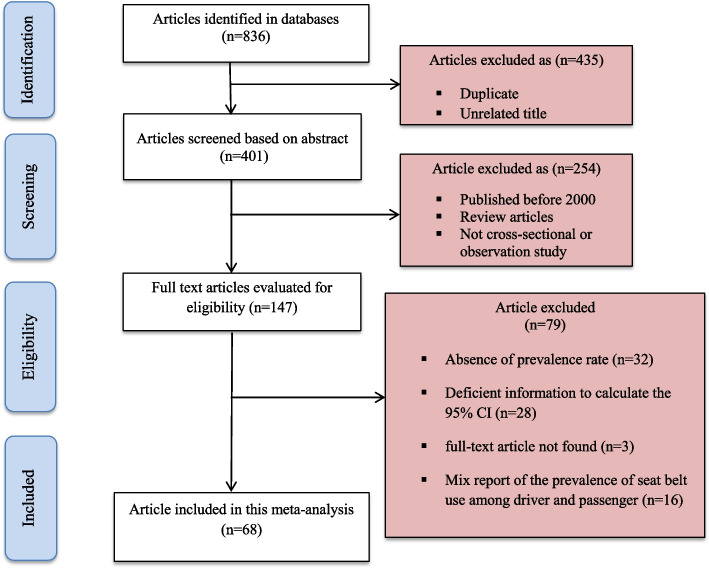
The databases of PubMed, Web of Science (WOS), and Google Scholar were searched from the beginning of 2000 to late December 2020 to identify studies that investigated the prevalence of seat belt use among drivers and passengers. The pooled prevalence was calculated using a random-effects model. The STATA-v14 software was used to perform data analysis.
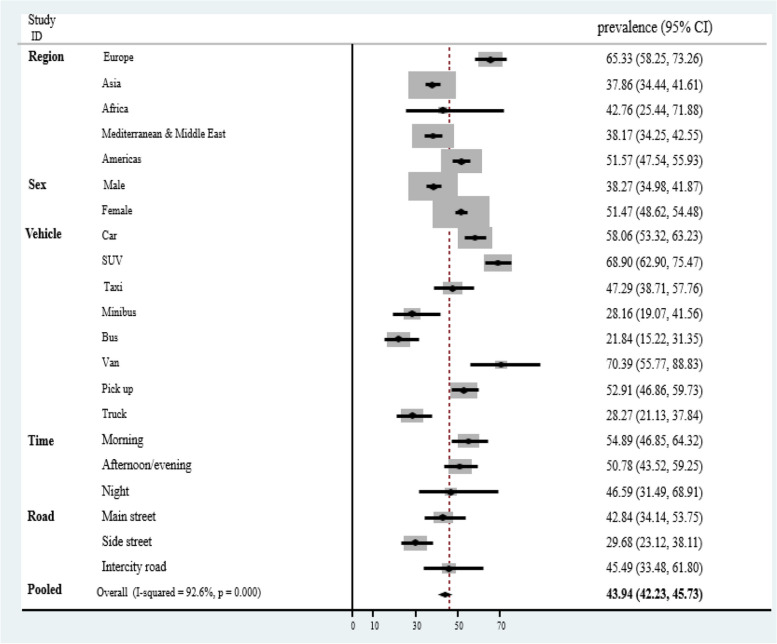
Sixty-eight studies that met the inclusion criteria and were suitable for this meta-analysis were identified. The pooled prevalence of seat belt use was 43.94% (95% CI: 42.23-45.73) among drivers, 38.47% (95% CI: 34.89-42.42) among front-seat passengers, and 15.32% (95% CI: 12.33-19.03) among rear-seat passengers. The lowest seat belt use among drivers and passengers was observed in Asia, the Middle East, and Africa, while the highest use was reported in Europe and America. Moreover, the prevalence of seat belt use was higher among women drivers [51.47% (95% CI: 48.62-54.48)] than men drivers [38.27% (95% CI: 34.98-41.87)] (P < 0.001). Furthermore, the highest prevalence of seat belt use was seen among drivers (68.9%) and front-seat passengers (50.5%) of sports utility vehicles (SUVs); in contrast, the lowest prevalence was observed among drivers and passengers of public vehicles such as buses, minibuses, and taxis.
In general, the prevalence of seat belt use was not high among drivers and was even lower among passengers. Moreover, drivers and passengers in Asia, the Middle East, and Africa had the lowest prevalence of seat belt usage. Additionally, drivers and passengers of public transportation (buses, minibuses, and taxis) had a lower rate of seat belt use, especially among men. Therefore, effective interventional programs to improve seat belt use should be designed and implemented, particularly among these at-risk populations in Asia, the Middle East, and Africa.
安全带可通过防止严重碰撞伤害并使乘客免受重伤,从而在车祸中挽救人们的生命。本荟萃分析旨在评估驾驶员和乘客使用安全带的普及率。
检索了PubMed、科学网(WOS)和谷歌学术数据库,检索时间从2000年初至2020年12月底,以确定调查驾驶员和乘客使用安全带普及率的研究。采用随机效应模型计算合并普及率。使用STATA-v14软件进行数据分析。
确定了68项符合纳入标准且适合本荟萃分析的研究。驾驶员使用安全带的合并普及率为43.94%(95%置信区间:42.23-45.73),前排乘客为38.47%(95%置信区间:34.89-42.42),后排乘客为15.32%(95%置信区间:12.33-19.03)。在亚洲、中东和非洲,驾驶员和乘客使用安全带的比例最低,而在欧洲和美洲报告的使用率最高。此外,女性驾驶员使用安全带的普及率[51.47%(95%置信区间:48.62-54.48)]高于男性驾驶员[38.27%(95%置信区间:34.98-41.87)](P<0.001)。此外,运动型多用途汽车(SUV)的驾驶员(68.9%)和前排乘客(50.5%)使用安全带的普及率最高;相比之下,公共车辆(如公共汽车、小型公共汽车和出租车)的驾驶员和乘客使用率最低。
总体而言,驾驶员使用安全带的普及率不高,乘客的普及率更低。此外,亚洲、中东和非洲的驾驶员和乘客使用安全带的普及率最低。此外,公共交通(公共汽车、小型公共汽车和出租车)的驾驶员和乘客使用安全带的比例较低,尤其是男性。因此,应设计并实施有效的干预计划,以提高安全带的使用率,特别是在亚洲、中东和非洲的这些高危人群中。