Department of Computer Engineering and Applications, GLA University, Mathura, India.
Department College of Computer Sci. and Eng., University of Hafr Al-Batin, Hafar Al-Batin, 39524, Saudi Arabia.
Sci Rep. 2023 Aug 2;13(1):12516. doi: 10.1038/s41598-023-39618-0.
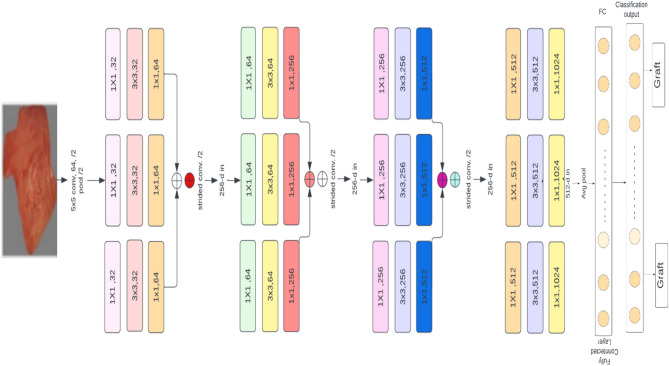
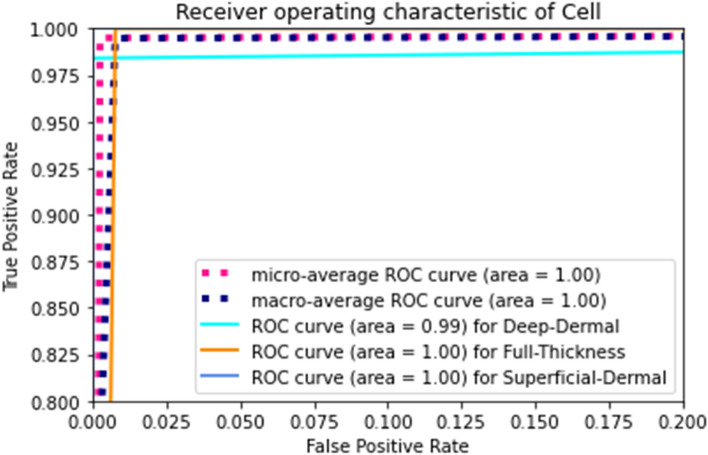
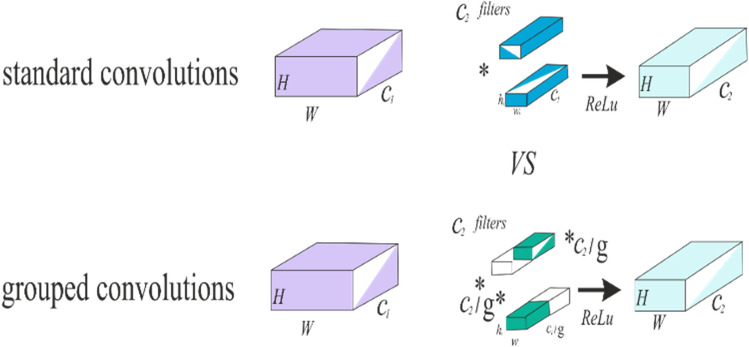
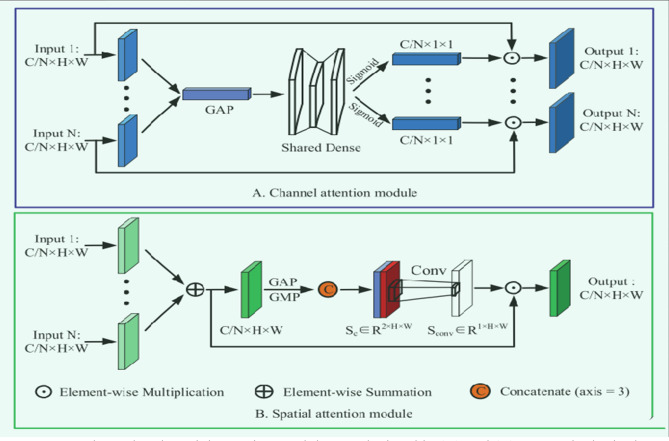
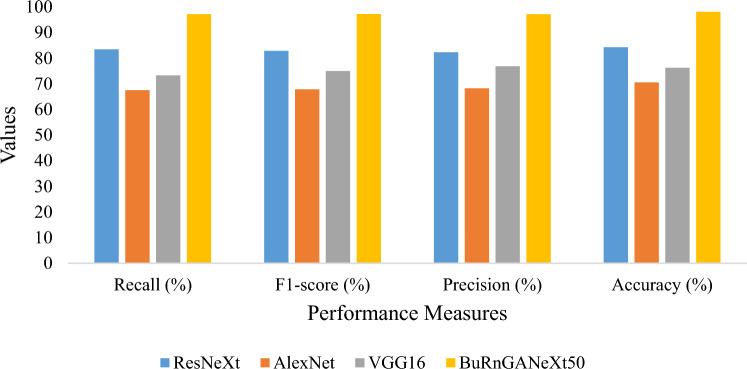
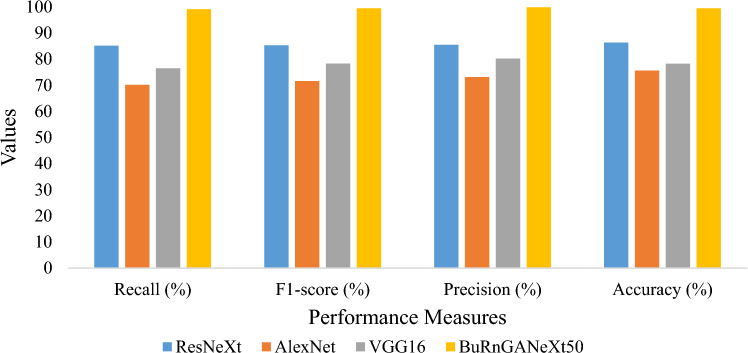
Diagnosing burns in humans has become critical, as early identification can save lives. The manual process of burn diagnosis is time-consuming and complex, even for experienced doctors. Machine learning (ML) and deep convolutional neural network (CNN) models have emerged as the standard for medical image diagnosis. The ML-based approach typically requires handcrafted features for training, which may result in suboptimal performance. Conversely, DL-based methods automatically extract features, but designing a robust model is challenging. Additionally, shallow DL methods lack long-range feature dependency, decreasing efficiency in various applications. We implemented several deep CNN models, ResNeXt, VGG16, and AlexNet, for human burn diagnosis. The results obtained from these models were found to be less reliable since shallow deep CNN models need improved attention modules to preserve the feature dependencies. Therefore, in the proposed study, the feature map is divided into several categories, and the channel dependencies between any two channel mappings within a given class are highlighted. A spatial attention map is built by considering the links between features and their locations. Our attention-based model BuRnGANeXt50 kernel and convolutional layers are also optimized for human burn diagnosis. The earlier study classified the burn based on depth of graft and non-graft. We first classified the burn based on the degree. Subsequently, it is classified into graft and non-graft. Furthermore, the proposed model performance is evaluated on Burns_BIP_US_database. The sensitivity of the BuRnGANeXt50 is 97.22% and 99.14%, respectively, for classifying burns based on degree and depth. This model may be used for quick screening of burn patients and can be executed in the cloud or on a local machine. The code of the proposed method can be accessed at https://github.com/dhirujis02/Journal.git for the sake of reproducibility.
诊断人类烧伤已变得至关重要,因为早期识别可以挽救生命。手动进行烧伤诊断既耗时又复杂,即使是经验丰富的医生也不例外。机器学习 (ML) 和深度卷积神经网络 (CNN) 模型已成为医学图像诊断的标准。基于 ML 的方法通常需要手工制作特征进行训练,这可能导致性能不佳。相反,基于深度学习的方法可以自动提取特征,但设计稳健的模型具有挑战性。此外,浅层深度学习方法缺乏长程特征依赖关系,从而降低了各种应用的效率。我们实施了几种用于人类烧伤诊断的深度 CNN 模型,包括 ResNeXt、VGG16 和 AlexNet。结果表明,这些模型的可靠性较低,因为浅层深度 CNN 模型需要改进的注意力模块来保留特征依赖关系。因此,在本研究中,将特征图分为几个类别,并突出显示给定类别内任意两个通道映射之间的通道依赖关系。通过考虑特征与其位置之间的联系来构建空间注意力图。我们的基于注意力的模型 BuRnGANeXt50 核和卷积层也经过了优化,可用于人类烧伤诊断。早期的研究是根据移植物和非移植物的深度对烧伤进行分类。我们首先根据烧伤程度对烧伤进行分类。随后,将其分为移植物和非移植物。此外,还在 Burns_BIP_US_database 上评估了所提出模型的性能。BuRnGANeXt50 分别在基于烧伤程度和深度对烧伤进行分类时的灵敏度为 97.22%和 99.14%。该模型可用于快速筛选烧伤患者,可在云端或本地机器上执行。为了便于重现性,可以在 https://github.com/dhirujis02/Journal.git 上访问所提出方法的代码。