Department of Medicine III, Gastroenterology, Metabolic Diseases and Intensive Care, University Hospital RWTH Aachen, Aachen, Germany.
Department of Biobehavioral Health Sciences, School of Nursing, University of Pennsylvania, Philadelphia, PA, United States.
Front Public Health. 2023 Jul 19;11:1192099. doi: 10.3389/fpubh.2023.1192099. eCollection 2023.
Non-alcoholic fatty liver disease (NAFLD) and alcoholic liver disease are among the most common liver diseases worldwide, and there are currently no Food and Drug Administration (FDA)-approved treatments. Recent studies have focused on lifestyle changes to prevent and treat NAFLD. Omega-3 supplementation is associated with improved outcomes in patients with chronic liver disease. However, it is unclear whether Omega-3 supplementation can prevent the development of liver disease, particularly in individuals at an increased (genetic) risk.
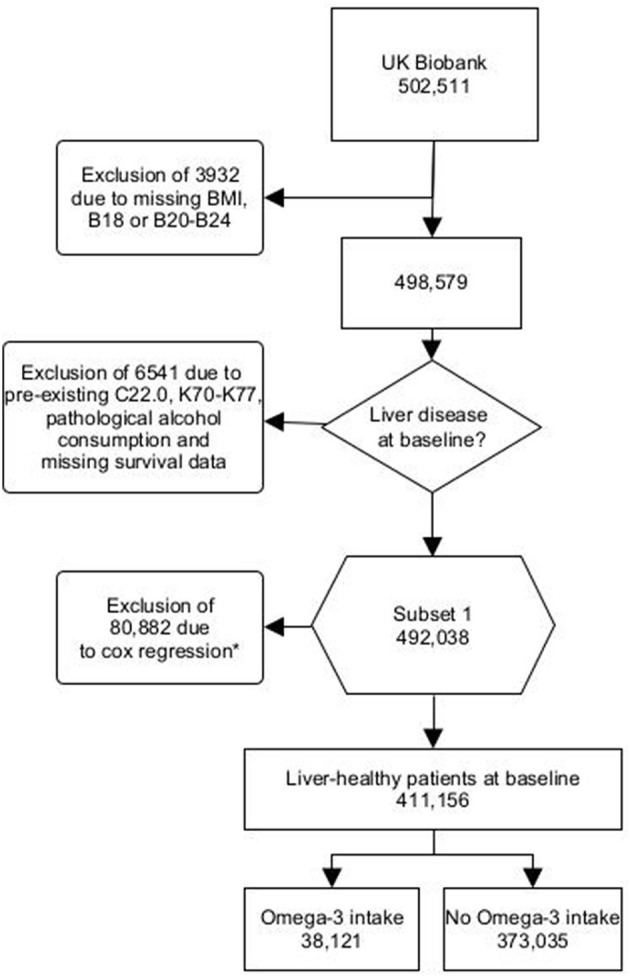
In this UK Biobank cohort study, we established a multivariate cox proportional hazards model for the risk of incident liver disease during an 11 year follow up time. We adjusted the model for diabetes, prevalent cardiovascular disorders, socioeconomic status, diet, alcohol consumption, physical activity, medication intake (insulin, biguanides, statins and aspirin), and baseline characteristics.
Omega-3 supplementation reduced the risk of incident liver disease (HR = 0.716; 95% CI: 0.639, 0.802; = 7.6 × 10). This protective association was particularly evident for alcoholic liver disease (HR = 0.559; 95% CI: 0.347, 0.833; = 4.3 × 10), liver failure (HR = 0.548; 95% CI: 0.343, 0.875; = 1.2 × 10), and non-alcoholic liver disease (HR = 0.784; 95% CI: 0.650, 0.944; = 1.0 × 10). Interestingly, we were able to replicate the association with reduced risk of NAFLD in a subset with liver MRIs (HR = 0.846; 95% CI: 0.777, 0.921; = 1.1 × 10). In particular, women benefited from Omega-3 supplementation as well as heterozygous allele carriers of the liver-damaging variant PNPLA3 rs738409.
Omega-3 supplementation may reduce the incidence of liver disease. Our study highlights the potential of personalized treatment strategies for individuals at risk of metabolic liver disease. Further evaluation in clinical trials is warranted before Omega-3 can be recommended for the prevention of liver disease.
非酒精性脂肪性肝病(NAFLD)和酒精性肝病是全球最常见的肝病之一,目前尚无美国食品和药物管理局(FDA)批准的治疗方法。最近的研究集中在生活方式的改变上,以预防和治疗 NAFLD。ω-3 补充剂与慢性肝病患者的改善结局相关。然而,目前尚不清楚 ω-3 补充剂是否可以预防肝病的发生,特别是在遗传风险增加的个体中。
在这项英国生物库队列研究中,我们建立了一个多变量 Cox 比例风险模型,用于在 11 年的随访期间发生肝病的风险。我们通过糖尿病、现患心血管疾病、社会经济地位、饮食、酒精摄入、体力活动、药物摄入(胰岛素、二甲双胍、他汀类药物和阿司匹林)和基线特征对模型进行了调整。
ω-3 补充剂降低了肝病的发病风险(HR = 0.716;95%CI:0.639,0.802; = 7.6 × 10)。这种保护作用在酒精性肝病(HR = 0.559;95%CI:0.347,0.833; = 4.3 × 10)、肝功能衰竭(HR = 0.548;95%CI:0.343,0.875; = 1.2 × 10)和非酒精性肝病(HR = 0.784;95%CI:0.650,0.944; = 1.0 × 10)中尤为明显。有趣的是,我们在有肝脏 MRI 的亚组中能够复制与降低 NAFLD 风险的关联(HR = 0.846;95%CI:0.777,0.921; = 1.1 × 10)。特别是,女性和具有肝脏损伤变异体 PNPLA3 rs738409 杂合子携带者的女性从 ω-3 补充剂中受益。
ω-3 补充剂可能降低肝病的发病率。我们的研究强调了针对代谢性肝病风险个体的个性化治疗策略的潜力。在推荐 ω-3 用于预防肝病之前,还需要在临床试验中进一步评估。