Sun Jing, Chen Xianyang, Wang Yongru, Song Yuelin, Pan Bo, Fan Bei, Wang Fengzhong, Chen Xiaonan, Tu Pengfei, Han Jiarui, Huo Huixia, Li Jun
Modern Research Center for Traditional Chinese Medicine, School of Chinese Materia Medica, Beijing University of Chinese Medicine, Beijing 100029, China.
Key Laboratory of Agro-products Quality and Safety Control in Storage and Transport Process, Laboratory of Agro-products Quality Safety Risk Assessment, Ministry of Agriculture, Institute of Food Science and Technology, Chinese Academy of Agricultural Sciences, Beijing 100193, China.
Chin Herb Med. 2023 May 25;15(3):430-438. doi: 10.1016/j.chmed.2022.12.010. eCollection 2023 Jul.
The present study aimed to evaluate the therapeutic effect and explore the underlying mechanisms of Longxue Tongluo Capsule (LTC) on ischemic stroke rats.
Twenty-six rats were randomly divided into four groups, including sham group, sham + LTC group, MCAO group, and MCAO + LTC group. Ischemic stroke rats were simulated by middle cerebral artery occlusion (MCAO), and LTC treatment group were orally administrated with 300 mg/kg of LTC once daily for seven consecutive days. LTC therapy was validated in terms of neurobehavioral abnormality evaluation, cerebral infarct area, and histological assessments. The plasma metabolome comparisons amongst different groups were conducted by UHPLC-Q Exactive MS in combination with subsequent multivariate statistical analysis, aiming to finding the molecules in respond to the surgery or LTC treatment.
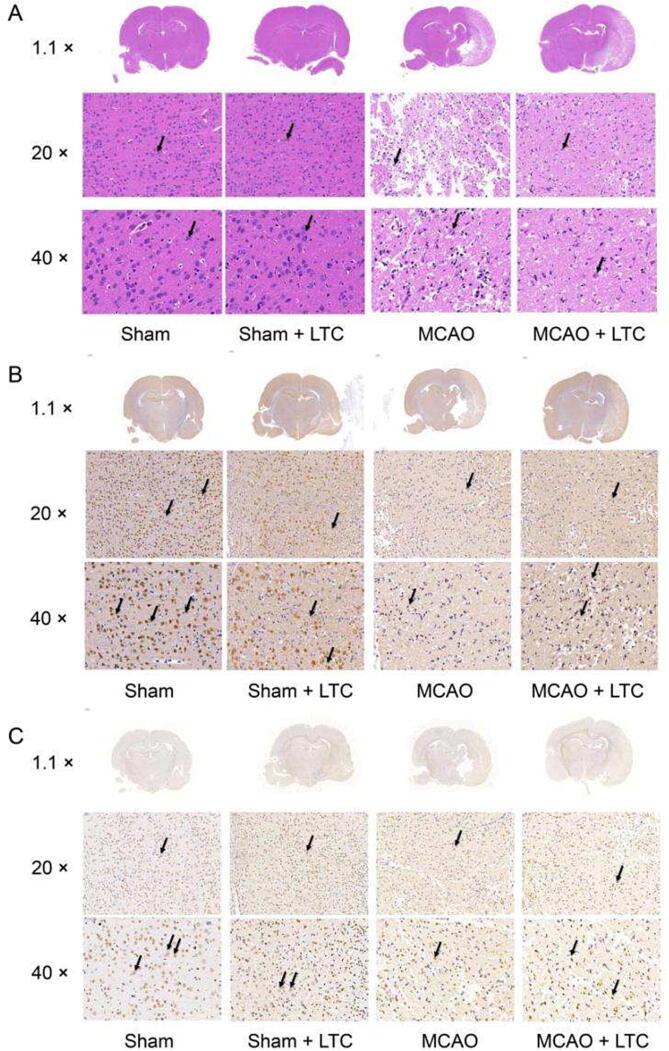
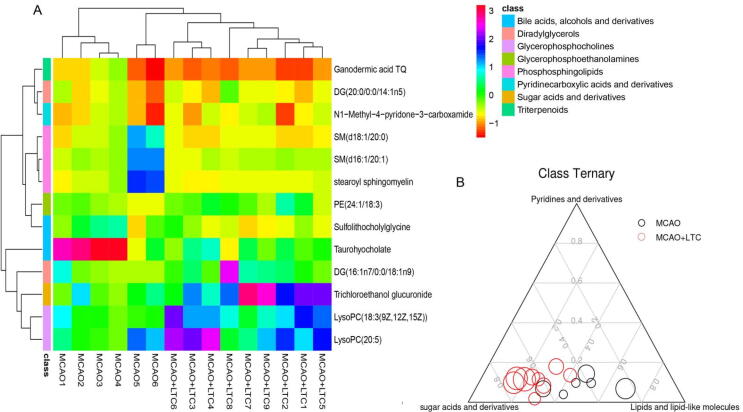
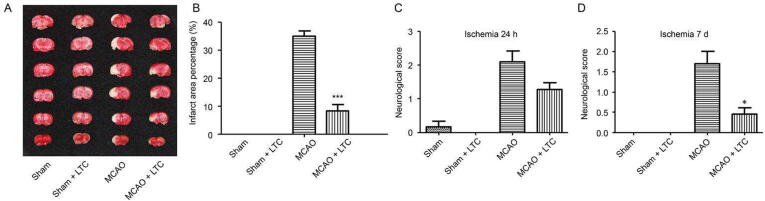
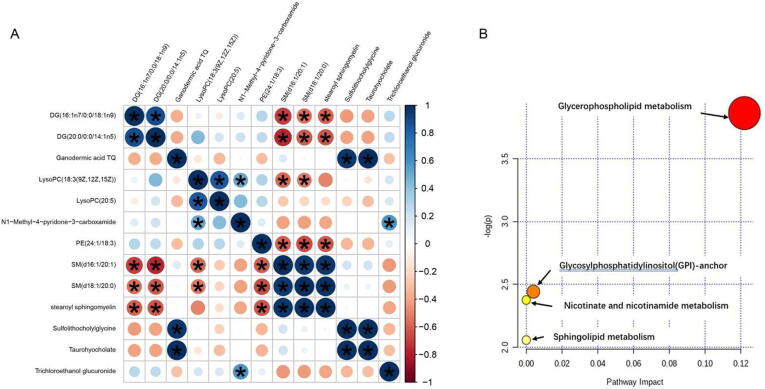
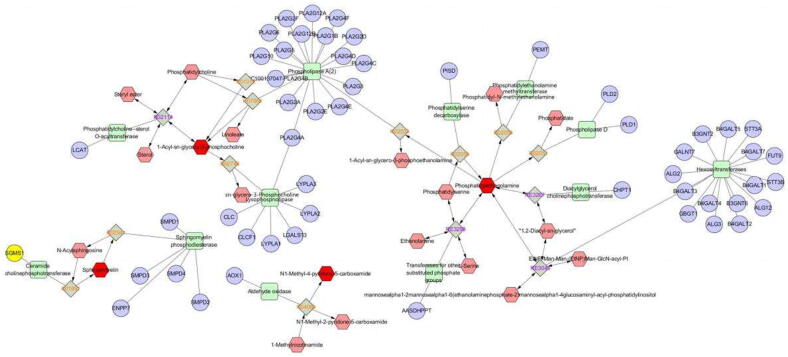
Intragastric administration of LTC significantly decreased not only the neurobehavioral abnormality scores but also the cerebral infarct area of MCAO rats. The interstitial edema, atrophy, and pyknosis of glial and neuronal cells occurred in the infarcted area, core area, and marginal area of cerebral cortex were improved after LTC treatment. A total of 13 potential biomarkers were observed, and Youden index of 11 biomarkers such as LysoPC, SM, and PE were more than 0.7, which were involved in neuroprotective process. The correlation and pathway analysis showed that LTC was beneficial to ischemic stroke rats via regulating glycerophospholipid and sphingolipid metabolism, together with nicotinate and nicotinamide metabolism. Heatmap and ternary analysis indicated the synergistic effect of carbohydrates and lipids may be induced by flavonoid intake from LTC.
The present study could provide evidence that metabolomics, as systematic approach, revealed its capacity to evaluate the holistic efficacy of TCM, and investigate the molecular mechanism underlying the clinical treatment of LTC on ischemic stroke.
本研究旨在评价龙血通络胶囊(LTC)对缺血性脑卒中大鼠的治疗作用,并探讨其潜在机制。
将26只大鼠随机分为四组,包括假手术组、假手术+LTC组、大脑中动脉闭塞(MCAO)组和MCAO+LTC组。采用大脑中动脉闭塞法模拟缺血性脑卒中大鼠,LTC治疗组连续7天每天口服300 mg/kg的LTC。通过神经行为异常评估、脑梗死面积和组织学评估来验证LTC治疗效果。采用超高效液相色谱-四级杆-飞行时间质谱联用技术结合多元统计分析对不同组间的血浆代谢组进行比较,旨在寻找对手术或LTC治疗有反应的分子。
胃内给予LTC不仅显著降低了MCAO大鼠的神经行为异常评分,还减小了其脑梗死面积。LTC治疗后,大脑皮质梗死区、核心区和边缘区的神经胶质细胞和神经元细胞的间质水肿、萎缩和固缩得到改善。共观察到13种潜在生物标志物,溶血磷脂酰胆碱、鞘磷脂和磷脂酰乙醇胺等11种生物标志物的约登指数大于0.7。这些生物标志物参与了神经保护过程。相关性和通路分析表明,LTC通过调节甘油磷脂和鞘脂代谢以及烟酸和烟酰胺代谢对缺血性脑卒中大鼠有益。热图和三元分析表明,LTC中的黄酮类化合物摄入可能诱导碳水化合物和脂质的协同作用。
本研究可为代谢组学作为一种系统方法揭示其评估中药整体疗效的能力以及研究LTC治疗缺血性脑卒中的临床分子机制提供证据。