Fujihira Kyoko, Takahashi Masaki, Wang Chunyi, Hayashi Naoyuki
Institute for Liberal Arts, Tokyo Institute of Technology, Tokyo, Japan.
Japan Society for the Promotion of Science, Tokyo, Japan.
Front Nutr. 2023 Jul 21;10:1192223. doi: 10.3389/fnut.2023.1192223. eCollection 2023.
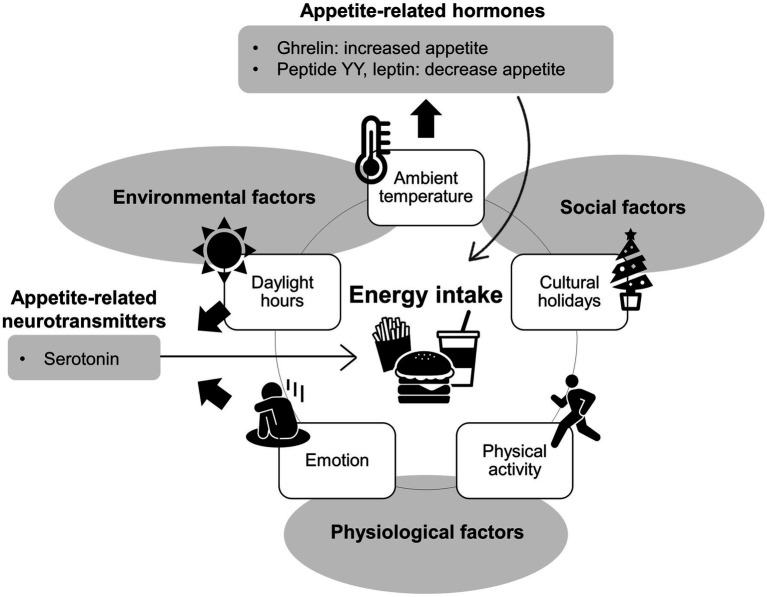
Maintaining a balance between energy intake and expenditure is crucial for overall health. There are seasonal variations in energy intake, with an increase during spring and winter as well as a decrease during summer. These variations are related to a combination of environmental factors, including changes in temperature and daylight hours; social factors, including events and holidays; and physiological factors, including changes in physical activity and emotions. Accordingly, this review aimed to summarize the environmental, social, and physiological factors that contribute to seasonal variations in energy intake. A review of the current literature revealed that changes in temperature and daylight hours may affect eating behavior by altering homeostatic responses and appetite-related hormones. Additionally, increased participation in events and frequency of eating out, especially during winter vacations, may contribute to increased energy intake. Notably, these findings may not be generalisable to all populations since environmental and social factors can vary significantly depending on the local climatic zones and cultural backgrounds. The findings of the present review indicate that seasonal climate, events, and associated hormonal changes should be taken into account in order to maintain adequate energy intake throughout the year.
保持能量摄入与消耗之间的平衡对整体健康至关重要。能量摄入存在季节性变化,春季和冬季增加,夏季减少。这些变化与多种环境因素有关,包括温度和日照时长的变化;社会因素,包括活动和节假日;以及生理因素,包括身体活动和情绪的变化。因此,本综述旨在总结导致能量摄入季节性变化的环境、社会和生理因素。对当前文献的综述表明,温度和日照时长的变化可能通过改变稳态反应和与食欲相关的激素来影响饮食行为。此外,尤其是在寒假期间,参与活动的增加和外出就餐频率的提高可能导致能量摄入增加。值得注意的是,这些发现可能不适用于所有人群,因为环境和社会因素可能因当地气候区和文化背景的不同而有很大差异。本综述的结果表明,为了全年保持充足的能量摄入,应考虑季节性气候、活动以及相关的激素变化。