Department of Medicine Mengo Hospital Kampala Uganda & Texila American University George Town Guyana.
Department of Medicine, Mother Kevin Post-Graduate Medical School, Uganda Martyr's University.
Afr Health Sci. 2023 Mar;23(1):515-527. doi: 10.4314/ahs.v23i1.54.
Atherogenic Index of Plasma (AIP) is a reliable predictor of coronary artery disease. There is paucity of data on AIP and its correlates among patients with type 2 diabetes (T2D) in Uganda.
To assess the profile of AIP and its cardiovascular risk factor correlates among patients with T2D in Uganda.
This was a cross-sectional study conducted in 8 health facilities with established T2D clinics in Central-Uganda. The study enrolled 500 patients aged 40 to 79 years. Data was collected on socio-demographic characteristics, lipid profile and glycated haemoglobin (HbA1c). The AIP was derived using log (triglycerides/high-density cholesterol) and further categorised as low cardiovascular disease (CVD) risk if the AIP was <0.1, intermediate risk (0.1-0.24) and high risk (≥0.24). Cardiovascular risk factors were defined according to international guidelines.Stata version 14 was used to analyse data, Pearson correlation analyses were conducted. Statistical significance was set at p<0.05.
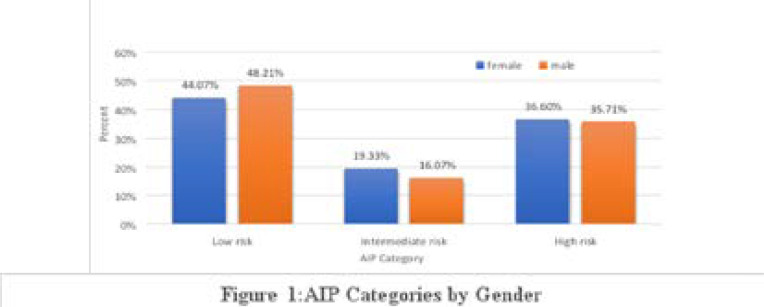
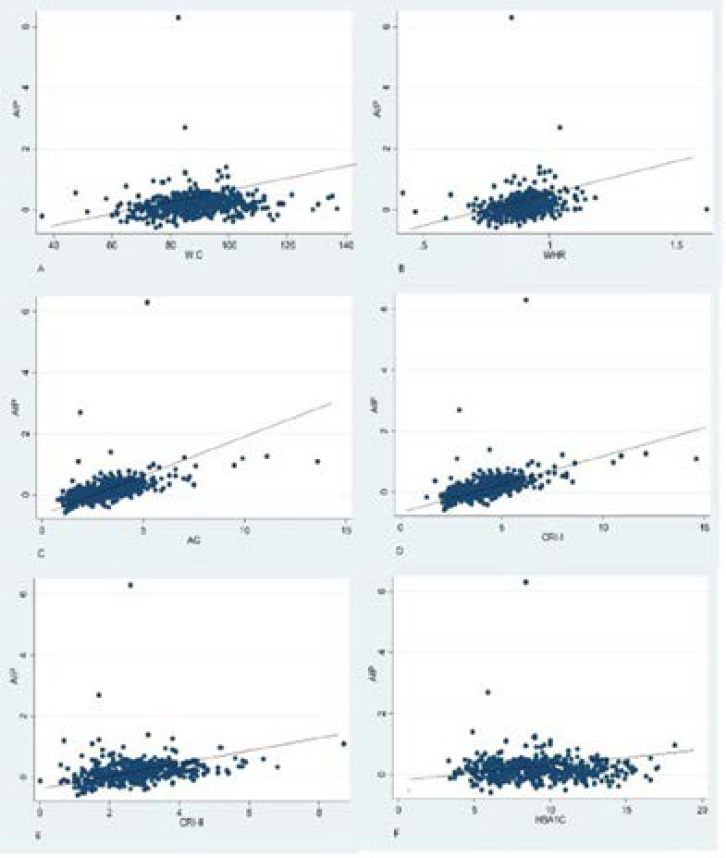
There were 389(77.4%) females with a mean age of 55.07±8. 979 years. Low-risk was found in 43.6%, intermediate risk in 20.2% and high risk in 36.2% of the participants. AIP significantly correlated with waist circumference (r=0.1095, p<0.0147), waist-hip ratio (r=0.1926, p<0.001), Casteri Risk Index I (r=0.506, r=<0.001), Casteri Risk Index II (r=0.246, p<0.001) and atherogenic coefficient (r=0.186, p<0.001). Insignificant correlation was observed between AIP and fasting blood sugar (r=0.017, p=0.7042), HBA1C (r=0.0108, p=0.8099) and diabetes duration (r=0.0445, p=0.32).
AIP is significantly elevated and correlated with cardiovascular risk factors in patients with T2D. In clinical management, this may be a useful tool in risk stratifying patients with T2D.
血浆致动脉粥样硬化指数(AIP)是冠心病的可靠预测指标。在乌干达,关于 2 型糖尿病(T2D)患者的 AIP 及其相关因素的数据很少。
评估乌干达 T2D 患者的 AIP 特征及其心血管危险因素相关性。
这是一项横断面研究,在乌干达中部的 8 个设有 T2D 诊所的卫生机构进行。该研究纳入了 500 名年龄在 40 至 79 岁的患者。收集了社会人口统计学特征、血脂谱和糖化血红蛋白(HbA1c)数据。使用 log(甘油三酯/高密度胆固醇)计算 AIP,并进一步将 AIP<0.1 定义为低心血管疾病(CVD)风险,0.1-0.24 为中风险,≥0.24 为高风险。根据国际指南定义心血管危险因素。使用 Stata 版本 14 分析数据,进行 Pearson 相关分析。p<0.05 为统计学显著性。
有 389(77.4%)名女性,平均年龄为 55.07±8.979 岁。参与者中低风险为 43.6%,中风险为 20.2%,高风险为 36.2%。AIP 与腰围(r=0.1095,p<0.0147)、腰臀比(r=0.1926,p<0.001)、Casteri 风险指数 I(r=0.506,r<0.001)、Casteri 风险指数 II(r=0.246,p<0.001)和致动脉粥样硬化系数(r=0.186,p<0.001)显著相关。AIP 与空腹血糖(r=0.017,p=0.7042)、HBA1C(r=0.0108,p=0.8099)和糖尿病病程(r=0.0445,p=0.32)无显著相关性。
T2D 患者的 AIP 显著升高并与心血管危险因素相关。在临床管理中,这可能是一种有用的工具,可用于对 T2D 患者进行风险分层。