Law Mandy M, Tan Sven-Jean, Wong Michael C G, Toussaint Nigel D
Department of Nephrology, the Royal Melbourne Hospital, Parkville, Victoria, Australia.
Department of Medicine, University of Melbourne, Parkville, Victoria, Australia.
Kidney Med. 2023 Jun 19;5(9):100690. doi: 10.1016/j.xkme.2023.100690. eCollection 2023 Sep.
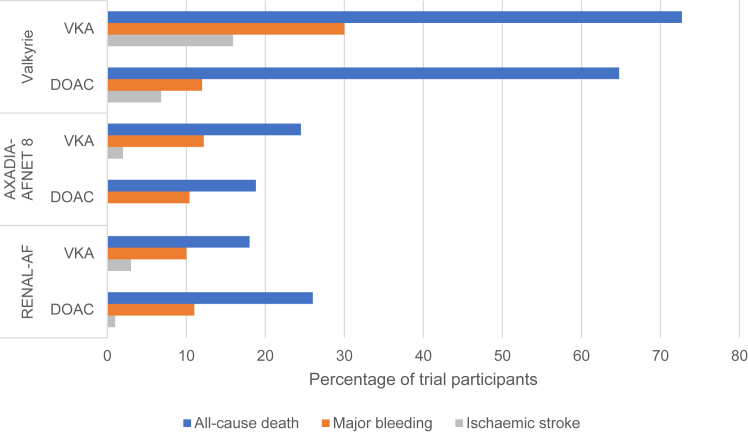
Management of atrial fibrillation (AF) is a clinical conundrum in people with kidney failure. Stroke risk is disproportionately high, but clinicians have a limited armamentarium to improve outcomes in this population in whom there is a concurrently high bleeding risk. Direct oral anticoagulants may have a superior benefit-risk profile compared with vitamin K antagonists in people on hemodialysis. Although research has predominantly focused on identifying a safe and effective oral anticoagulation option to reduce stroke risk in people with kidney failure (and predominantly those on hemodialysis), it remains uncertain how clinicians discriminate between people who would derive net clinical benefit as opposed to net harm. The recommended CHADSVASc score cutoffs provide poor discriminatory value, and there is an urgent need to identify robust markers of thromboembolic risk in kidney failure. There is increasing data to challenge the prior dogma of risk equivalence across AF type, and the American Heart Association highlights moving beyond AF as a binary entity to consider the prognostic significance of AF burden. Implantable cardiac monitor studies reveal high rates and varied burden of subclinical and paroxysmal AF in people on hemodialysis. The association between AF burden and the proarrhythmic environment of hemodialysis with cyclical volume loading, offloading, and electrolyte changes is not well studied. We review the significance of AF burden as a contributor to thromboembolic risk, its potential as the missing link in risk assessment, and updated evidence for anticoagulation in people with kidney failure.
心房颤动(AF)的管理是肾衰竭患者面临的一个临床难题。中风风险极高,但临床医生用于改善该人群预后的手段有限,因为他们同时存在较高的出血风险。与维生素K拮抗剂相比,直接口服抗凝剂对于接受血液透析的患者可能具有更优的效益风险比。尽管研究主要集中在确定一种安全有效的口服抗凝方案以降低肾衰竭患者(主要是接受血液透析的患者)的中风风险,但临床医生如何区分能获得净临床益处与净危害的患者仍不明确。推荐的CHADSVASc评分临界值的鉴别价值不佳,迫切需要确定肾衰竭患者血栓栓塞风险的可靠标志物。越来越多的数据对既往关于房颤类型风险等效性的教条提出了挑战,美国心脏协会强调应超越将房颤视为二元实体的观念,考虑房颤负荷的预后意义。植入式心脏监测研究显示,接受血液透析的患者亚临床房颤和阵发性房颤的发生率很高且负荷各异。房颤负荷与血液透析的促心律失常环境(包括周期性容量负荷、卸载和电解质变化)之间的关联尚未得到充分研究。我们综述了房颤负荷作为血栓栓塞风险因素的重要性、其作为风险评估中缺失环节的潜力以及肾衰竭患者抗凝治疗的最新证据。