Gupta Anjali, Gautam Sarika, Chanana Shelly, Sangwan Neetu, Singhal Savita Rani, Anand Smriti, Dahiya Sonia
Department of Obstetrics and Gynaecology, Pt B D Sharma PGIMS, Rohtak, Haryana, India.
J Family Reprod Health. 2023 Jun;17(2):73-79. doi: 10.18502/jfrh.v17i2.12869.
Comparison of two different intervals of misoprostol administration after mifepristone in second trimester abortions.
This 12-month prospective study was conducted at a tertiary care facility. Only pregnancies with congenital deformity or sterilisation failure were included in the study's recruitment of 100 women who visited the hospital for a second trimester abortion between 12 and 20 weeks; cases with scarred uteri were omitted. In a systematic random selection of 50 women in each group, the administration of 200 mg of mifepristone orally was followed by two distinct intervals of intravaginal misoprostol administration at 24- and 48-hour intervals. After 24 hours, group A women received intravaginal 400 mcg misoprostol three hourly, up to a maximum of five doses, while group B received the same doses after 48 hours. Induction abortion interval noted on various parameters and paired t test and chi square test applied.
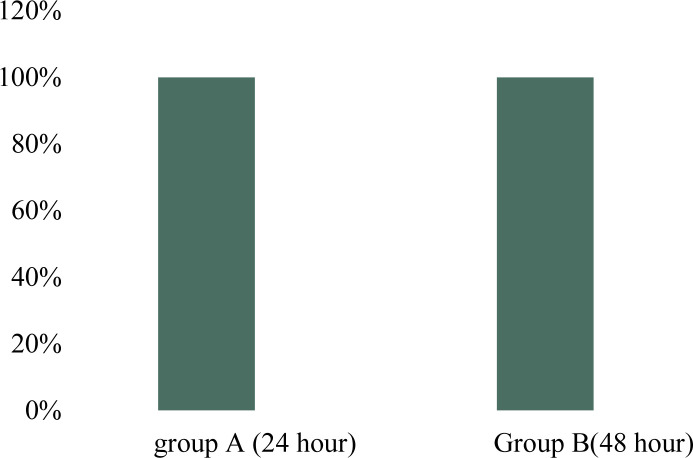
The mean IAI following misoprostol administration was 8.14 2±.03 hours in group A and 7.71 ±2.56 hours in group B. This difference was statistically insignificant. Average misoprostol doses for group A were 1.68±0.71 and for the group, B were 1.68±0.84; both doses were found to be statistically insignificant when used to induce abortion. All women aborted successfully in each group. There was no significant difference in side effects in both groups.
Based on the results it was observed that shorter interval between mifepristone and misoprostol i.e., 24 hours can be chosen to decrease the hospital stay as there was no significant difference was seen after intravaginal misoprostol in terms of induction abortion interval, number of doses and side effects.
比较米非司酮用于中期妊娠流产后两种不同米索前列醇给药间隔的效果。
本前瞻性研究在一家三级医疗中心进行,为期12个月。在12至20周前来医院进行中期妊娠流产的100名女性中,仅纳入有先天性畸形或绝育失败的妊娠者;子宫有瘢痕的病例被排除。通过系统随机抽样,每组选取50名女性,先口服200mg米非司酮,随后分别在24小时间隔和48小时间隔进行两次不同的阴道内米索前列醇给药。24小时后,A组女性每三小时阴道内给予400mcg米索前列醇,最多五剂,而B组在48小时后给予相同剂量。记录诱导流产间隔的各项参数,并应用配对t检验和卡方检验。
米索前列醇给药后的平均诱导流产间隔时间,A组为8.14±0.03小时,B组为7.71±2.56小时。这种差异无统计学意义。A组米索前列醇的平均剂量为1.68±0.71,B组为1.68±0.84;两者用于诱导流产时均无统计学意义。每组所有女性均成功流产。两组副作用无显著差异。
基于研究结果观察到,米非司酮和米索前列醇之间较短的间隔时间即24小时可被选择以减少住院时间,因为在诱导流产间隔、剂量数量和副作用方面,阴道内给予米索前列醇后未见显著差异。