Artificial Intelligence in Medicine Program, Mass General Brigham, Harvard Medical School, Boston, Massachusetts.
Department of Radiation Oncology, Dana-Farber Cancer Institute and Brigham and Women's Hospital, Harvard Medical School, Boston, Massachusetts.
JAMA Netw Open. 2023 Aug 1;6(8):e2328280. doi: 10.1001/jamanetworkopen.2023.28280.
Sarcopenia is an established prognostic factor in patients with head and neck squamous cell carcinoma (HNSCC); the quantification of sarcopenia assessed by imaging is typically achieved through the skeletal muscle index (SMI), which can be derived from cervical skeletal muscle segmentation and cross-sectional area. However, manual muscle segmentation is labor intensive, prone to interobserver variability, and impractical for large-scale clinical use.
To develop and externally validate a fully automated image-based deep learning platform for cervical vertebral muscle segmentation and SMI calculation and evaluate associations with survival and treatment toxicity outcomes.
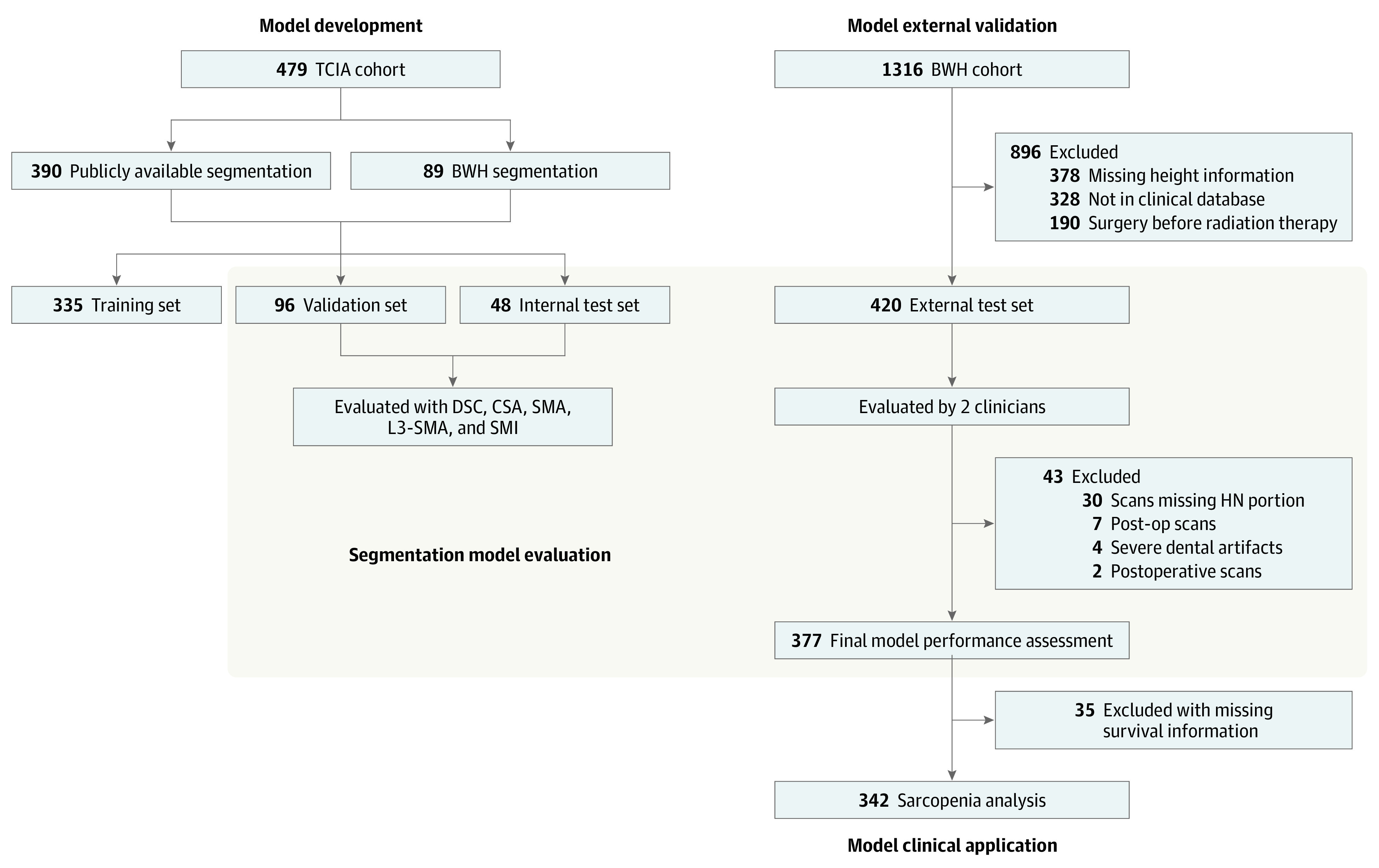
DESIGN, SETTING, AND PARTICIPANTS: For this prognostic study, a model development data set was curated from publicly available and deidentified data from patients with HNSCC treated at MD Anderson Cancer Center between January 1, 2003, and December 31, 2013. A total of 899 patients undergoing primary radiation for HNSCC with abdominal computed tomography scans and complete clinical information were selected. An external validation data set was retrospectively collected from patients undergoing primary radiation therapy between January 1, 1996, and December 31, 2013, at Brigham and Women's Hospital. The data analysis was performed between May 1, 2022, and March 31, 2023.
C3 vertebral skeletal muscle segmentation during radiation therapy for HNSCC.
Overall survival and treatment toxicity outcomes of HNSCC.
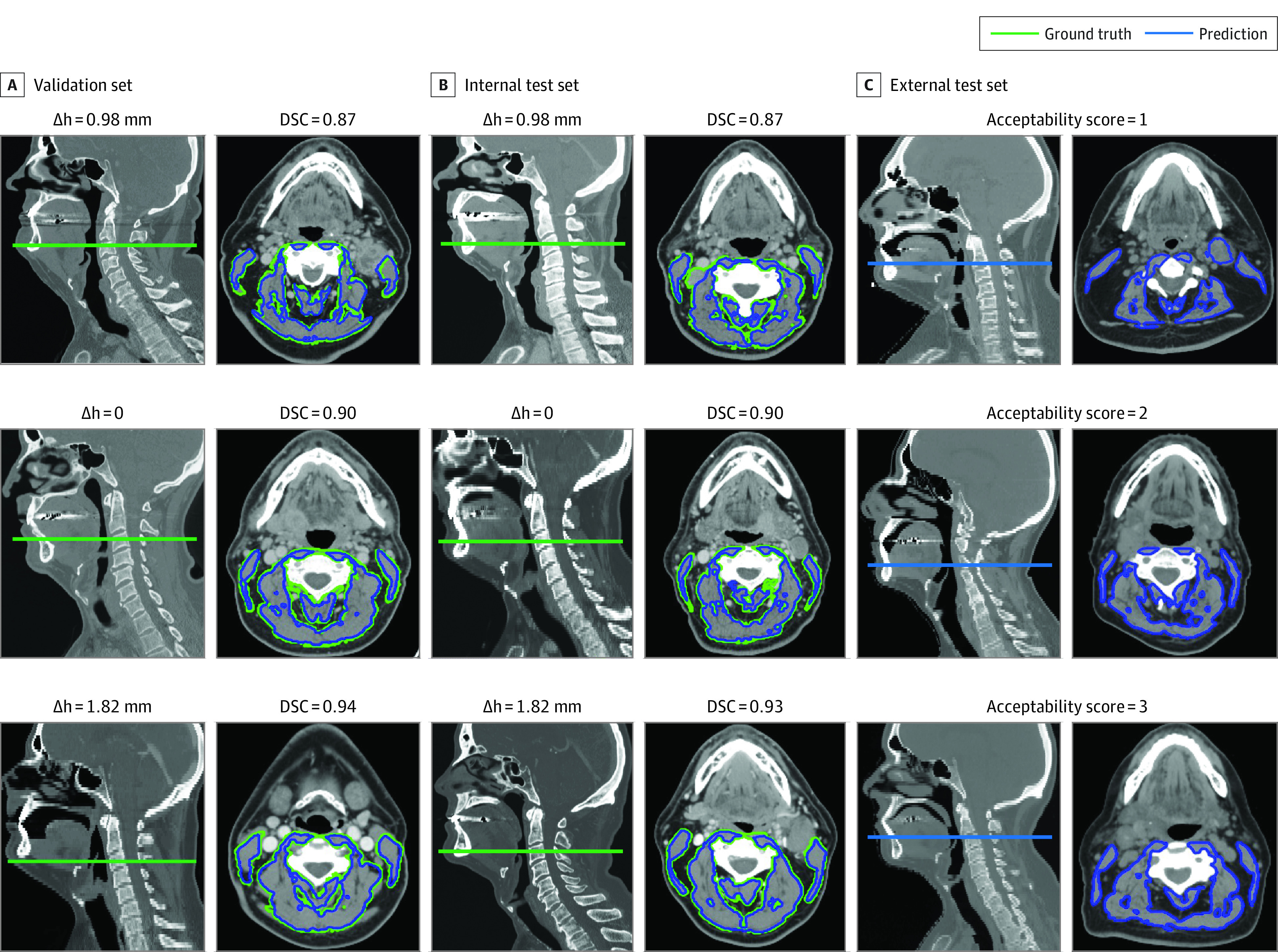
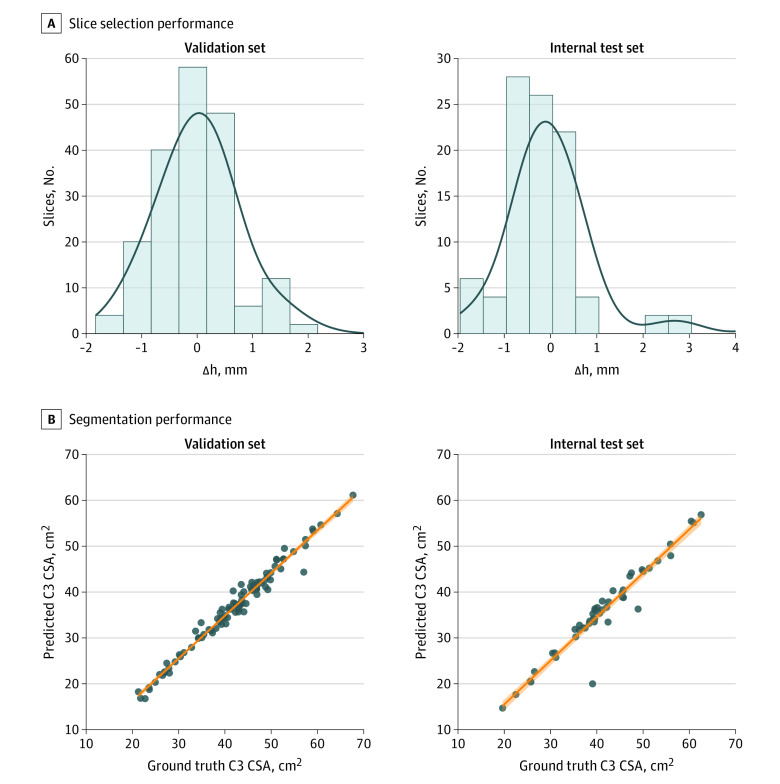
The total patient cohort comprised 899 patients with HNSCC (median [range] age, 58 [24-90] years; 140 female [15.6%] and 755 male [84.0%]). Dice similarity coefficients for the validation set (n = 96) and internal test set (n = 48) were 0.90 (95% CI, 0.90-0.91) and 0.90 (95% CI, 0.89-0.91), respectively, with a mean 96.2% acceptable rate between 2 reviewers on external clinical testing (n = 377). Estimated cross-sectional area and SMI values were associated with manually annotated values (Pearson r = 0.99; P < .001) across data sets. On multivariable Cox proportional hazards regression, SMI-derived sarcopenia was associated with worse overall survival (hazard ratio, 2.05; 95% CI, 1.04-4.04; P = .04) and longer feeding tube duration (median [range], 162 [6-1477] vs 134 [15-1255] days; hazard ratio, 0.66; 95% CI, 0.48-0.89; P = .006) than no sarcopenia.
This prognostic study's findings show external validation of a fully automated deep learning pipeline to accurately measure sarcopenia in HNSCC and an association with important disease outcomes. The pipeline could enable the integration of sarcopenia assessment into clinical decision making for individuals with HNSCC.
在头颈部鳞状细胞癌(HNSCC)患者中,肌肉减少症是一种既定的预后因素;通过成像评估的肌肉减少症的量化通常通过骨骼肌指数(SMI)来实现,SMI 可以通过颈椎骨骼肌分割和横截面积来获得。然而,手动肌肉分割劳动强度大,容易受到观察者间变异性的影响,并且不适合大规模临床使用。
开发和外部验证一种完全自动化的基于图像的深度学习平台,用于颈椎椎体肌肉分割和 SMI 计算,并评估其与生存和治疗毒性结局的相关性。
设计、地点和参与者:对于这项预后研究,从 MD 安德森癌症中心治疗的 HNSCC 患者的公开和去识别数据中策划了一个模型开发数据集,时间范围为 2003 年 1 月 1 日至 2013 年 12 月 31 日。总共选择了 899 名接受原发性放化疗的 HNSCC 患者,这些患者接受了腹部计算机断层扫描扫描,并具有完整的临床信息。外部验证数据集是从 1996 年 1 月 1 日至 2013 年 12 月 31 日在 Brigham 和妇女医院接受原发性放射治疗的患者中回顾性收集的。数据分析于 2022 年 5 月 1 日至 2023 年 3 月 31 日进行。
HNSCC 放疗期间的 C3 颈椎骨骼肌肉分割。
HNSCC 的总生存和治疗毒性结局。
总患者队列包括 899 名 HNSCC 患者(中位[范围]年龄,58[24-90]岁;140 名女性[15.6%]和 755 名男性[84.0%])。验证集(n=96)和内部测试集(n=48)的 Dice 相似系数分别为 0.90(95%CI,0.90-0.91)和 0.90(95%CI,0.89-0.91),在外部临床测试(n=377)中,两位审阅者的平均 96.2%可接受率。估计的横截面积和 SMI 值与手动注释值相关(Pearson r=0.99;P<0.001),跨越数据集。在多变量 Cox 比例风险回归中,SMI 衍生的肌肉减少症与总生存期更差相关(风险比,2.05;95%CI,1.04-4.04;P=0.04)和更长的喂养管持续时间(中位数[范围],162[6-1477]与 134[15-1255]天;风险比,0.66;95%CI,0.48-0.89;P=0.006)比无肌肉减少症。
这项预后研究的结果表明,完全自动化的深度学习管道可以准确测量 HNSCC 中的肌肉减少症,并与重要的疾病结局相关,该管道可以将肌肉减少症评估纳入 HNSCC 个体的临床决策。