Department of Neurology, Shenzhen Samii Medical Center (The Fourth People's Hospital of Shenzhen), Shenzhen, Guangdong Province, 518000, China.
Department of Rehabilitation, Shenzhen Dapeng New District Nan'ao People's Hospital, No. 6, Renmin Road, Dapeng New District, Shenzhen, Guangdong Province, 518000, China.
Cardiovasc Diabetol. 2023 Aug 10;22(1):205. doi: 10.1186/s12933-023-01934-0.
The atherogenic index of plasma (AIP) can reflect the burden of atherosclerosis. Hyperglycemia is one of the leading causes of atherosclerosis. However, the relationship between AIP and prediabetes is rarely studied. Therefore, we aimed to explore the relationship between AIP and prediabetes.
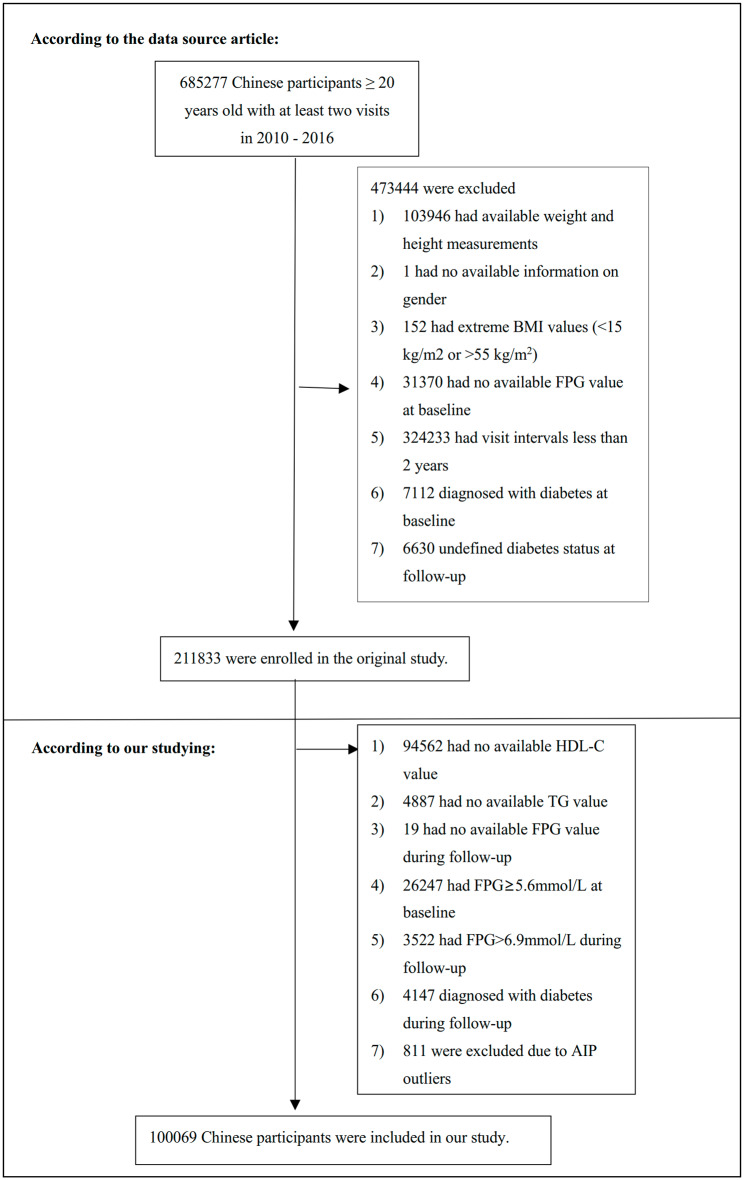
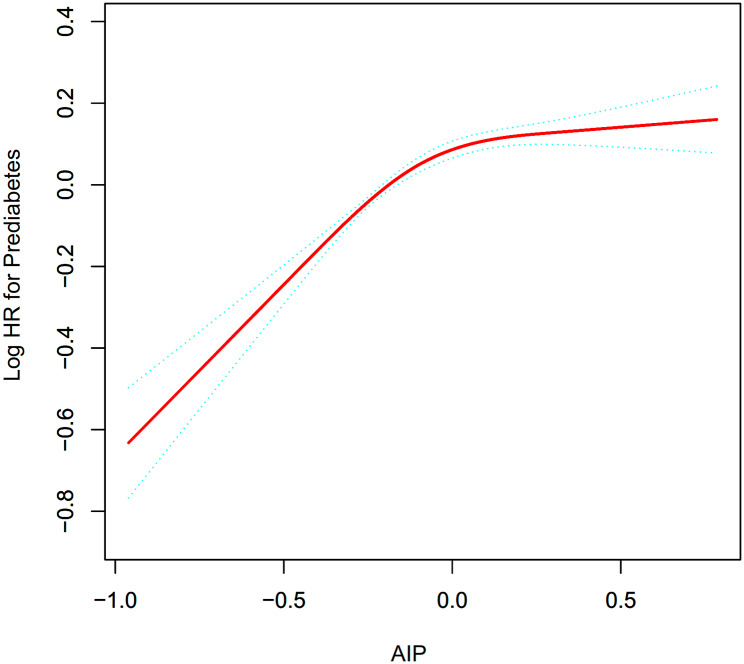
This retrospective cohort study recruited 100,069 Chinese adults at the Rich Healthcare Group from 2010 to 2016. AIP was calculated according to Log10 (triglyceride/high-density lipoprotein cholesterol) formula. Cox regression method, sensitivity analyses and subgroup analyses were used to examine the relationship between AIP and prediabetes. Cox proportional hazards regression with cubic spline functions and smooth curve fitting was performed to explore the non-linearity between AIP and prediabetes. The two-piece Cox proportional hazards regression model was used to determine the inflection point of AIP on the risk of prediabetes.
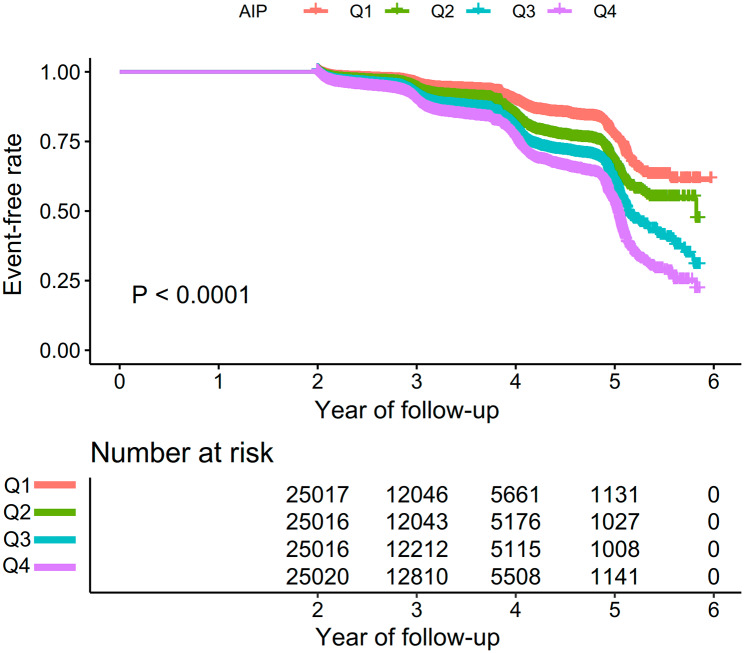
After adjusting for confounding covariates, AIP was positively associated with prediabetes (HR: 1.41, 95%CI: 1.31-1.52, P < 0.0001). The two-piecewise Cox proportional hazards regression model discovered that the AIP's inflection point was 0.03 (P for log-likelihood ratio test < 0.001). AIP was positively associated with the risk of prediabetes when AIP ≤ 0.03 (HR: 1.90, 95%CI: 1.66-2.16, P < 0.0001). In contrast, When AIP > 0.03, their association was not significant (HR: 1.04, 95%CI: 0.91-1.19, P = 0.5528).
This study shows that AIP was positively and non-linearly associated with the risk of prediabetes after adjusting for other confounding factors. When AIP ≤ 0.03, AIP was positively associated with the risk of prediabetes.
血浆致动脉粥样硬化指数(AIP)可以反映动脉粥样硬化的负担。高血糖是动脉粥样硬化的主要原因之一。然而,AIP 与糖尿病前期的关系很少被研究。因此,我们旨在探讨 AIP 与糖尿病前期的关系。
本回顾性队列研究于 2010 年至 2016 年在瑞驰医疗集团招募了 100069 名中国成年人。根据 Log10(甘油三酯/高密度脂蛋白胆固醇)公式计算 AIP。采用 Cox 回归法、敏感性分析和亚组分析来检验 AIP 与糖尿病前期的关系。采用 Cox 比例风险回归与三次样条函数和平滑曲线拟合来探讨 AIP 与糖尿病前期之间的非线性关系。采用两段 Cox 比例风险回归模型来确定 AIP 对糖尿病前期风险的拐点。
在校正混杂协变量后,AIP 与糖尿病前期呈正相关(HR:1.41,95%CI:1.31-1.52,P<0.0001)。两段 Cox 比例风险回归模型发现 AIP 的拐点为 0.03(对数似然比检验 P<0.001)。当 AIP≤0.03 时,AIP 与糖尿病前期的风险呈正相关(HR:1.90,95%CI:1.66-2.16,P<0.0001)。相比之下,当 AIP>0.03 时,两者之间的关联并不显著(HR:1.04,95%CI:0.91-1.19,P=0.5528)。
本研究表明,在校正其他混杂因素后,AIP 与糖尿病前期的风险呈正相关且呈非线性关系。当 AIP≤0.03 时,AIP 与糖尿病前期的风险呈正相关。